 Understanding Application Integration Framework Web Services
This chapter provides an overview of Application Integration Framework web services and discusses the cross-reference lookup service.
Understanding Application Integration Framework Web Services
Application Integration Framework web services provide external applications a web-service-based means of accessing Application Integration Framework map information. Web services are implemented by means of the PeopleTools Integration Broker (IB) framework. The Integration Gateway web application receives all the web service requests and forwards them to the Integration Engine (application server) for processing.
This diagram illustrates an external application using the cross-reference lookup web service to look up values in an Application Integration Framework cross-reference map.
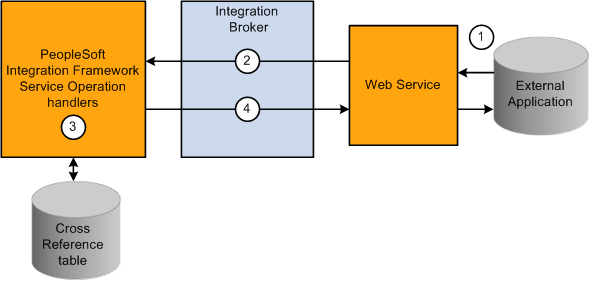
Using Application Integration Framework web service with an external application
The external application invokes one of the web service operations.
PeopleSoft Integration Broker receives the service operation and validates the WS security credentials.
The request is passed to the application server for processing. The application server authenticates the service operation and routes it to the respective handler. The handler runs the PeopleCode and sends the response to the Integration Gateway.
Integration Broker sends the response to the external application.
Cross-Reference Lookup Web ServiceThe service operation EOTF_XREF_LOOKUP.v1 is used by external systems to look up a cross-reference value. For the external system to have access to the web service, it must be published on the PeopleSoft application.
See Enterprise PeopleTools 8.50 PeopleBook: Integration Broker, Providing Services.
Example: Cross-Reference Map Definition
In this example, the third-party system requests a cross-reference lookup for payment terms. This page shows elements in the value map PaymentTermsGUID:
Three elements are defined: UniqueGUID, SETID, and PYMNT_TERMS_CD.
This page shows the domains that are defined for the domain value map:
Two domains are defined for this map:
PSFT represents the PeopleSoft application which contains the elements SETID and PYMNT_TERMS_CD.
UinqueGUID is the domain used by the third party; it contains the UniqueGUID element.
Example: Web Service Request and Response
This is a sample request to obtain the PeopleSoft values for a common GUID value:
<soapenv:Envelope xmlns:soapenv="http://schemas.xmlsoap.org/soap/envelope/" xmlns:⇒
xref="http://xmlns.oracle.com/Enterprise/tools/schema/xrefLookupValue.v1">
   <soapenv:Header/>
   <soapenv:Body>
      <xref:xrefLookupValue needFault="true">
         <xref:mapname>PaymentTermGUID</xref:mapname>
         <xref:Values>
            <xref:domain>UniqueGUID</xref:domain>
            <!--1 or more repetitions:-->
            <xref:element name="UniqueGUID">9d266732-90e2-11dd-a062-96c8921a7858<⇒
/xref:element>
         </xref:Values>
         <xref:targetDomain>PSFT</xref:targetDomain>
      </xref:xrefLookupValue>
   </soapenv:Body>
</soapenv:Envelope>
This is the response:
<soapenv:Envelope xmlns:soapenv="http://schemas.xmlsoap.org/soap/envelope/" xmlns:⇒
soapenc="http://schemas.xmlsoap.org/soap/encoding/" xmlns:xsd="http://www.w3.org⇒
/2001/XMLSchema" xmlns:xsi="http://www.w3.org/2001/XMLSchema-instance">
   <soapenv:Body>
      <xrefResponse xmlns="http://xmlns.oracle.com/Enterprise/tools/schema/xref⇒
Response.v1">
         <status>Success</status>
         <responseValues>
            <domain>PSFT</domain>
            <element name="SETID">SHARE</element>
            <element name="PYMNT_TERMS_CD">CD01</element>
         </responseValues>
      </xrefResponse>
   </soapenv:Body>
</soapenv:Envelope>