| Oracle® Communications Data Model Operations Guide 11g Release 1 (11.2) Part Number E15883-01 |
|


|
View PDF |
| Oracle® Communications Data Model Operations Guide 11g Release 1 (11.2) Part Number E15883-01 |
|
|
View PDF |
This chapter introduces the Oracle Communications Data Model, which is a start-up kit for implementing a Oracle Communications Data Model data warehouse solution:
Oracle Communications Data Model Logical and Physical Models
Oracle Products That Make Up Oracle Communications Data Model
Where Oracle Communications Data Model Fits in a Data Warehousing Project
You use Oracle Communications Data Model to jump-start the design and implementation of a Oracle Communications Data Model data warehouse to quickly achieve a positive ROI for your data warehousing and business intelligence project with a predictable implementation effort.
The Oracle Communications Data Model consists of logical and physical data models, intra-ETL that map data from the Oracle Communications Data Model 3NF level to the aggregate level, sample reports, and the Oracle Interactive Dashboard using features of Oracle Business Intelligence Suite Enterprise Edition.
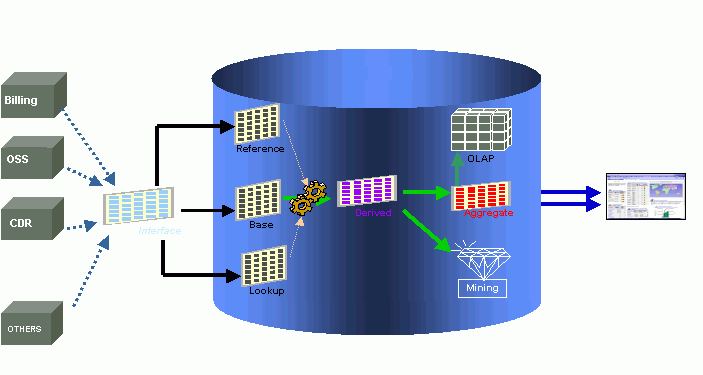
As illustrated in Figure 1-1, Oracle Communications Data Model includes the following components:
Logical model
The logical model is introduced in "Logical Model" and described in detail in Oracle Communication Data Model Reference.
Physical model
The physical model is introduced in "Physical Model" and described in detail in Oracle Communication Data Model Reference.
Intra-ETL database packages and SQL scripts to extract, transform, and load (ETL) data from one layer of Oracle Communications Data Model to another.
The intra-ETL packages and SQL scripts are described in detail in Oracle Communication Data Model Reference. How to use these packages and scripts to populate a data warehouse based on the Oracle Communications Data Model is discussed in Chapter 3, "Populating an Oracle Communications Data Model Warehouse."
Pre-defined data mining models.
These models are described in detail in Oracle Communication Data Model Reference. Working with these data mining models is discussed in "Refreshing Data Mining Models" and "Modifying Data Mining Models".
Sample reports and dashboards using OBIEE.
These reports are described in detail in Oracle Communication Data Model Reference. Working with these reports are discussed in "Customizing the Reports Delivered with Oracle Communications Data Model".
DDL and installation scripts
Figure 1-1 Oracle Communications Data Model
The logical and physical models of Oracle Communications Data Model have the following characteristics:
Communication industry-specific, 3rd Normal Form logical and physical relational models
Physical data model with:
120+ best-practice sample reports and dashboards
Logical Model
Oracle Communications Data Model provides a predefined logical model. The logical data model defines the business entities and their relationships in order provide a clear understanding of the business and data requirements for the data warehouse.
The logical data model is described in detail in Oracle Communication Data Model Reference.
Physical Model
Oracle Communications Data Model provides a predefined physical data model.
The physical data model includes the following types of tables and views:
Reference tables
Lookup tables
Database sequences
Base tables
Derived tables
Aggregate tables
Cube materialized views and views of these dimensions, hierarchies and measures of these cubes.
The physical data model is described in detail in Oracle Communication Data Model Reference.
Notes:
When examining the predefined physical model, keep in mind the naming convention using DW (Data Warehouse) prefixes and suffixes to identify the types of tables and views:DWR_ : Reference data tables
DWL_ : Lookup tables
DWB_ : Base transaction data (3NF) tables
DWD_ : Derived (data mining) tables
DWA_ : Aggregate tables
DWC_: Control tables
CB$: Cube materialized views
_VIEW : View
Several Oracle technologies are involved in building the infrastructure for communication business intelligence:
Oracle Database with OLAP, Data Mining and Partitioning Option
Oracle Communications Data Model utilizes a complete Oracle technical stack. It leverages the following data warehousing features of the Oracle database: SQL model, compression, partitioning, advanced statistical functions, materialized views, data mining, and online analytical processing (OLAP).
Tip:
To save some money, you can consider using RAC and commodity hardware.Oracle Development Tools
The following Oracle tools can be used to customize the predefined logical and physical models provided with Oracle Communications Data Model, or to populate the target relational tables and materialized cube views.
Table 1-1 Oracle Development Tools Used with Oracle Communications Data Model
| Name | Use |
|---|---|
|
Oracle SQL Data Modeler |
To modify, customize, and extend the logical model |
|
SQL Developer or SQL*Plus |
To modify, customize, and extend database objects |
|
Oracle Warehouse Builder |
For the process control of the intra ETL process |
|
Analytic Workspace Manager |
To view, create, develop, and manage OLAP dimensional objects. |
Oracle BI EE Presentation Tools
Oracle Business Intelligence Suite Enterprise Edition is a comprehensive suite of enterprise BI products that delivers a full range of analysis and reporting capabilities. You can use Oracle BI EE Answers and Dashboard presentation tools to customize the predefined sample dashboard reports that are provided with Oracle Communications Data Model.
Oracle Communications Data Model provides much of the data modeling work that you must do for a communication business intelligence solution. The Base Layer provides a solid foundation for a communication data warehouse. The Derived and Aggregate Layers provide the infrastructure for creating business intelligence reports.
Each communication operator is unique, and therefore the structure of the data warehouse will need to be different in order to match the needs of that unique communication environments. Oracle Communications Data Model comes with a generic schema that requires modification. These modifications include, adding, deleting, modifying, or renaming tables and columns; or altering foreign keys, constraints, or indexes.
After the data warehouse is populated, you populate the derived and aggregate layers to support the reporting requirements. Oracle Communications Data Model includes a solid infrastructure for a range of reports.
As discussed in "Oracle Products That Make Up Oracle Communications Data Model", Oracle Communications Data Model uses much of the Oracle stack. Consequently, to successfully customize Oracle Communications Data Model, you need:
An understanding of the Oracle technology stack, especially data warehouse (Database, Data Warehouse, OLAP, Data Mining, Warehouse Builder, Business Intelligence EE)
Hands-on experience using: Oracle database, PL/SQL; SQL DDL and DML syntax; Analytic Workspace Manager; Oracle SQL Developer; BI EE Administrator, Answers, and Dashboards.
Experience performing information and data analysis and data modeling, especially using Oracle SQL Data Modeler, is a plus.
|
 Copyright © 2010, Oracle and/or its affiliates. All rights reserved. Legal Notices |
|

