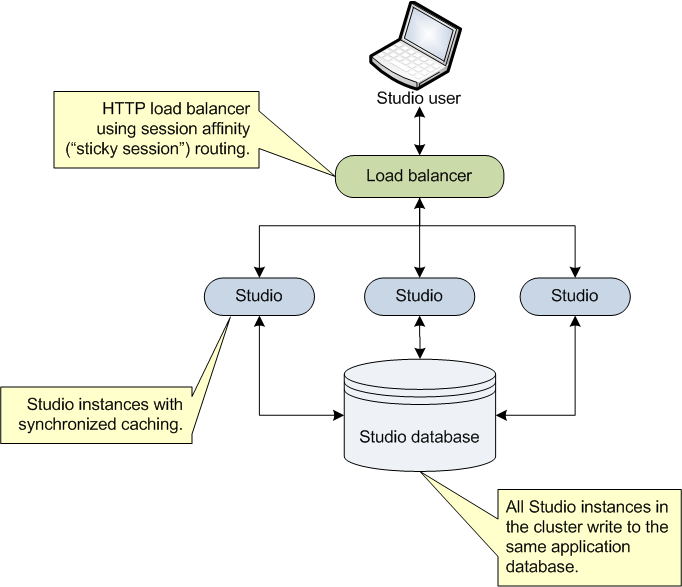
Studio allows you to create clusters of Studio instances. In a cluster, changes made to one instance are automatically made to the other instances. For a large production environment, using clustering provides redundancy and support for higher throughput, allowing for more concurrent users.
The cluster is made up of Studio instances configured to write to the same application database.
The Studio instances also must be configured to use synchronized caching, so that information cached on one instance is available to all of the other instances in the cluster. Studio uses Ehcache (www.ehcache.org), which uses RMI (Remote Method Invocation) multicast to notify each member of the cluster when the cache has been updated.
While there are multiple ways to cluster an application, based on the application server, Studio supports using an HTTP load balancer in front of the Studio instances. The load balancer must use session affinity (also known as "sticky session") load balancing. If a member of the cluster is down, the load balancer routes requests to another instance in the cluster.