
The RBI Liquidity Coverage Ratio calculations address the final guidelines on the LCR, Liquidity Risk Monitoring Tools, and LCR Disclosure Standards that were published by Reserve Bank of India in June 2014. Additionally, the calculations cater to the amendments published subsequently up to March 2016. Major amendments include additional classification rules for Level 2B assets, identification, and treatment of lien marked deposits and inclusion and treatment of new counterparties such as Hindu Undivided Family (HUF) and Association of Persons (AoP).
Topics:
· Inputs
· Preconfigured Regulatory LCR Scenario
The LRRCRBI application requires the following inputs for LCR calculation:
· Liquidity haircut for each asset level should be provided through business assumption with assumption category as valuation change and assumption sub-category as the haircut.
· The business assumption which defines the outflow percentage should be defined through appropriate business assumptions. For example, retail deposit Run-off is defined through business assumption with category as incremental cash flow and sub-category as Run-off.
· The business assumption which defines the inflow percentage should be defined through appropriate business assumptions. For example, Rollover Reverse Repo is defined through business assumption with category as Cash Flow Movement and sub-category as a Roll Over.
· Liquidity Horizon is specified as the Run time parameter.
The application supports a ready-to-use RBI LCR which has the regulatory scenario with associated HQLA haircuts, inflow, and outflow percentage/rates preconfigured in the form of business assumptions.
Topics:
· Classifying Operational Deposits
· Identifying Deposit Stability
· Identifying Lien Marked Deposits
· Treatment of Lien Marked Deposits
· Calculating Contractually Required Collateral
· Calculating Excess Collateral
· Calculating Downgrade Impact Amount
· Calculating Net Derivative Cash Inflows and Outflows
· Calculating Twenty-Four Month Look-back Amount
· Calculating Operational Amount
· Calculating HQLA Transferability Restriction
· Calculating Net Cash Outflows
· Calculating Liquidity under Alternative Liquidity Approach
· Calculating Liquidity Coverage Ratio
· Significant Currency Liquidity Coverage Ratio Calculation
· Liquidity Risk Monitoring Tools
High-Quality Liquid Assets (HQLA) are assets that can be easily sold or used as collateral to obtain funds at little or no loss of value even under stress scenarios. All assets, whether owned by the bank or received from counterparties as collateral, that meet the high-quality liquid asset criteria specified by RBI, are classified by the application as follows:
· Level 1 Assets
· Level 2A Assets
· Level 2B Assets
Level1 assets can be included without limit and Level 2 assets can only comprise 40% of the stock of HQLA. Of this, Level 2B assets can only comprise 15% of the stock of HQLA. Any asset not classified as an HQLA is considered as an Other Asset.
Topics:
· Identification and Treatment of Level 1 Assets
· Identification and Treatment of Level 2A Assets
· Identification and Treatment of Level 2B Assets
The application identifies the following assets as HQLA Level 1 assets:
1. Cash including cash reserves in excess of required Cash Reserve Ratio (CRR). For banks incorporated, these also include:
§ Excess reserves held with foreign central banks, where an international rating agency has assigned a 0% risk weight to the foreign sovereign.
§ Excess reserves held with foreign central banks, where an international rating agency has assigned a non-0% risk weight to the foreign sovereign and a 0% risk weight has been assigned at national discretion under Basel II Framework, to the extent these balances cover the bank’s stressed net cash outflows in that specific currency.
2. Central bank excess reserves include the balance held by a bank at the central bank directly or through a correspondent bank less any minimum reserve requirement. It also includes overnight deposits or term deposits held with the central bank that meet the regulatory criteria. The value of eligible term deposits that is included in the amount net of any withdrawal penalty.
NOTE:
The process of identifying the value to be included in the stock of HQLA up to the extent of a bank stressed net cash outflows in a particular currency is documented in the following section. Government securities in excess of the minimum Statutory Liquidity Ratio (SLR) requirement.
Within the mandatory SLR requirement, government securities to the extent of 2% of Net Demand and Time Liability (NDTL) are currently allowed under Margin Standing Facility (MSF).
3. Marketable securities, assigned a 0% risk weight under both Basel and by international rating agencies, which satisfy the following conditions:
§ Issuer type or guarantor type is a foreign sovereign.
§ Traded in large, deep and active repo or cash markets characterized by a low level of concentration.
§ Have a proven record as a reliable source of liquidity in the markets (repo or sale) even during stressed market conditions.
§ Not an obligation of a financial institution or any of its affiliated entities.
4. Marketable securities, assigned a non-0% risk weight by international rating agencies and 0% risk weight at national discretion, which satisfy the following conditions:
§ Issuer type is a foreign sovereign or issuer type is a domestic sovereign and account is denominated in a foreign currency.
§ Traded in large, deep and active repo or cash markets characterized by a low level of concentration.
§ Have a proven record as a reliable source of liquidity in the markets (repo or sale) even during stressed market conditions.
§ Not an obligation of a financial institution or any of its affiliated entities.
5. Such marketable securities are included in the stock of HQLA only up to the extent of the bank’s net stressed cash outflows in that currency arising from bank’s operations in that foreign jurisdiction.
To meet this requirement the application identifies and updates the account country liquidity risk flag as follows:
a. The existence of the bank’s operations in a particular jurisdiction is identified. If the bank holds either liabilities or non-marketable assets in that jurisdiction, the application assumes that the bank has operations in that specific jurisdiction. This is identified in a country and currency combination.
b. Next, the application identifies whether the asset is held to meet the bank’s net stressed cash outflows in that currency arising from the bank’s operations in that specific jurisdiction by checking the following conditions:
c. If the issuer’s country is the same as the account country.
d. If the issuer’s country is the same as the country in which local operations are present in a particular jurisdiction as identified in step (i) above.
e. If the account currency is the same as the currency in which local operations are present in a particular jurisdiction as identified in step (i) above.
f. If all of the above criteria are met, the account country's liquidity risk flag is updated as “Yes” which indicates that the particular asset is held to meet the net cash outflows in a particular jurisdiction.
g. Finally, the application identifies the amount to be included in the stock of HQLA when account country liquidity risk flag = “Yes” as follows:
Assets classified as HQLA Level1 are assigned a 0% haircut under the regulatory scenario prescribed by RBI.
The application identifies the following assets as HQLA Level 2A assets:
1. Marketable securities which satisfy the following conditions:
§ Issuer type or guarantor type is one of the following:
— Sovereign
— Public Sector Entity (PSE)
— Multi-Lateral Development Bank (MDB)
§ Assigned a 20% risk-weight under the standardized Approach of Basel II.
§ Not an obligation of a financial institution or any of its affiliated entities.
§ Price has not decreased or haircut has not increased by more than 10% over a 30-day period during a relevant period of significant liquidity stress.
2. Corporate debt securities, including commercial papers, which satisfy the following conditions:
§ Not an obligation of a financial institution or any of its affiliated entities.
§ Assigned a long term rating of equal to or greater than AA- or an equivalent short term rating by an eligible credit rating agency.
§ Not a complex structured product or subordinated debt.
§ Price has not decreased or haircut has not increased by more than 10% over a 30 day period during a relevant period of significant liquidity stress which is specified by the bank.
3. Assets classified as HQLA Level2A are assigned a 15% haircut under the regulatory scenario prescribed by RBI.
The application identifies the following assets as HQLA Level 2B assets:
1. Marketable securities which satisfy the following conditions:
§ Issuer type or guarantor type is a sovereign.
§ Assigned risk-weight greater than 20% but equal to or less than 50% under the standardized Approach of Basel II.
§ Price has not decreased or haircut has not increased by more than 20% over a 30 day period during a relevant period of significant liquidity stress.
2. Common Equity Shares which satisfy the following conditions:
§ Not an obligation of a financial institution or any of its affiliated entities.
§ Included in NSE CNX Nifty index and/or S&P BSE Sensex index.
§ Price has not decreased or haircut has not increased by more than 40% over a 30 day period during a relevant period of significant liquidity stress.
3. Corporate debt securities, including commercial papers, which satisfy the following conditions:
§ Not an obligation of a financial institution or any of its affiliated entities.
§ Assigned a long term rating between A+ and BBB- or an equivalent short term rating by an eligible credit rating agency.
§ Traded in large, deep and active repo or cash markets characterized by a low level of concentration.
§ Price has not decreased or haircut has not increased by more than 10% over a 30 day period during a relevant period of significant liquidity stress which is specified by the bank.
Assets classified as HQLA Level2B are assigned a 50% haircut under the regulatory scenario prescribed by RBI.
The application identifies whether a bank’s asset or a mitigant received under rehypothecation rights meets all the operational requirements prescribed by RBI. If an asset classified as HQLA meets all the relevant operational criteria, it is identified as eligible HQLA and included in the stock of HQLA. The application checks for the following operational criteria:
· Operational Capability to Monetize HQLA
An asset is considered HQLA only if the bank has demonstrated the operational capability to monetize such an asset, and has periodically monetized such an asset. The application captures this information for each asset as a flag.
· Unencumbered
The application looks at the encumbrance status and includes only those assets in the stock which are unencumbered. If partially encumbered, then the portion of the asset that is unencumbered is considered as HQLA and included in the stock. If an asset is pledged to the central bank, or a PSE, but is not used, the unused portion of such an asset is included in the stock. The application assigns the usage of a pledged asset in the ascending order of asset quality, that is, the lowest quality collateral is marked as used first.
· Inclusion and Exclusion of Certain Rehypothecated Assets
Assets received under rehypothecation rights as part of the reverse repo and securities financing transactions are considered as eligible HQLA if they are not rehypothecated. An asset pledged to central banks or PSEs, but not used is considered eligible HQLA. Any asset that a bank receives under a rehypothecation right, is not considered eligible HQLA if the counterparty or beneficial owner of the asset has a contractual right to withdraw the asset at any time within 30 calendar days.
· Unsegregated Assets
The application includes unsegregated assets, received as collateral under rehypothecation rights, for derivative transactions, in the stock of HQLA. Conversely, it excludes all segregated assets from the stock of HQLA.
· HQLA Under the Control of the Treasurer
To be considered eligible HQLA the asset is required to be under the control of the management function of the bank that manages liquidity, for example, Treasurer. The application captures this information for each asset as a flag.
· Termination of Transaction Hedging HQLA
If an HQLA is hedged by a specific transaction, then the application considers the impact of closing out the hedge to liquidate the asset that is, the cost of terminating the hedge while computing the stock of HQLA. The hedge termination cost is deducted from the market value of the asset and the difference is included in the stock of HQLA.
All unencumbered assets classified as Level 1, 2A, or 2B, which meet the HQLA eligibility criteria, are included in the Stock of High Quality Liquid Assets (SHQLA). The formula for calculating SHQLA is as follows:

Where,
Adjustment due to Cap on Level 2B Assets: Adjustment for 15% cap
Adjustment due to Cap on Level 2 Assets: Adjustment for 40% cap
The application applies the relevant liquidity haircuts to the market value of each eligible HQLA based on the haircuts specified as part of a business assumption. The sum of haircut adjusted market value of all assets which are not other assets and which are classified as eligible HQLA comprises of the stock of HQLA. The stock includes the bank’s own assets which are unencumbered, that is, not placed as collateral; as well as assets received from counterparties where the bank has a rehypothecation right and where such assets are not rehypothecated.
NOTE:
All calculations are based on the market value of assets.
The following steps involved in computing the stock of HQLA:
Topics:
· Calculation of Stock of Liquid Assets
· Identification of Eligible HQLA on Unwind
· Unwinding of Transactions Involving Eligible HQLA
· Calculation of Adjusted Stock of HQLA
· Calculation of Adjustments to Stock of HQLA Due to Cap on Level 2 Assets
The steps for calculation of stock of liquid assets are as follows:
1. Calculation of Stock of Level 1 Assets
The stock of Level 1 assets equals the market value of all Level 1 liquid assets held by the bank as of the calculation date that is eligible HQLA, less the amount of the minimum/mandatory reserves, less hedge termination costs (if any), less withdrawal penalty on time deposits (if any).
2. Calculation of Stock of Level 2A Assets
The stock of Level 2A liquid assets equals 85 percent of the market value of all Level 2A liquid assets held by the bank as on the calculation date that are eligible HQLA, less hedge termination costs (if any).
3. Calculation of Stock of Level 2B Assets
The stock of Level 2B liquid assets equals 50 percent of the market value of all Level 2B liquid assets held by the bank as on the calculation date that are eligible HQLA, less hedge termination costs (if any).
The application identifies the assets placed as collateral which are eligible HQLA if they are not encumbered. Placed collateral is marked as eligible HQLA on unwind if it fulfills all of the following criteria:
· Asset Level is Level 1, Level 2A, or Level 2B asset.
· Meets HQLA Operational Requirements on Unwind.
The application identifies all transactions maturing within the LCR horizon where HQLA is placed or received. These transactions include repos, reverse repos, secured lending transactions, collateral swaps, and so on. Such transactions are unwound, that is, the original position is reversed and the cash or stock of HQLA has adjusted accordingly. This is done to avoid including any asset in the stock that should be returned to its owner before the end of the LCR horizon. The unwinding of transactions results in adjustments to the stock of HQLA, such as additions to or deductions from the stock of HQLA.
The adjusted SHQLA is calculated as follows:
1. Adjusted Stock of Level 1 Assets
The formula for calculating adjusted stock of Level 1 assets is as follows:

NOTE:
Adjustments relate to the cash received or paid and the eligible Level 1 asset posted or received as collateral or underlying assets as part of secured funding, secured lending, and asset exchange transactions.
2. Adjusted Stock of Level 2A Assets
The formula for calculating adjusted stock of Level 2A assets is as follows:

NOTE:
Adjustments relate to eligible Level 2A assets posted or received as collateral or underlying assets as part of secured funding, secured lending, and asset exchange transactions.
3. Adjusted Stock of Level 2B Assets
The formula for calculating adjusted stock of Level 2B RMBS assets is as follows:

NOTE:
Adjustments relate to eligible Level 2B assets posted or received as collateral or underlying assets as part of secured funding, secured lending, and asset exchange transactions.
The adjusted SHQLA due to cap on Level 2 assets is calculated as follows:
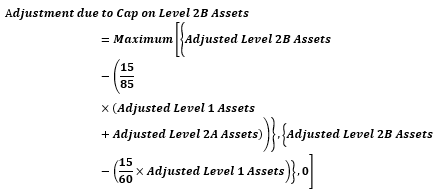
1. Adjustment Due to Cap on Level 2B Assets
Level 2B assets can only constitute up to 15% of the stock of HQLA after considering the impact of unwinding transactions maturing within the LCR horizon. Adjustment to the stock of HQLA due to the cap on Level 2B assets, that is, adjustment for 15% cap is calculated as follows:
2. Adjustment Due to Cap on Level 2 Assets
Level 2 assets can only constitute up to 40% of the stock of HQLA after considering the impact of unwinding transactions maturing within the LCR horizon. Adjustment to the stock of HQLA due to the cap on Level 2 assets, that is, adjustment for 40% cap is calculated as follows:

Operational deposits are those deposits placed by customers with a bank to meet their payment and settlement requirements and make other payments. The application classifies accounts as operational if they meet the following criteria:
1. They are held in specifically designated accounts that are held as operational accounts by the customers at the bank.
2. They are priced without giving economic incentives to the customer to leave excess funds in the account.
3. They arise out of a clearing, custody, or cash management relationship with the bank.
4. They do not arise out of correspondent banking services or in the context of prime brokerage services.
5. The termination of such agreements requires a minimum notice period of 30 days.
6. If the agreement can be terminated within 30 days, the customer must pay significant switching or termination costs to the bank.
Any excess balances held in an account classified as an operational deposit over and above that which is required to meet the operational requirements of the customer is assigned a higher outflow rate by the regulator. The application supports a methodology for computing the portion of the balance held for operational purposes which are truly required to meet the operational requirements of the customer. See Calculation of Operational Amount for details.
This section provides the steps involved in deposit stability identification.
Topics:
· Identification of Insurance Eligible Accounts
· Allocation of Deposit Insurance
· Identification of Deposit Stability
The identification of insurance eligible accounts involves looking at the inclusion as well as the exclusion criteria. The application requires users to provide the following inclusion criteria:
1. Ownership Category
OFS LRRCRBI allocates the insurance limit separately for each ownership category level. Ownership categories include single accounts, joint accounts, trusts, and so on. As per the DICGC, a separate limit is assigned to a unique depositor combination based on the ownership category of accounts. Users are required to provide the ownership categories that get a separate limit. If a particular customer gets a single limit irrespective of whether the accounts are held as single, joint, or a combination, the ownership category should have a single default value.
2. Product Type
This is a list of product types that are covered under the respective jurisdiction’s deposit insurance scheme. The insurance limit is allocated to only those customer accounts whose product types match those covered by the deposit insurance. For RBI, DICGC covers all types of deposits such as current accounts, savings accounts, recurring deposits, and term deposits, which must be provided as inputs.
3. Product Type Prioritization
The sequence in which the insured amount is to be allocated to each product type is captured. For instance, the product prioritization may be specified as a current account, savings account, and term deposit. This indicates that the insured amount is allocated first to a current account held by the customer. After current accounts have been fully covered, the remaining amount is allocated to savings accounts and finally to term deposits.
NOTE:
In case product type prioritization is not specified, the default allocation will be proportionate to the EOP balance of each account irrespective of the product type.
4. Currency Eligibility for Insurance
This is a list of currencies in which the accounts are denominated that are eligible for insurance coverage under a deposit insurance scheme. Some jurisdictions cover foreign currency deposits under their deposit insurance schemes. If eligible currencies are specified for insurance, then the insured balance is allocated to all the accounts belonging to the particular legal entity which have the associated attributes required for assigning the insured balance. For instance, if DICGC insures only INR denominated, the eligible currency against the DICGC insurance scheme should be provided as Indian Rupees.
The application includes insurance exemption criteria covering deposits of foreign sovereigns, central and state governments, and banks, and so on. The deposits that are eligible for insurance under a particular insurance scheme are identified based on the inclusion and exclusion criteria as specified by the users.
As part of the RBI Run, the application allocates the deposit insurance to accounts based on the guidelines specified by the Deposit Insurance and Credit Guarantee Corporation (DICIGC) of India. The insurance limit captured against each deposit insurance scheme is allocated to the insurance-eligible accounts under that scheme based on the ownership category and the unique depositor combination.
The insurance limit, that is the maximum deposit balance covered by an insurance scheme per customer, is captured against each insurance scheme - ownership category combination. Customers having an account in multiple legal entities get a separate deposit insurance limit per legal entity. As per the DICGC insurance scheme, the limit amount must be provided in Stage Insurance Scheme Master Table at the granularity of insurance scheme. The insurance limit is allocated to accounts as per the following procedure:
1. The application identifies the unique depositor combination for each ownership category and legal entity combination.
2. All insurance eligible accounts with a particular unique depositor combination are identified and arranged in the descending order of their outstanding balances.
The insurance limit available is allocated to account 1 to n-1 as per the following formula:

Where,
Insurance Limit Available: Limit available post allocation to previous accounts = Insurance Limit Availablex-1 - Insured Amount x-1
x: Number of accounts up to the current account to which insured amount is to be allocated.
n: Total number of accounts of a customer which are eligible for insurance coverage under a given ownership category.
3. The remaining available insurance is allocated to the last account, that is, account n for which insurance was not allocated.
An illustration of this procedure is provided considering an INR 1,00,000 insurance limit for each unique depositor combination under each ownership category for each legal entity. The inputs to this calculation, including account details and customer details, are provided as follows, along with the unique depositor combination, as identified by OFS LRRCRBI as per the DICGC guidelines.
Legal Entity |
Account Number |
Account Balance |
Ownership Category |
Primary Holder |
Secondary Holder 1 |
Secondary Holder 2 |
Secondary Holder 3 |
Unique Depositor Combination |
|---|---|---|---|---|---|---|---|---|
Legal Entity 1 |
100001 |
49965 |
Single |
Customer A |
|
|
|
1 |
Legal Entity 1 |
100002 |
36903 |
Joint |
Customer A |
Customer B |
Customer C |
|
1 |
Legal Entity 1 |
100003 |
33762 |
Partnership |
Customer ABC |
|
|
|
1 |
Legal Entity 1 |
100004 |
40681 |
Company |
Customer XYZ |
|
|
|
1 |
Legal Entity 1 |
100005 |
7355 |
Company |
Customer XYZ |
|
|
|
1 |
Legal Entity 1 |
100006 |
44995 |
Joint |
Customer B |
Customer A |
Customer C |
|
2 |
Legal Entity 1 |
100007 |
35614 |
Joint |
Customer A |
Customer B |
Customer C |
|
1 |
Legal Entity 1 |
100008 |
7568 |
Joint |
Customer C |
Customer B |
Customer A |
|
5 |
Legal Entity 1 |
100009 |
37205 |
Single |
Customer A |
|
|
|
1 |
Legal Entity 1 |
100010 |
7337 |
Partnership |
Customer ABC |
|
|
|
1 |
Legal Entity 1 |
100011 |
45016 |
Company |
Customer YZX |
|
|
|
2 |
Legal Entity 1 |
100012 |
6574 |
Partnership |
Customer BC |
|
|
|
2 |
Legal Entity 1 |
100013 |
4759 |
Company |
Customer XYZ |
|
|
|
1 |
Legal Entity 1 |
100014 |
20517 |
Company |
Customer ZXY |
|
|
|
3 |
Legal Entity 1 |
100015 |
24254 |
Joint |
Customer B |
Customer C |
Customer A |
|
4 |
Legal Entity 1 |
100016 |
68691 |
Joint |
Customer B |
Customer A |
Customer C |
Customer D |
3 |
Legal Entity 1 |
100017 |
20565 |
Joint |
Customer C |
Customer B |
Customer A |
|
5 |
Legal Entity 2 |
200001 |
34042 |
Single |
Customer A |
|
|
|
1 |
Legal Entity 2 |
200002 |
3100 |
Joint |
Customer A |
Customer B |
Customer C |
|
1 |
Legal Entity 2 |
200003 |
43096 |
Single |
Customer B |
|
|
|
2 |
Legal Entity 2 |
200004 |
42522 |
Joint |
Customer A |
Customer B |
Customer C |
|
1 |
Legal Entity 2 |
200005 |
32457 |
Joint |
Customer A |
Customer B |
Customer C |
|
1 |
Legal Entity 2 |
200006 |
33075 |
Joint |
Customer A |
Customer B |
Customer C |
|
1 |
The application allocates the insurance limit of INR 1,00,000 to all eligible accounts held by each unique depositor combination as follows.
Legal Entity |
Account Number |
Account
Balance |
Ownership Category |
Unique Depositor Combination |
Limit Applicable |
Available Limit (b = bt-1 - ct-1) |
Insured Amount [c = As per Step (3)] |
Uninsured
Amount |
|---|---|---|---|---|---|---|---|---|
Legal Entity 1 |
100004 |
40681 |
Company |
1 |
100000 |
100000 |
40681 |
0 |
Legal Entity 1 |
100005 |
7355 |
Company |
|
|
59319 |
7355 |
0 |
Legal Entity 1 |
100013 |
4759 |
Company |
|
|
51964 |
4759 |
0 |
Legal Entity 1 |
100011 |
45016 |
Company |
2 |
100000 |
100000 |
45016 |
0 |
Legal Entity 1 |
100014 |
20517 |
Company |
3 |
100000 |
100000 |
20517 |
0 |
Legal Entity 1 |
100002 |
36903 |
Joint |
1 |
100000 |
100000 |
36903 |
0 |
Legal Entity 1 |
100007 |
35614 |
Joint |
|
|
63097 |
35614 |
0 |
Legal Entity 1 |
100006 |
44995 |
Joint |
2 |
100000 |
100000 |
44995 |
0 |
Legal Entity 1 |
100016 |
68691 |
Joint |
3 |
100000 |
100000 |
68691 |
0 |
Legal Entity 1 |
100015 |
24254 |
Joint |
4 |
100000 |
100000 |
24254 |
0 |
Legal Entity 1 |
100017 |
20565 |
Joint |
5 |
100000 |
100000 |
20565 |
0 |
Legal Entity 1 |
100008 |
7568 |
Joint |
|
|
79435 |
7568 |
0 |
Legal Entity 1 |
100003 |
33762 |
Partnership |
1 |
100000 |
100000 |
33762 |
0 |
Legal Entity 1 |
100010 |
7337 |
Partnership |
|
|
66238 |
7337 |
0 |
Legal Entity 1 |
100012 |
6574 |
Partnership |
2 |
100000 |
100000 |
6574 |
0 |
Legal Entity 1 |
100001 |
49965 |
Single |
1 |
100000 |
100000 |
49965 |
0 |
Legal Entity 1 |
100009 |
37205 |
Single |
|
|
50035 |
37205 |
0 |
Legal Entity 2 |
200004 |
42522 |
Joint |
1 |
100000 |
100000 |
42522 |
0 |
Legal Entity 2 |
200006 |
33075 |
Joint |
|
|
57478 |
33075 |
0 |
Legal Entity 2 |
200005 |
32457 |
Joint |
|
|
21303 |
21303 |
11154 |
Legal Entity 2 |
200002 |
3100 |
Joint |
|
|
24403 |
3100 |
0 |
Legal Entity 2 |
200001 |
34042 |
Single |
1 |
100000 |
100000 |
34042 |
0 |
Legal Entity 2 |
200003 |
43096 |
Single |
2 |
100000 |
100000 |
43096 |
0 |
Once the insurance limit is allocated at an account level, the application determines the deposit stability as follows:
1. Stable Deposits
A stable deposit is the portion of a deposit which is covered by deposit insurance provided by an effective deposit insurance scheme or a public guarantee that provides equivalent protection and which satisfies one of the following conditions:
§ It is held in a transactional account by the depositor.
Or
§ The depositor has an established relationship with the reporting legal entity.
The application identifies the existence of an established relationship if the depositor meets one of the following criteria:
§ The depositor holds more than one account with the bank, with at least one account of a type other than a deposit.
Or
§ The bank has assigned a customer relationship manager to the depositor.
If a deposit is partially covered by insurance and meets the other criteria, the insured portion of such deposits is treated as stable while the uninsured portion is treated as less stable. Stable deposits receive a 5% Run-off rate.
2. Less Stable Deposits
All insured and uninsured deposit or funding balances that do not meet the stable deposits criteria are classified as less stable deposits: This includes the following:
§ Uninsured balance of deposits meeting stable deposits criteria.
§ Insured balance of deposits which are not transactional accounts and the customer has no established relationship with the bank.
§ Deposit balance where the insurance coverage status is Uninsured.
Less stable deposits receive a 10% Run-off rate.
A bank does lien marking of a deposit when the bank’s deposit or deposits is placed as a security against a loan or loans extended by the bank. It indicates that, when a customer receives a loan from a bank and contractually places the deposits held within the same bank as collateral, then the bank marks the respective deposits as lien marked deposits.
For lien marked deposits, the deposit proceeds are paid out only when the loan against the deposit is repaid in full. This indicates that the deposit placed against the loan is encumbered for the entire term of the loan until it is repaid. Given this nature, only deposits with a fixed maturity, that is, term deposits are eligible for lien marking. Also, multiple deposits can be placed against multiple liens, such as loans, lines of credit, guarantees and so on, forming many-to-many relationships.
The RBI amendments (2016) allows for certain exceptions concerning outflow calculation when it comes to lien marked deposits.
The guidelines state that outflows for lien marked deposits which will not mature within the LCR horizon may be excluded from LCR calculation if the following conditions are met:
· The loan will not mature or settle in the next 30 days.
· The pledge arrangement is subject to a legally enforceable contract disallowing withdrawal of the deposit before the loan is fully settled or repaid.
· The amount of deposit to be excluded cannot exceed the outstanding balance of the loan.
Lien marked deposits are identified against deposits in the staging area by the Lien Marked Indicator flag. The mapping between deposits which are lien marked and the lien against it is many to many and is a download for the application.
When all the guideline conditions are satisfied, the encumbered portion of lien marked deposits are excluded and receives a 0% factor. The unencumbered portion of the lien marked deposits is included and receives an appropriate Run-off rate as applicable.
Outflow factors as for other products and dimensional combinations are defined in the form of business assumptions. To cater to lien marked deposits, the following new based measures are introduced in the business assumptions:
· Unencumbered stable balance: This measure populates the minimum of the unencumbered amount and stable amount.
· Unencumbered less stable balance: This measure populates the minimum of the unencumbered amount and less stable amount.
· Encumbered balance: This measure populates the encumbered amount of the deposit.
See the Regulations Addressed through Business Assumptions section for details of the preseeded assumptions on lien marked deposits.
Contractually required collateral is the amount of collateral that is contractually due from one party to the other based on the current exposure and collateral position. This amount must be paid to the party soon and results in outflow for the party owing the collateral and inflow to the party to whom the collateral is due. It can be of two types based on the direction of the exposure, Excess Collateral Due or Excess Collateral Receivable.
Topics:
· For Other Assets and Liabilities
This section details the calculation of contractually due collateral and contractually receivable collateral for derivatives.
Topics:
· Calculation of Contractually Due Collateral
· Calculation of Contractually Receivable Collateral
The application computes the value of the collateral that a bank is required to post contractually to its derivative counterparty as follows, if one of the following conditions are met:
1. If Secured Indicator is No, then the contractually due collateral is 0.
2. If Secured Indicator is Yes and CSA Type is One way, then the contractually due collateral is 0.
3. If Secured Indicator is Yes, CSA Type is Two way and Gross Exposure is greater than or equal to 0, then the contractually due collateral is 0.
4. If Secured Indicator is Yes, CSA Type is Two way and Gross Exposure is less than 0, the application computes the contractually due collateral as follows:

Where,
Threshold is the unsecured exposure that a party to a netting agreement is willing to assume before making collateral calls.
The contractually due collateral is assumed to be posted and therefore receives the relevant outflow rate specified by the regulator as part of the preconfigured business assumptions for LCR calculations.
The application computes the value of the collateral that a derivative counterparty is required to post contractually to the bank as follows, if one of the following conditions are met:
1. If Secured Indicator is No, then the contractually receivable collateral is 0.
2. If Secured Indicator is Yes and Gross Exposure is less than or equal to 0, then the contractually receivable collateral is 0.
3. If Secured Indicator is Yes and Gross Exposure is greater than 0, then the application computes the contractually receivable collateral as follows:

The contractually receivable collateral does not receive a pre-specified inflow rate from the regulator and is, therefore, excluded from the LCR calculations. However, the application computes this to generate reports.
This section details the calculation of contractually due collateral and contractually receivable collateral for other assets and liabilities.
NOTE:
This functionality is available only for RBI Contractual Run.
Topics:
· Calculation of Contractually Due Collateral
· Calculation of Contractually Receivable Collateral
The application calculates contractually due collateral for other assets and liabilities as follows, if one of the following conditions are met:
1. If Balance Sheet Category is Asset, then the contractually due collateral is 0.
2. If Balance Sheet Category is Liability, and Secured Indicator is N, then the contractually due collateral is 0.
3. If Balance Sheet Category is Liability, and Secured Indicator is Y, then the application computes the contractually due collateral as follows:

The application calculates contractually receivable collateral for other assets and liabilities as follows, if one of the following conditions are met:
1. If Balance Sheet Category is Liability, then the contractually due collateral is 0.
2. If Balance Sheet Category is Asset, and Secured Indicator is N, then the contractually due collateral is 0.
3. If Balance Sheet Category is Asset, and Secured Indicator is Y then the application computes the contractually due collateral as follows:

Excess collateral is the value of collateral posted or received that is more than the collateral required based on the current levels of exposure and collateral position. This amount can be withdrawn by the party which has provided the collateral over its exposure and results in outflow to the party holding the excess collateral and an inflow to the party who has provided the excess collateral. It can be of two types, Excess Collateral Due or Excess Collateral Receivable.
Topics:
· For Other Assets and Liabilities
This section details the calculation of excess collateral due and excess collateral receivable for derivatives.
Topics:
· Calculation of Excess Collateral Due
· Calculation of Excess Collateral Receivable
The application computes the value of the collateral that a derivative counterparty has posted to the bank, over the contractually required collateral, and therefore can be withdrawn by the counterparty, as follows:
1. If Secured Indicator is No, then the excess collateral due is 0.
2. If Secured Indicator is Y and Gross Exposure are less than or equal to 0, the application computes the excess collateral due as follows:

Where,
Adjusted collateral received: Collateral received from the counterparty less customer withdrawable collateral.
Customer withdrawable collateral: Collateral received under rehypothecation rights that can be contractually withdrawn by the customer within the LCR horizon without a significant penalty associated with such a withdrawal.
3. If Secured Indicator is Y and Gross Exposure are greater than 0, the application computes the excess collateral due as follows:

The excess collateral due is assumed to be recalled by the counterparty and therefore receives the relevant outflow rate specified by the regulator as part of the preconfigured business assumptions for LCR calculations.
The application computes the value of the collateral that the bank has posted to its derivative counterparty, over the contractually required collateral, and therefore can be withdrawn by the bank, as follows:
1. If Secured Indicator is No, then the excess collateral receivable is 0.
2. If Secured Indicator is Y and Gross Exposure are greater than or equal to 0, the application computes the excess collateral receivable as follows:

Where,
Adjusted collateral posted: Collateral posted by the bank less firm withdrawable collateral.
Firm withdrawable collateral: Collateral provided under rehypothecation rights that can be contractually withdrawn by the bank within the LCR horizon without a significant penalty associated with such a withdrawal.
3. If Secured Indicator is Y and Gross Exposure are less than 0, the application computes the excess collateral receivable as follows:

The excess collateral receivable does not receive a pre-specified inflow rate from the regulator and is, therefore, excluded from the LCR calculations. However, the application computes this to report.
This section details the calculation of excess collateral due and excess collateral receivable for other assets and liabilities.
NOTE:
This functionality is available only for RBI Contractual Run.
Topics
· Calculation of Excess Collateral Due
· Calculation of Excess Collateral Receivable
The application calculates the excess collateral due for other assets and liabilities as follows, if one of the following conditions are met:
1. If Balance Sheet Category is Liability, then the contractually due collateral is 0.
2. If Balance Sheet Category is Asset, and Secured Indicator is N, then the contractually due collateral is 0.
3. If Balance Sheet Category is Asset, and Secured Indicator is Y, then the application computes the contractually due collateral as follows:

The application calculates the excess collateral receivable for other assets and liabilities as follows, if one of the following conditions are met:
1. If Balance Sheet Category is Asset, then the contractually due collateral is 0.
2. If Balance Sheet Category is Liability, and Secured Indicator is N, then the contractually due collateral is 0.
3. If Balance Sheet Category is Liability, and Secured Indicator is Y, then the application computes the contractually due collateral as follows:

This section details the calculation of downgrade impact amount for derivatives and for other liabilities.
Topics:
· Calculation of Downgrade Impact Amount for Derivatives
· Calculation of Downgrade Impact Amount for Other Liabilities
The application calculates the downgrade impact amount for derivatives as follows, if one of the following conditions are met:
1. If a downgrade trigger does not exist for the derivatives contract or netting agreement, the downgrade impact amount is 0.
2. If Net Exposure greater than 0, the downgrade impact amount is 0.
3. If Net Exposure less than or equal to 0, the downgrade impact amount is calculated as follows:

The application calculates the downgrade impact amount for other liabilities, including annuities, that have an associated downgrade, derivatives as follows, if one of the following conditions are met:
1. If a downgrade trigger does not exist for the liability account, the downgrade impact amount is 0.
2. The downgrade impact amount for liabilities other than derivatives and securitizations is calculated as follows:

NOTE:
Any liability account that is triggered due to a particular level of rating downgrade has an outflow corresponding to a pre-specified percentage of the downgrade impact amount. For instance, if a 3-notch downgrade is specified, then the downgrade impact amount will outflow only for those accounts that have a trigger of 1-notch, 2-notches, and 3-notches. If a 2-notch downgrade is specified, then the downgrade impact amount will outflow only for those accounts that have a trigger of 1-notch and 2-notches. The rating downgrade and the outflow percentage as specified by the regulator are part of the preconfigured business assumptions for LCR calculations.
This section details the calculation of net derivative cash inflows and outflows.
Topics:
· Cash Flow Netting at Derivative Contract Level
· Cash Flow Netting at Netting Agreement Level
Cash flows from each derivative contract are netted as follows:
1. When cash inflows and outflows are denominated in the same currency and occur at the same time bucket:
a. The cash inflows and outflows are summed up and the net value is computed as follows:

b. If the net cash flow is positive and there is no netting agreement associated with the derivative contract, the value is treated as net derivative cash outflow.
c. If the net cash flow is negative and there is no netting agreement associated with the derivative contract, the value is treated as net derivative cash inflow.
2. When cash inflows and outflows are denominated in different currencies but settle within the same day:
a. The cash inflows and outflows are summed up after being converted to the reporting currency and the net value is computed.
b. If the net cash flow is positive and there is no netting agreement associated with the derivative contract, the value is treated as net derivative cash outflow.
c. If the net cash flow is negative and there is no netting agreement associated with the derivative contract, the value is treated as net derivative cash inflow.
3. When cash inflows and outflows are denominated in different currencies and do not settle within the same day:
a. The cash outflows from each derivative contract without an associated netting agreement are summed up and treated as net derivative cash outflows.
b. The cash inflows from each derivative contract without an associated netting agreement are summed up and treated as net derivative cash inflow.
1
NOTE:
If a derivative contract has a netting agreement associated with it, the cash flow is further netted across contracts at the netting agreement level.
For derivative contracts which have a netting agreement associated with them, the net cash flows computed at the derivative contract level are further netted across multiple contracts under the same netting agreement as follows:
1. For derivative contracts, that belong to a single netting agreement, whose payment netting agreement flag is Yes:
a. The cash inflows and outflows occurring in each time bucket, denominated in each currency, are summed up across all contracts whose payment netting agreement flag is Yes and the net value is computed.
b. If the net cash flow is positive, the value is treated as net derivative cash outflow.
c. If the net cash flow is negative, the value is treated as net derivative cash inflow.
2. For derivative contracts, that belong to a single netting agreement, whose payment netting agreement flag is No:
a. The cash outflows occurring in each time bucket, denominated in each currency, are summed up separately for each derivative contract whose payment netting agreement flag is No and treated as net derivative cash outflow.
b. The cash inflows occurring in each time bucket, denominated in each currency, are summed up separately for each derivative contract whose payment netting agreement flag is No and treated as net derivative cash inflow.
NOTE:
Cash flow netting for netting agreements is done separately for each currency. Cash flows are not netted across currencies. Instead, the inflows and outflows converted into the reporting currency are summed up separately to report the net derivatives cash inflow and net derivatives cash outflow at an entity level.
The application computes the 24-month look-back amount, to define outflows due to increased liquidity requirements related to market valuation changes on derivatives as per the following procedure:
· The Mark-to-Market (MTM) value of collateral outflows and inflows due to valuation changes on derivative transactions are captured at a legal entity level. The values over a 24-month historical time window from the as of date are identified.
· The application computes the largest 30-day absolute net collateral flow occurring within each rolling 30-day historical time window as follows:
a. The net Mark-to-Market collateral change is computed for each day within a particular 30-day historical time window as follows:

b. The cumulative net Mark-to-Market collateral change is computed for each day within a particular 30-day historical time window as follows:

Where,
i: Each day within a particular 30-day historical time window.
n: Each 30-day historical time window.
c. The absolute net Mark-to-Market collateral change is computed for each day within the rolling 30-day historical time window as follows:

d. The largest 30-day absolute net collateral flow occurring within the rolling 30-day historical time window is identified as follows:

NOTE:
Steps (a) to (d) are repeated for each rolling 30-day historical time window.
e. The 24-month look-back amount is calculated as follows:

NOTE:
1. This calculation is done for each legal entity separately.
2. The largest 30-day absolute net collateral flow is computed in 30-day blocks on a rolling basis. For example, the first 30-day block is As of Date to As of Date - 29; the second 30-day block is As of Date - 1 to As of Date - 30 and so on.
3. The 24-month look-back amount is computed as the maximum of the largest absolute net collateral flow during all rolling 30-day periods in every 24 months.
The 24-month look-back calculations are illustrated in the following table, considering a 34-day historical time window instead of 24-months. This results in 5 rolling 30-day windows.
Rolling 30-Day Period |
Day |
Mark-To-Market
Collateral Outflows Due To Derivative Transaction Valuation Changes |
Mark-To-Market
Collateral Inflows Due To Derivative Transaction Valuation Changes |
Net Mark-To-Market
Collateral Change |
Cumulative
Net Mark-To-Market Collateral Change |
Absolute
Net Mark-To-Market Collateral Change |
|---|---|---|---|---|---|---|
As of Date to As of Date - 29 |
As of Date |
65 |
14 |
51 |
51 |
51 |
As of Date - 1 |
65 |
9 |
56 |
107 |
107 |
|
As of Date - 2 |
74 |
83 |
-9 |
98 |
98 |
|
As of Date - 3 |
71 |
97 |
-26 |
72 |
72 |
|
As of Date - 4 |
84 |
89 |
-5 |
67 |
67 |
|
As of Date - 5 |
8 |
57 |
-49 |
18 |
18 |
|
As of Date - 6 |
40 |
59 |
-19 |
-1 |
1 |
|
As of Date - 7 |
42 |
87 |
-45 |
-46 |
46 |
|
As of Date - 8 |
100 |
6 |
94 |
48 |
48 |
|
As of Date - 9 |
41 |
30 |
11 |
59 |
59 |
|
As of Date - 10 |
45 |
9 |
36 |
95 |
95 |
|
As of Date - 11 |
9 |
32 |
-23 |
72 |
72 |
|
As of Date - 12 |
59 |
67 |
-8 |
64 |
64 |
|
As of Date - 13 |
61 |
10 |
51 |
115 |
115 |
|
As of Date - 14 |
22 |
36 |
-14 |
101 |
101 |
|
As of Date - 15 |
63 |
81 |
-18 |
83 |
83 |
|
As of Date - 16 |
36 |
3 |
33 |
116 |
116 |
|
As of Date - 17 |
61 |
22 |
39 |
155 |
155 |
|
As of Date - 18 |
94 |
37 |
57 |
212 |
212 |
|
As of Date - 19 |
3 |
18 |
-15 |
197 |
197 |
|
As of Date - 20 |
13 |
27 |
-14 |
183 |
183 |
|
As of Date - 21 |
24 |
56 |
-32 |
151 |
151 |
|
As of Date - 22 |
57 |
75 |
-18 |
133 |
133 |
|
As of Date - 23 |
66 |
87 |
-21 |
112 |
112 |
|
As of Date - 24 |
33 |
71 |
-38 |
74 |
74 |
|
As of Date - 25 |
29 |
30 |
-1 |
73 |
73 |
|
As of Date - 26 |
64 |
25 |
39 |
112 |
112 |
|
As of Date - 27 |
54 |
39 |
15 |
127 |
127 |
|
As of Date - 28 |
51 |
6 |
45 |
172 |
172 |
|
As of Date - 29 |
35 |
31 |
4 |
176 |
176 |
|
As of Date - 1 to As of Date - 30 |
As of Date - 1 |
65 |
9 |
56 |
56 |
56 |
As of Date - 2 |
74 |
83 |
-9 |
47 |
47 |
|
As of Date - 3 |
71 |
97 |
-26 |
21 |
21 |
|
As of Date - 4 |
84 |
89 |
-5 |
16 |
16 |
|
As of Date - 5 |
8 |
57 |
-49 |
-33 |
33 |
|
As of Date - 6 |
40 |
59 |
-19 |
-52 |
52 |
|
As of Date - 7 |
42 |
87 |
-45 |
-97 |
97 |
|
As of Date - 8 |
100 |
6 |
94 |
-3 |
3 |
|
As of Date - 9 |
41 |
30 |
11 |
8 |
8 |
|
As of Date - 10 |
45 |
9 |
36 |
44 |
44 |
|
As of Date - 11 |
9 |
32 |
-23 |
21 |
21 |
|
As of Date - 12 |
59 |
67 |
-8 |
13 |
13 |
|
As of Date - 13 |
61 |
10 |
51 |
64 |
64 |
|
As of Date - 14 |
22 |
36 |
-14 |
50 |
50 |
|
As of Date - 15 |
63 |
81 |
-18 |
32 |
32 |
|
As of Date - 16 |
36 |
3 |
33 |
65 |
65 |
|
As of Date - 17 |
61 |
22 |
39 |
104 |
104 |
|
As of Date - 18 |
94 |
37 |
57 |
161 |
161 |
|
As of Date - 19 |
3 |
18 |
-15 |
146 |
146 |
|
As of Date - 20 |
13 |
27 |
-14 |
132 |
132 |
|
As of Date - 21 |
24 |
56 |
-32 |
100 |
100 |
|
As of Date - 22 |
57 |
75 |
-18 |
82 |
82 |
|
As of Date - 23 |
66 |
87 |
-21 |
61 |
61 |
|
As of Date - 24 |
33 |
71 |
-38 |
23 |
23 |
|
As of Date - 25 |
29 |
30 |
-1 |
22 |
22 |
|
As of Date - 26 |
64 |
25 |
39 |
61 |
61 |
|
As of Date - 27 |
54 |
39 |
15 |
76 |
76 |
|
As of Date - 28 |
51 |
6 |
45 |
121 |
121 |
|
As of Date - 29 |
35 |
31 |
4 |
125 |
125 |
|
As of Date - 30 |
93 |
68 |
25 |
150 |
150 |
|
As of Date - 2 to As of Date - 31 |
As of Date - 2 |
74 |
83 |
-9 |
-9 |
9 |
As of Date - 3 |
71 |
97 |
-26 |
-35 |
35 |
|
As of Date - 4 |
84 |
89 |
-5 |
-40 |
40 |
|
As of Date - 5 |
8 |
57 |
-49 |
-89 |
89 |
|
As of Date - 6 |
40 |
59 |
-19 |
-108 |
108 |
|
As of Date - 7 |
42 |
87 |
-45 |
-153 |
153 |
|
As of Date - 8 |
100 |
6 |
94 |
-59 |
59 |
|
As of Date - 9 |
41 |
30 |
11 |
-48 |
48 |
|
As of Date - 10 |
45 |
9 |
36 |
-12 |
12 |
|
As of Date - 11 |
9 |
32 |
-23 |
-35 |
35 |
|
As of Date - 12 |
59 |
67 |
-8 |
-43 |
43 |
|
As of Date - 13 |
61 |
10 |
51 |
8 |
8 |
|
As of Date - 14 |
22 |
36 |
-14 |
-6 |
6 |
|
As of Date - 15 |
63 |
81 |
-18 |
-24 |
24 |
|
As of Date - 16 |
36 |
3 |
33 |
9 |
9 |
|
As of Date - 17 |
61 |
22 |
39 |
48 |
48 |
|
As of Date - 18 |
94 |
37 |
57 |
105 |
105 |
|
As of Date - 19 |
3 |
18 |
-15 |
90 |
90 |
|
As of Date - 20 |
13 |
27 |
-14 |
76 |
76 |
|
As of Date - 21 |
24 |
56 |
-32 |
44 |
44 |
|
As of Date - 22 |
57 |
75 |
-18 |
26 |
26 |
|
As of Date - 23 |
66 |
87 |
-21 |
5 |
5 |
|
As of Date - 24 |
33 |
71 |
-38 |
-33 |
33 |
|
As of Date - 25 |
29 |
30 |
-1 |
-34 |
34 |
|
As of Date - 26 |
64 |
25 |
39 |
5 |
5 |
|
As of Date - 27 |
54 |
39 |
15 |
20 |
20 |
|
As of Date - 28 |
51 |
6 |
45 |
65 |
65 |
|
As of Date - 29 |
35 |
31 |
4 |
69 |
69 |
|
As of Date - 30 |
93 |
68 |
25 |
94 |
94 |
|
As of Date - 31 |
51 |
97 |
-46 |
48 |
48 |
|
As of Date - 3 to As of Date - 32 |
As of Date - 3 |
71 |
97 |
-26 |
-26 |
26 |
As of Date - 4 |
84 |
89 |
-5 |
-31 |
31 |
|
As of Date - 5 |
8 |
57 |
-49 |
-80 |
80 |
|
As of Date - 6 |
40 |
59 |
-19 |
-99 |
99 |
|
As of Date - 7 |
42 |
87 |
-45 |
-144 |
144 |
|
As of Date - 8 |
100 |
6 |
94 |
-50 |
50 |
|
As of Date - 9 |
41 |
30 |
11 |
-39 |
39 |
|
As of Date - 10 |
45 |
9 |
36 |
-3 |
3 |
|
As of Date - 11 |
9 |
32 |
-23 |
-26 |
26 |
|
As of Date - 12 |
59 |
67 |
-8 |
-34 |
34 |
|
As of Date - 13 |
61 |
10 |
51 |
17 |
17 |
|
As of Date - 14 |
22 |
36 |
-14 |
3 |
3 |
|
As of Date - 15 |
63 |
81 |
-18 |
-15 |
15 |
|
As of Date - 16 |
36 |
3 |
33 |
18 |
18 |
|
As of Date - 17 |
61 |
22 |
39 |
57 |
57 |
|
As of Date - 18 |
94 |
37 |
57 |
114 |
114 |
|
As of Date - 19 |
3 |
18 |
-15 |
99 |
99 |
|
As of Date - 20 |
13 |
27 |
-14 |
85 |
85 |
|
As of Date - 21 |
24 |
56 |
-32 |
53 |
53 |
|
As of Date - 22 |
57 |
75 |
-18 |
35 |
35 |
|
As of Date - 23 |
66 |
87 |
-21 |
14 |
14 |
|
As of Date - 24 |
33 |
71 |
-38 |
-24 |
24 |
|
As of Date - 25 |
29 |
30 |
-1 |
-25 |
25 |
|
As of Date - 26 |
64 |
25 |
39 |
14 |
14 |
|
As of Date - 27 |
54 |
39 |
15 |
29 |
29 |
|
As of Date - 28 |
51 |
6 |
45 |
74 |
74 |
|
As of Date - 29 |
35 |
31 |
4 |
78 |
78 |
|
As of Date - 30 |
93 |
68 |
25 |
103 |
103 |
|
As of Date - 31 |
51 |
97 |
-46 |
57 |
57 |
|
As of Date - 32 |
12 |
31 |
-19 |
38 |
38 |
|
As of Date - 4 to As of Date - 33 |
As of Date - 4 |
84 |
89 |
-5 |
-5 |
5 |
As of Date - 5 |
8 |
57 |
-49 |
-54 |
54 |
|
As of Date - 6 |
40 |
59 |
-19 |
-73 |
73 |
|
As of Date - 7 |
42 |
87 |
-45 |
-118 |
118 |
|
As of Date - 8 |
100 |
6 |
94 |
-24 |
24 |
|
As of Date - 9 |
41 |
30 |
11 |
-13 |
13 |
|
As of Date - 10 |
45 |
9 |
36 |
23 |
23 |
|
As of Date - 11 |
9 |
32 |
-23 |
0 |
0 |
|
As of Date - 12 |
59 |
67 |
-8 |
-8 |
8 |
|
As of Date - 13 |
61 |
10 |
51 |
43 |
43 |
|
As of Date - 14 |
22 |
36 |
-14 |
29 |
29 |
|
As of Date - 15 |
63 |
81 |
-18 |
11 |
11 |
|
As of Date - 16 |
36 |
3 |
33 |
44 |
44 |
|
As of Date - 17 |
61 |
22 |
39 |
83 |
83 |
|
As of Date - 18 |
94 |
37 |
57 |
140 |
140 |
|
As of Date - 19 |
3 |
18 |
-15 |
125 |
125 |
|
As of Date - 20 |
13 |
27 |
-14 |
111 |
111 |
|
As of Date - 21 |
24 |
56 |
-32 |
79 |
79 |
|
As of Date - 22 |
57 |
75 |
-18 |
61 |
61 |
|
As of Date - 23 |
66 |
87 |
-21 |
40 |
40 |
|
As of Date - 24 |
33 |
71 |
-38 |
2 |
2 |
|
As of Date - 25 |
29 |
30 |
-1 |
1 |
1 |
|
As of Date - 26 |
64 |
25 |
39 |
40 |
40 |
|
As of Date - 27 |
54 |
39 |
15 |
55 |
55 |
|
As of Date - 28 |
51 |
6 |
45 |
100 |
100 |
|
As of Date - 29 |
35 |
31 |
4 |
104 |
104 |
|
As of Date - 30 |
93 |
68 |
25 |
129 |
129 |
|
As of Date - 31 |
51 |
97 |
-46 |
83 |
83 |
|
As of Date - 32 |
12 |
31 |
-19 |
64 |
64 |
|
As of Date - 33 |
34 |
36 |
-2 |
62 |
62 |
The largest 30-day absolute net collateral flow for each rolling 30-day period and the 24-month look-back value (in this example, the 34-day look-back value) is computed as follows:
Rolling 30-Day Period |
Largest 30-Day Absolute Net Collateral Flow [f = Max (e)] |
24 Month Look-back Value [Max (f)] |
|---|---|---|
As of Date to As of Date - 29 |
212 |
212 |
As of Date - 1 to As of Date - 30 |
161 |
|
As of Date - 2 to As of Date - 31 |
153 |
|
As of Date - 3 to As of Date - 32 |
144 |
|
As of Date - 4 to As of Date - 33 |
140 |
The regulator-prescribed lower outflow rate for operational deposits should be applied only to the portion of the EOP balance that is truly held to meet operational requirements. The application supports a new methodology to compute the operational portion of the EOP balance of operational deposits. The following steps are involved in computing the operational balance:
1. All deposits classified as operational as per regulatory guidelines are identified. This is a separate process in LRM.
2. The EOP balances of eligible operational accounts are obtained over a 90-day historical window including the As of Date. For example, As of Date - 89 days. To identify historical observations, the f_reporting_flag must be updated as Y for one execution of the Run per day in the LRM Run Management Execution Summary UI. The application looks up the balance for such accounts against the Run execution for which the Reporting Flag is updated as Y for each day in the past.
NOTE:
The historical time window is captured as a parameter in the SETUP_MASTER table. The default value is 90 days which can be modified by the user. To modify this value, update the value under the component code DAYS_HIST_OPER_BAL_CALC_UPD
3. A rolling 5-day average is calculated for each account over the historical window.
4. The average of the 5-day rolling averages computed in Step 3 is calculated.
5. The operational balance is calculated as follows:
NOTE:
The calculation of the operational balance can be either a direct download from the staging tables or through the historical balance approach.

NOTE:
The operational balance calculation based on historical lookback is optional. You can choose to compute the operational balances using this method or provide the value as a download. To provide the value as a download, update the value in the SETUP_MASTER table under the component code HIST_OPERATIONAL_BAL_CALC_UPD as N. If the value is Y then the value would be calculated through historical balance approach.
6. The non-operational balance is calculated as follows:

7. The operational insured balance is calculated as follows:

The insured and uninsured balances are calculated as part of a separate process, for example, the insurance allocation process which is explained in detail in the relevant section under each jurisdiction.
8. The operational uninsured balance is calculated as follows:

9. The non-operational insured balance is calculated as follows:

10. The non-operational uninsured balance is calculated as follows:

The operational deposit computation process is illustrated as follows assuming a 15-day historical window instead of 90-days and for the as of date 28th February 2017. The historical balances for 15-days including the as of date are provided as follows.
Clients With Operational Accounts |
Eligible Operational Accounts |
Historical Time Window |
As of Date |
|||||||||||||
|---|---|---|---|---|---|---|---|---|---|---|---|---|---|---|---|---|
2/14/ 2017 |
2/15/ 2017 |
2/16/ 2017 |
2/17/ 2017 |
2/18/ 2017 |
2/19/ 2017 |
2/20/ 2017 |
2/21/ 2017 |
2/22/ 2017 |
2/23/ 2017 |
2/24/ 2017 |
2/25/ 2017 |
2/26/ 2017 |
2/27/ 2017 |
2/28/ 2017 |
||
A |
10001 |
102,000 |
102,125 |
102,250 |
102,375 |
102,500 |
102,625 |
102,750 |
102,875 |
103,000 |
103,125 |
103,250 |
103,375 |
103,500 |
103,625 |
103,750 |
10296 |
23,500 |
23,550 |
23,600 |
23,650 |
23,700 |
23,750 |
23,800 |
23,850 |
23,900 |
23,950 |
24,000 |
24,050 |
24,100 |
24,150 |
24,200 |
|
B |
31652 |
65,877 |
59,259 |
59,234 |
59,209 |
59,184 |
59,159 |
59,134 |
59,109 |
59,084 |
59,059 |
59,034 |
59,009 |
58,984 |
58,959 |
58,934 |
The rolling averages and cumulative average are computed as follows:
Clients with Operational Accounts |
Eligible Operational Accounts |
5-day Rolling Average |
Cumulative Average (a) |
||||||||||
|---|---|---|---|---|---|---|---|---|---|---|---|---|---|
2/18/ 2017 |
2/19/ 2017 |
2/20/ 2017 |
2/21/ 2017 |
2/22/ 2017 |
2/23/ 2017 |
2/24/ 2017 |
2/25/ 2017 |
2/26/ 2017 |
2/27/ 2017 |
2/28/ 2017 |
|||
A |
10001 |
102,250 |
102,375 |
102,500 |
102,625 |
102,750 |
102,875 |
103,000 |
103,125 |
103,250 |
103,375 |
103,500 |
95136 |
|
10296 |
23,600 |
23,650 |
23,700 |
23,750 |
23,800 |
23,850 |
23,900 |
23,950 |
24,000 |
24,050 |
24,100 |
22721 |
B |
31652 |
60,553 |
59,209 |
59,184 |
59,159 |
59,134 |
59,109 |
59,084 |
59,059 |
59,034 |
59,009 |
58,984 |
56931 |
The operational and non-operational balances are computed as follows:
Clients with Operational Accounts |
Eligible Operational Accounts |
Current Balance (b) |
Operational Balance (c = a - b) |
Non-Operational Balance |
Insured Balance |
Uninsured Balance |
Insured Operational Balance |
Uninsured Operational Balance |
Insured Non-Operational Balance |
Uninsured Non-Operational Balance |
|---|---|---|---|---|---|---|---|---|---|---|
A |
10001 |
103,750 |
95,136 |
8,615 |
100,000 |
3,750 |
95,136 |
|
4,865 |
3,750 |
10296 |
24,200 |
22,721 |
1,480 |
|
24,200 |
|
22,721 |
|
1,480 |
|
B |
31652 |
58,934 |
56,931 |
2,003 |
58,934 |
|
56,931 |
|
2,003 |
|
NOTE:
· Negative historical balances are replaced by zero for this computation.
· For operational accounts that have an account start date greater than the historical days including the as of date, missing balances are replaced by previously available balance.
· For operational accounts that have an account start date less than historical days including the as of date:
1. Missing balances between the account start date and as of date are replaced by previously available balance.
2. The rolling average is calculated only for the period from the account start date to the as of date.
· The methodology to compute operational balance is optional. This can be turned On or Off using the SETUP_MASTER table, where component code = HIST_OPERATIONAL_BAL_CALC_UPD. The option to provide the operational balance as a download is supported by the application.
Regulators across jurisdictions recognize the existence of liquidity transfer restrictions, for banks that operate in multiple jurisdictions. Such transfer restrictions have implications for the group-wide consolidated LCR calculations and must be treated appropriately. In the LCR consolidation process, OFS LRRCRBI includes the restricted HQLA from a subsidiary in the consolidated stock of HQLA only to the extent of that subsidiary’s liquidity requirements such as its net cash outflow, per the regulatory requirements. The treatment of transferability restriction during consolidation is as follows:
1. The net cash outflows are computed for a subsidiary, on a consolidated basis. The consolidation entity is the subsidiary itself in this case. If the subsidiary is a leaf level entity, then the net cash outflow is calculated on a standalone basis.
2. The restricted and unrestricted stock of Level 1, Level 2A and Level 2B is computed for the subsidiary on a consolidated basis. The application captures the HQLA transferability restriction at an account level through the flag F_TRANSFERABILITY_RESTRICTION.
3. The application checks whether the stock of restricted Level 1 assets is greater than the net cash outflows. If yes, it includes the stock of restricted Level 1 assets in the calculation of its immediate parent entity’s stock of HQLA up to the extent of its own net cash outflows computed as part of step 1. If no, the entire stock of restricted Level 1 assets is included in the consolidated calculations.
4. The application checks whether the sum of stock of restricted Level 1 and Level 2A assets is greater than the net cash outflows. If yes, it includes the stock of restricted Level 2A assets in the calculation of its immediate parent entity’s stock of HQLA up to the extent of its own net cash outflows computed as part of step 1 less stock of restricted Level 1 asset. If no, the entire stock of restricted Level 2A assets is included in the consolidated calculations.
5. The application checks whether the sum of stock of restricted Level 1, Level 2A and Level 2B assets is greater than the net cash outflows. If yes, it includes the stock of restricted Level 2B assets in the calculation of its immediate parent entity’s stock of HQLA up to the extent of its own net cash outflows computed as part of step 1 is less stock of restricted Level 1 and Level 2A assets. If no, the entire stock of restricted Level 2B assets is included in the consolidated calculations.
6. The unrestricted Level 1, 2A, and 2B assets are included fully in the calculation of its immediate parent entity’s stock of HQLA.
7. Steps 1 to 6 are repeated for each sub-consolidation level within the organization structure of the consolidation entity till the consolidation entity itself.
NOTE:
1. The allocation of restricted assets is done in the descending order of asset quality to maximize the stock of HQLA.
2. This calculation is part of the LCR consolidation process. To get a complete view of the process, refer to Consolidation, where the consolidation process is described.
The net cash outflows are computed after applying the scenario specified by the user, as a set of business assumptions, to the contractual cash flows. The process of computing the net cash outflows is provided as follows:
1. Calculation of Total Cash Inflows
The application applies the business assumptions, specified on products involving cash inflows, selected as part of the Run. The regulatory assumptions specified in the Regulations Addressed through Business Assumptions section are predefined and packaged as part of the ready-to-use Run to determine the inflows over the liquidity horizon. The business assumption adjusted cash inflows occurring over the liquidity horizon are summed up to obtain the total cash inflow. These include inflows from earning assets such as loans, assets that are not eligible for inclusion in the stock of HQLA, derivatives inflows, and so on.
2. Calculation of Total Cash Outflows
The application applies the business assumptions, specified on products involving cash outflows, selected as part of the Run. The regulatory assumptions specified in the Regulations Addressed through Business Assumptions section are predefined and packaged as part of the ready-to-use Run to determine the outflows over the liquidity horizon. The business assumption adjusted cash outflows occurring over the liquidity horizon is summed up to obtain the total cash outflow. These include outflows from liabilities, derivatives outflows, outflows due to changes in financial conditions such as rating downgrade and valuation changes, and so on.
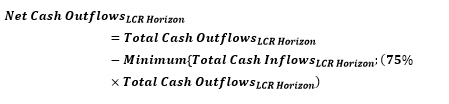
3. Calculation of Net Cash Outflow
Net cash outflow is computed as follows:
NOTE:
The inflow and outflow rates as prescribed by RBI for computing LCR are predefined within the application and ready to be used. Users are also allowed to define bank-specific inflow and outflow rates and apply them to the contractual cash flows to view the stock of HQLA, net cash outflows, and LCR across multiple scenarios.
The approach to consolidation as per LCR approach followed by OFS LRRCRBI is as follows:
a. Identification and Treatment of Unconsolidated Subsidiary
The application assesses whether a subsidiary is to be consolidated or not by checking the regulatory consolidated flag F_REGULATORY_ENTITY_IND against each legal entity. OFS LRM considers the cash inflows and outflows of a subsidiary as part of the consolidated LCR calculation, only if the subsidiary is identified as a consolidated subsidiary for regulatory calculations. If the entity is an unconsolidated subsidiary, the cash inflows and outflows from the operations of such subsidiaries are ignored (unless otherwise specifically included in the denominator of LCR per regulations) and only the equity investment in such subsidiaries is considered as the bank’s asset and appropriately taken into the numerator or denominator based on the asset level classification.
For instance, legal entity 1 has 3 subsidiaries, legal entity 2, legal entity 3, and legal entity 4. The flag F_REGULATORY_ENTITY_IND for legal entity 4 is ‘No’. In this case, legal entity 4 is treated as a third party for consolidation, and its assets and cash flows are completely excluded from calculations. Legal entity 1’s interest in legal entity 4 including common equity of legal entity 4 and assets and liabilities where legal entity 4 is the counterparty will not be eliminated as legal entity 4 is considered a third-party during consolidation.
b. HQLA Consolidation by Subsidiary Type
The process of consolidating HQLA differs slightly based on whether the subsidiary is a material entity that is expected to report LCR separately from the parent or not. This is done to ensure consistency in the results when consolidating at a parent level and when calculating the LCR at the material subsidiary level as well. The methods followed for consolidating HQLA are:
i. For material subsidiaries subject to individual LCR requirements, consolidation is done as follows:
— The application identifies whether the subsidiary is a consolidated subsidiary.
— If condition (a) is fulfilled, it identifies whether the consolidated subsidiary is subject to LCR requirement that is, whether the subsidiary in question is a regulated entity.
— If condition (b) is fulfilled, then it calculates the net cash outflow by eliminating inter-company transactions at the level of the consolidated subsidiary.
— The application consolidates post-haircut restricted HQLA to the extent of the consolidated subsidiary’s net cash outflow that is, to the extent required to satisfy minimum LCR requirements of that subsidiary as part of the covered company’s HQLA. Restricted HQLA are the assets that have a restriction on their transferability to the parent entity. They are allowed to be included in the stock of HQLA to the extent required to meet that entity’s net cash outflows, but the surplus HQLA is not allowed to be used to meet the parent’s LCR requirements.
— It consolidates the entire amount of post-haircut unrestricted HQLA held at the consolidated subsidiary as part of the covered company’s HQLA.
— It consolidates all cash inflows and outflows which are part of the net cash flow calculation.
ii. For subsidiaries not subject to individual LCR requirements, consolidation is done as follows:
— The application identifies whether the subsidiary is a consolidated subsidiary.
— If condition (a) is fulfilled, it identifies whether the consolidated subsidiary is subject to minimum LCR requirement that is, whether the subsidiary in question is a regulated entity.
— If condition (b) is not fulfilled, it eliminates all inter-company transactions till the level of the immediate parent of the consolidated subsidiary and then calculates the net cash outflow.
— The application consolidates post-haircut restricted HQLA to the extent of the consolidated subsidiary’s net cash outflow and the entire amount of post-haircut unrestricted HQLA as part of the covered company’s HQLA.
— It consolidates all cash inflows and outflows which are part of the net cash flow calculation.
c. Consolidated LCR Calculation
Consolidation is done on a step-by-step basis based on each level of the organization structure starting from the most granular level. This indicates that intercompany transactions are eliminated at each sub-consolidation level till the final level of the consolidation (generally BHC) is reached. The consolidated HQLA calculated at the level of the immediate subsidiary of the BHC is added to the HQLA held by the BHC. All intercompany cash flows are eliminated and the LCR is calculated per the LCR approach.
For instance, a bank’s organizational structure is as follows:
Figure 1: Banks Organization Structure
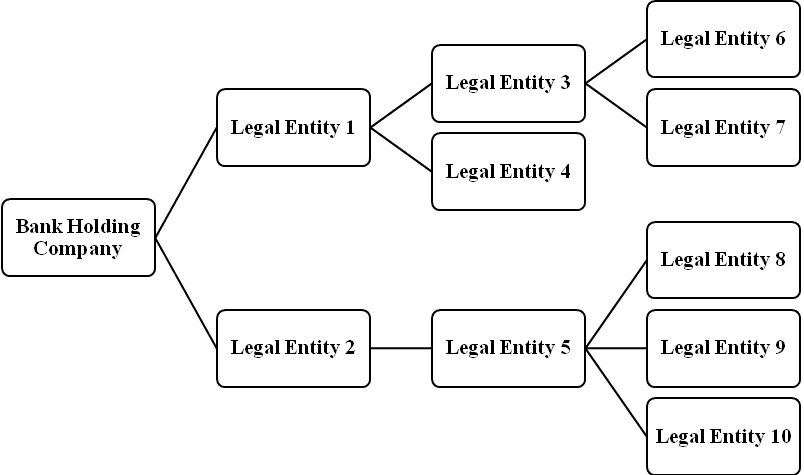
In this case, at the first level of consolidation, calculation of net cash outflows and HQLA is done on a solo basis for legal entities 6, 7, 8, 9, and 10 as they do not have any subsidiaries. For regulated entities, such as material entities, intercompany transactions are not eliminated; whereas for non-regulated entities, intercompany transactions are eliminated to the next level of consolidation that is, legal entities 3 and 5. The restricted HQLA from entities 6 and 7 are consolidated to the extent of their net cash outflows, while the unrestricted HQLA is transferred fully to legal entity 3. The cash inflows and outflows are consolidated to the full extent.
At the second level of consolidation that is, legal entity 3, intercompany transactions are eliminated till legal entity 1, if LE 3 is a non-regulated entity. The HQLA is calculated as a sum of the consolidated restricted and unrestricted HQLA of entities 6 and 7 and the HQLA of legal entity 3. The net cash outflow is calculated based on the cash flows of entities 3, 6, and 7, post-elimination of intercompany transactions if applicable. The consolidated HQLA is calculated based on the procedure detailed in Step 2 above.
This process continues in a step-by-step manner till the highest parent level which is the bank holding company in this example.
To meet any shortfalls in the LCR, RBI allows banks to avail of a special liquidity facility termed as Facility to Avail Liquidity for Liquidity Coverage Ratio or FALLCR. This is allowed to be utilized only if a bank has exhausted all eligible HQLA held for meeting liquidity requirements and as a last resort. The liquidity facility is provided by RBI to banks under certain conditions including:
· The facility can be availed for a maximum of 90 days.
· Liquidity against securities is available after applying the haircuts specified for availing MSF.
· The rate of interest will be 200 basis points above the prevailing LAF rate or as specified by RBI.
· The facility will be effective from 1, January 2015.
The application identifies FALLCR through the standard product type, line of credit received, the credit line purpose, Contractual Committed Facility Extended by Central Bank as Alternative Liquidity, and where the counterparty is a central bank. This is a standard facility extended by multiple regulators across jurisdictions and hence is captured in a manner that is consistent across jurisdictions. Only those credit lines received from the central bank with the specific credit line purpose are assumed to meet the conditions to avail FALLCR and therefore are included in the stock of HQLA in case of shortfalls. Such credit lines are excluded from the net cash outflow calculations.
The application utilizes the alternative liquidity approach to bridge the shortfall as follows:
1. The LCR is computed in each currency and the shortfall in HQLA is identified as follows:

2. The application checks whether a line of credit received from a central bank with the credit line purpose “Contractual Committed Facility Extended by Central Bank as Alternative Liquidity” exists in the particular shortfall currency.
If such a line of credit exists, then the application computes the liquidity availed under the alternative liquidity approach as follows:
 Where,
ALA Committed Amount: Amount available to be drawn down under the Facility to Avail Liquidity for Liquidity Coverage Ratio = Drawn + Undrawn Amount of the line of credit received with the credit line purpose Contractual Committed Facility Extended by Central Bank as Alternative Liquidity.
The value included in the stock of HQLA on a consolidated currency basis on availing FALLCR is computed as follows:
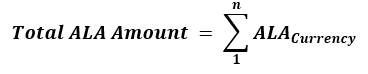
Where,
n: Number of currencies in which an HQLA shortfall is observed which are allowed to be bridged using the ALA.
The liquidity coverage ratio is calculated for a legal entity on both solo and consolidated basis. The formula for calculating the liquidity coverage ratio is as follows:

The liquidity coverage ratio is also calculated for each legal entity at the level of each significant currency to identify potential currency mismatches. This is done by first identifying significant currencies for a legal entity, at a solo or consolidated level as specified in the Run, as follows:

The application further computes and reports the stock of HQLA, net cash outflows, and LCR for each currency identified as significant in the manner detailed in the earlier sections. This calculation is done on both a solo and consolidated basis.
The Basel III framework also prescribes five monitoring tools/metrics for better monitoring a bank's liquidity position. These metrics along with their objective and the prescribed returns are detailed as follows:
1. Contractual Maturity Mismatch
The contractual maturity mismatch profile identifies the gaps between the contractual inflows and outflows of liquidity for defined time bands. These maturity gaps indicate how much liquidity a bank potentially must raise in each of these time bands if all outflows occurred at the earliest possible date. This metric provides insight into the extent to which the bank relies on maturity transformation under its current contracts.
2. Concentration of Funding
This metric is meant to identify those sources of funding that are of such significance, the withdrawal of which triggers liquidity problems. The metric thus encourages the diversification of funding sources recommended in the Basel Committee's Sound Principles. This metrics aims to address the funding concentration of banks by monitoring their funding from each significant counterparty, each significant product/instrument, and each significant currency.
3. Available Unencumbered Assets
This metric provides supervisors with data on the quantity and key characteristics of banks' available unencumbered assets. These assets have the potential to be used as collateral to raise additionally secured funding in secondary markets and/or are eligible at central banks.
4. Market-related Monitoring Tools
This includes high-frequency market data that can serve as early warning indicators in monitoring potential liquidity difficulties at banks.
5. Liquidity Coverage Ratio by Significant Currency
This metric provides supervisors with data related to the liquidity indicators of the significant currency at the banks. A currency is considered as significant if the aggregate liabilities denominated in that currency amount to 5% or more of the bank’s total liabilities. This statement includes only those assets and liabilities which include the contingent liabilities too which are denominated in the specific significant foreign currency.
OFS LRRCRBI supports a ready-to-use RBI LCR which has the regulatory scenario with associated HQLA haircuts, inflow, and outflow percentage or rates preconfigured in the form of business assumptions. This section explains the business assumptions and the corresponding regulatory reference.
NOTE:
This section provides only contextual information about the business assumptions. For more detailed information, see the OFS LRS application (UI). For detailed processes and tasks, see the Run Chart.
The following table lists the Document Identifiers provided in the Regulatory Reference column of the Regulations Addressed through Business Assumptions and Regulations Addressed through Business Rules sections.
Regulation Reference Number |
Document Number |
Document Name |
Issued Date |
|---|---|---|---|
MR1 |
DBOD.BP.BC.No.120 / 21.04.098/2013-14 |
Basel III Framework on Liquidity Standards - Liquidity Coverage Ratio (LCR), Liquidity Risk Monitoring Tools and LCR Disclosure Standards |
9-Jun-14 |
MC |
DBOD.BP.BC.No.120 / 21.04.098/2013-14 |
Basel III Framework on Liquidity Standards - Liquidity Coverage Ratio (LCR), Liquidity Risk Monitoring Tools and LCR Disclosure Standards |
9-Jun-14 |
AR1 |
DBR.BP.BC.No.52/21.04.098/2014-15 |
Basel III Framework on Liquidity Standards - Liquidity Coverage Ratio (LCR), Liquidity Risk Monitoring Tools and LCR Disclosure Standards |
28-Nov-14 |
AR2 |
DBR.No.BP.BC.80 /21.06.201/2014-15 |
Prudential Guidelines on Capital Adequacy and Liquidity Standards - Amendments |
31-Mar-15 |
AR3 |
DBR. BP. BC. No. 77/21.04.098/2015-16 |
Basel III Framework on Liquidity Standards - Liquidity Coverage Ratio (LCR), Liquidity Risk Monitoring Tools and LCR Disclosure Standards |
11-Feb-16 |
AR4 |
DBR.BP.BC.No.86/21.04.098/2015-16 |
Liquidity Risk Management & Basel III Framework on Liquidity Standards - Liquidity Coverage Ratio (LCR), Liquidity Risk Monitoring Tools and LCR Disclosure Standards |
23-Mar-16 |
AR5 |
DBR.BP.BC.No.2/21.04.098/2016-17 |
Basel III Framework on Liquidity Standards - Liquidity Coverage Ratio (LCR), Liquidity Risk Monitoring Tools and LCR Disclosure Standards |
21-Jul-16 |
BLR1 |
Basel III Liquidity Returns |
BLR 1: LCR |
|
AR6 |
DBR.No.Ret.BC.15/12.02.001/2016-17 |
Section 24 and Section 56 of the Banking Regulation Act, 1949 - Maintenance of Statutory Liquidity Ratio (SLR) |
13-Oct-16 |
AR7 |
DBR.BP.BC.No. 81/21.04.098/2017-18 |
Basel III Framework on Liquidity Standards - Liquidity Coverage Ratio (LCR), Liquidity Risk Monitoring Tools and LCR Disclosure Standard |
2-Aug-17 |
AR8 |
RBI/2018-19/98 DBR.BP.BC.No.17/21.04.098/2018-19 |
Basel III Framework on Liquidity Standards - Liquidity Coverage Ratio (LCR), FALLCR against credit disbursed to NBFCs and HFCs |
28-Dec-18 |
AR9 |
RBI/2019-20/217 DOR.BP.BC.No.65/21.04.098/2019-20 |
Basel III Framework on Liquidity Standards - Liquidity Coverage Ratio (LCR) |
17-Apr-2020 |
DICGC FAQ |
|
A Guide to Deposit Insurance - Frequently Asked Questions |
|
The list of preconfigured business Rules and assumptions as well as the corresponding reference to the regulatory requirement that it addresses are provided in the tables listed in the Regulations Addressed through Business Assumptions and Regulations Addressed through Business Rules sections.
The Regulatory Reference column for each rule or assumption has reference to the name of the Document Identifiers such as MR1, MC, AR1, AR2, and so on, and should be read in conjunction with the Document Identifier listed in the preceding table.
Topics:
· Regulation Addressed through Business Assumptions
· Regulation Addressed through Business Rules
The application supports multiple assumptions with preconfigured rules and scenarios based on regulator specified scenario parameters such as HQLA haircuts, inflow and outflow percentage/rates, and so on. The list of preconfigured business assumptions and the corresponding reference to the regulatory requirement that it addresses is provided in the following table.
Sl. No. |
Assumption Name |
Assumption Description |
Regulatory Requirement Addressed |
Regulatory Reference |
|---|---|---|---|---|
1 |
HQLAHaircutAssign |
Haircuts for high-quality liquid assets. |
The haircuts on high-quality liquid assets are predefined as part of this assumption. This assumption applies a 0% haircut on Level 1 assets, 15% on Level 2A assets, and 50% on Level 2B assets. |
MR1 Paragraph 6.3, 6.4 |
Outflows |
||||
1 |
RBI- Non lien marked stable retail deposits |
Run-offs on the stable portion of non-lien marked deposits from retail customers and unsecured wholesale funding from SMEs treated as retail. |
The Run-off rates on the stable portion of non-lien marked deposits from retail customers and SMEs who are treated like retail customers for the purposes of LCR are predefined as part of this assumption. This assumption applies a 5% Run-off on the stable portion of retail deposits, and either mature or result in early withdrawal, without incurring a significant penalty, within the LCR horizon. |
AR2 Part D |
2 |
RBI- Lien marked stable retail deposits |
Run offs on the stable portion of lien marked deposits from customers treated as retail. |
This assumption defines the Run-off rates on the stable portion of lien marked deposits from all customers treated as retail, wherein the deposit maturity and the encumbrance period is within the LCR horizon. Since such deposits can be withdrawn within the horizon, these are treated similar to non-lien marked stable deposits. This assumption applies a 5% Run-off rate on the stable portion of such deposit. |
AR4 Sr no 9 |
3 |
RBI- Unencumbered stable lien marked deposits |
Run-offs on the unencumbered stable portion of lien marked deposits from customers treated as retail. |
Run-off rates for an unencumbered stable portion of lien marked deposits from customers treated as retail wherein the deposit maturity is within the horizon, but the encumbrance period is beyond the LCR horizon is defined as a part of this assumption. The unencumbered stable portion of such deposits receives a 5% Run-off rate. |
AR4 Sr no 9 |
4 |
RBI- Encum portion exclusion of retail Lien marked deposits |
Run-offs on the encumbered portion of lien marked deposits from customers treated as retail. |
Run-offs on the encumbered portion of lien marked deposits from customers treated as retail wherein the deposit maturity is within the horizon, but the encumbrance period is beyond the LCR horizon is defined as a part of this assumption. The encumbered portion of both stable and less stable lien marked deposits receive a 0% Run-off rate. |
AR4 Sr no 9 |
5 |
RBI- Non lien marked less stable deposits |
Run-offs on the less stable portion of non-lien marked deposits from retail customers and unsecured wholesale funding from SMEs treated as retail. |
The Run-off rates on the less stable portion of non-lien marked deposits from retail customers and SMEs who are treated like retail customers for the purposes of LCR are predefined as part of this assumption. This assumption applies a 10% Run-off on the portion of retail deposits that do not meet the deposit stability criteria and either mature or result in early withdrawal, without incurring a significant penalty, within the LCR horizon. |
AR2 Part D |
6 |
RBI- Lien marked less stable retail deposits |
Run-offs on the stable portion of lien marked deposits from customers treated as retail. |
This assumption defines the Run-off rates on less stable portion of lien marked deposits from all customers treated as retail, wherein the deposit maturity and the encumbrance period is within the LCR horizon. Since such deposits can be withdrawn within the horizon, these are treated similar to non-lien marked less stable deposits. This assumption applies a 10% Run-off rate on the stable portion of such deposit. |
AR4 Sr no 9 |
7 |
RBI -Unencumbered less stable lien marked deposits |
Run-offs on the unencumbered less stable portion of lien marked deposits from customers treated as retail. |
Run-off rates for an unencumbered less stable portion of lien marked deposits from customers treated as retail wherein the deposit maturity is within the horizon, but the encumbrance period is beyond the LCR horizon is defined as a part of this assumption. The unencumbered less stable portion of such deposits receive a 10% Run-off rate. |
AR4 Sr no 9 |
9a |
RBI - Insured Operational Balance Run-off |
Run-off on the portion of the operational balance, from deposits generated by clearing, custody, and cash management activities, that is fully covered by deposit insurance. |
The Run-off rates on the insured portion of the balance held in operational accounts to fulfill operational requirements are predefined as part of this assumption. This assumption applies a 3% Run-off on insured operational balances that meet the additional criteria for deposit insurance schemes and a 5% Run-off on those that do not meet the additional criteria. |
AR2 part D Sr No 10, |
9b |
RBI - Uninsured Operational Balance Run-off |
Run-off on the portion of the operational balance, from deposits generated by clearing, custody, and cash management activities, that is not covered by deposit insurance. |
The Run-off rates on the uninsured portion of the balance held in operational accounts to fulfill operational requirements are predefined as part of this assumption. This assumption applies a 25% Run-off on operational balances that are not covered by deposit insurance. |
AR2 part D Sr No 10, |
10 |
RBI-Run-off on Unsec Non-Op Funding from SME and others |
Run-off on the unsecured wholesale funding, provided by SMEs, that is not classified as an operational deposit. This is achieved by rolling over 1 - Run-off rate to beyond the LCR horizon of 30 days. |
The Run-off rates on the cash flows, from unsecured funding that is not classified as an operational deposit, received from SME's, treated as wholesale customers and AoP, HUF, partnerships, trusts which are treated as wholesale, for the purposes of LCR, are predefined as part of this assumption. This assumption applies a 60% rollover for an SME treated as wholesale and a 0% rollover on the other entities. |
AR2 Part D Sr 9 |
11 |
RBI-NFC, Sov, CB, PSE UWF Run-off on Non-op Balance |
Run-off on the unsecured wholesale funding (UWF), provided by non-financial corporate (NFC), sovereigns (Sov), central banks (CB), and multilateral development banks (MDB) and PSEs that is not classified as an operational deposit. This is achieved by rolling over 1 - Run-off rate to beyond the LCR horizon of 30 days. |
The Run-off rates on the cash flows, from unsecured funding that is not classified as an operational deposit, received from non-financial corporates, sovereigns, central banks, multilateral development banks, and PSEs, are predefined as part of this assumption. This assumption applies an 80% rollover that is a 20% Run-off on cash flows from non-operational funding accounts that are fully covered by deposit insurance and a 60% rollover that is 40% Run-off on those non-operational funding accounts that are not fully covered by deposit insurance. |
AR2 Part D Sr 9 |
12 |
RBI-UWF Run-off on Non-op Balance from SMEs and others |
Run-offs on unsecured wholesale funding (UWF) from SMEs not treated as retail. |
The Run-off rates on the non-operational portion of operational deposits from SME's treated as wholesale customers for the purposes of LCR, and AoP, HUF, partnerships, trusts which are treated as wholesale are predefined as part of this assumption. . This assumption applies a 40% Run-off for an SME treated as wholesale and a 100% Run-off on the other entities. |
AR2 Part D Sr 9 |
13 |
RBI-NFC, Sov, CB,PSE Non-operational UWF Run-off |
Run-off on the non-operational portion of unsecured wholesale funding provided by non-financial corporate (NFC), sovereigns (Sov), central banks (CB), and multilateral development banks (MDB) and PSEs that is classified as an operational deposit. |
The Run-off rates on the non-operational portion of operational deposits from non-financial corporates, sovereigns, central banks, multilateral development banks, and PSEs, are predefined as part of this assumption. This assumption applies a 40% Run-off on rate on the non-operational portion of deposits from these counterparties. |
AR2 Part D Sr 9 |
14a |
Non lien marked term deposits from SME, AoP, trusts etc |
Non-lien marked term deposits from SME, AoP, HUF, Trusts, and partnerships treated as wholesale. |
The Run-off rates for non-lien marked term deposits from SMEs, AoPs, HUF, Trusts, and partnerships treated as wholesale for the purposes of LCR are predefined as part of this assumption. This assumption applies a 40% Run-off on Wholesale SME and a 100% Run-off on the other counterparties. |
AR4 Sr no 9 |
14b |
Term deposits with no lien marked. |
Non-lien marked term deposits from sovereigns, central banks, MDB, non-financial corporates, and PSE. |
The Run-off rates for non-lien marked term deposits from sovereigns, Central banks, non-financial corporates, MDB, and PSE are predefined as part of this assumption. This assumption applies a 40% Run-off on all the counterparties. |
AR4 Sr no 9 |
15a |
Lien marked term deposits from SME, AoP, trusts etc |
Lien marked term deposits from SME, AoP, HUF, Trusts, and partnerships treated as wholesale. |
The Run-off rates for lien marked term deposits from SMEs, AoPs, HUF, Trusts, and partnerships treated as wholesale for the purposes of LCR are predefined as part of this assumption. This assumption applies a 40% Run-off on Wholesale SME and a 100% Run-off on the other counterparties. |
AR4 Sr no 9 |
15b |
Lien marked term deposits from PSE, MDB etc |
Lien marked term deposits from sovereigns, central banks, MDB, non-financial corporates, and PSE. |
The Run-off rates for lien marked term deposits from sovereigns, Central banks, non-financial corporates, MDB and PSE are predefined as part of this assumption. This assumption applies a 40% Run-off on all the counterparties. |
AR4 Sr no 9 |
16a |
Unenc portion of lien marked TD from SME, AoP |
The unencumbered portion of lien marked deposits from SME, AoP, HUF, Trusts, and partnerships treated as wholesale. |
The Run-off rates for the unencumbered portion of lien marked term deposits from SMEs, HUF, AoPs, Trusts, and partnerships treated as wholesale for the purposes of LCR are predefined as part of this assumption. This assumption applies a 40% Run-off on Wholesale SME and a 100% Run-off on the other counterparties. |
AR4 Sr no 9 |
16b |
Unenc portion of lien marked TD from sov, CB |
The unencumbered portion of lien marked deposits from sovereigns, Central banks, MDB, Non-financial corporates, and PSE. |
The Run-off rates for the unencumbered portion of lien marked term deposits from sovereigns, Central banks, non-financial corporates, MDB and PSE are predefined as part of this assumption. This assumption applies a 40% Run-off on all the counterparties. |
AR4 Sr no 9 |
17a |
Encum portion of lien marked dep from SME, AoP etc |
The encumbered portion of lien marked deposits from SME, AoP, HUF, Trusts, and partnerships treated as wholesale. |
The Run-off rates for the encumbered portion of lien marked term deposits from SMEs, AoPs, HUF, Trusts, and partnerships treated as wholesale for the purposes of LCR are predefined as part of this assumption. This assumption applies a 0% Run-off on all the counterparties. |
AR4 Sr no 9 |
17b |
Enc portion of lien marked TD from sov, CB |
The encumbered portion of lien marked deposits from sovereigns, Central banks, MDB, Non-financial corporates, and PSE. |
The Run-off rates for the encumbered portion of lien marked term deposits from sovereigns, Central banks, non-financial corporates, MDB and PSE are predefined as part of this assumption. This assumption applies a 0% Run-off on all the counterparties. |
AR4 Sr no 9 |
18 |
RBI - Other LE Unsecured Wholesale Funding Run-off |
Run-off on unsecured wholesale funding, from wholesale customers other than SMEs, non-financial corporates, sovereigns, central banks, multilateral development banks, and PSEs, provided for non-operational purposes. |
The run-off rates on the cash flows, from unsecured funding that is not classified as an operational deposit, received from wholesale counterparties other than SMEs, non-financial corporates, sovereigns, central banks, multilateral development banks, and PSEs, are predefined as part of this assumption. This assumption applies a 0% rollover, that is, 100% run-off on cash flows from non-operational funding accounts. |
BLR Template A2 (iv) |
19 |
RBI-UWF Run-off on Non-operational Balance of Other Entities |
Run-off on the non-operational portion of unsecured wholesale funding (UWF) provided by customers other than non-financial corporates, sovereigns, central banks, multilateral development banks, and PSEs that are classified as an operational deposit. |
The Run-off rates on the non-operational portion of operational deposits from wholesale counterparties other than SMEs, non-financial corporates, sovereigns, central banks, multilateral development banks, and PSEs, are predefined as part of this assumption. This assumption applies a 100% Run-off on the non-operational portion of operational deposits from such counterparties. |
BLR Template A2 (iv) |
20a |
Non lien marked TD from other LE |
Run-off for non-lien marked term deposits from other legal entities. |
The Run-off rates for non-lien marked term deposits from all other legal entities are predefined as part of this assumption. This assumption applies a 100% Run-off for such deposits. |
AR4 Sr no 9 |
20b |
Lien marked TD from other LE |
Run-off for lien marked term deposits from other legal entities. |
The Run-off rates for lien marked term deposits from all other legal entities are predefined as part of this assumption. This assumption applies a 100% Run-off for such deposits. |
AR4 Sr no 9 |
20c |
Unenc portion of lien marked TD from other LE |
Run-off for an unencumbered portion of lien marked term deposits from other legal entities. |
The Run-off rates for the unencumbered portion of lien marked term deposits from all other legal entities are predefined as part of this assumption. This assumption applies a 100% Run-off. |
AR4 Sr no 9 |
20d |
Enc portion of lien marked TD from other LE |
Run-off for an encumbered portion of lien marked term deposits from other legal entities. |
The Run-off rates for the encumbered portion of lien marked term deposits from all other legal entities are predefined as part of this assumption. This assumption applies a 0% Run-off. |
AR4 Sr no 9 |
21a |
RBI- Secured funding run off - Central banks |
Run-off on secured funding, excluding collateral swaps with central banks as counterparty. |
The Run-off rates on the secured funding, excluding collateral swaps, with Central banks as counterparty, are predefined as part of these assumptions. The assumption applies a 100% roll-over to cash flows from such transactions. |
AR2 Part D Sr No11 |
21b |
RBI- Secured funding run off - all other counterparties |
Run-off on secured funding, excluding collateral swaps, with all counterparties except central banks. |
The Run-off rates on the secured funding, excluding collateral swaps, from all counterparties except Central banks, are predefined as part of these assumptions. This assumption applies the regulatory Run-offs applicable to each counterparty type in the form of rollover rates that is 1 - Run-off rates. |
AR2 Part D Sr No11 |
22 |
RBI-Collateral Swap Run-off |
Run-off on collateral swap transactions. |
The Run-off rates on collateral swaps are predefined as part of this assumption. This assumption applies the Run-offs applicable to the market value of received collateral, when the collateral received under a swap transaction is of a higher quality than the collateral placed, as the difference between the liquidity haircuts applicable to the received and placed collateral. |
AR2 Part D Sr No 11 |
23 |
RBI- Derivatives cash outflows |
Net cash outflows from derivative transactions. |
The outflow rate on the 30-day cash outflows from derivative transactions is predefined as part of this assumption. This assumption applies a 100% outflow on derivatives cash outflows, on a net basis in case of derivatives which are part of a netting agreement and on a non-net basis for other derivatives. |
BLR Template A 4 (i) |
24 |
RBI-Additional Collateral Required Due to Ratings Downgrade |
Increased liquidity needs arising from the requirement to post additional collateral due to a 3-notch rating downgrade. |
The outflow rate, on the additional collateral required to be posted on contracts with downgrade triggers, due to a 3-notch rating downgrade, is predefined as part of this assumption. This assumption applies a 100% outflow on the downgrade impact amount arising from a 3-notch rating downgrade. |
AR2 Part D Sr No 12, Explanatory note (ix) |
25 |
RBI-Loss of Re-hypothecation Rights Due to Ratings Downgrade |
Increased liquidity needs arising from a loss of rehypothecation rights on assets received as collateral due to a 3-notch rating downgrade. |
The outflow rate, on the additional cash outflows arising on contracts with downgrade triggers that result in a loss of rehypothecation rights due to a 3-notch rating downgrade, is predefined as part of this assumption. This assumption applies a 100% outflow on the value of mitigants received under rehypothecation rights corresponding to accounts whose downgrade trigger is activated due to the 3-notch ratings downgrade. |
AR2 Part D Sr No 12, Explanatory note (ix) |
26 |
RBI - Increased Liquidity Needs Due to Change in Coll Value |
Increased liquidity needs arising from the potential change in the value of posted collateral. |
The outflow rate on the additional cash outflow due to a potential loss in the market value of non-Level 1 assets posted as collateral is predefined as part of this assumption. This assumption applies a 100% outflow on the value of non-Level 1 posted collateral computed after netting the non-Level 1 collateral received under rehypothecation rights on the same transaction. |
AR2 Part D Sr No 12, Explanatory note (x) |
27 |
RBI-Increased Liquidity Needs Due to Market Valuation Change |
Increased liquidity needs arising from market valuation changes on derivatives and other transactions. |
The outflow rate on the collateral outflows occurring due to market valuation changes on derivatives and other transactions is predefined as part of this assumption. This assumption applies a 100% outflow rate on the largest absolute net 30-day collateral flow occurring during the preceding 24 months under the historical look-back approach. |
AR2 Part D Sr No 12 |
28 |
RBI-Increased Liquidity Needs Due To Excess Collateral |
Increased liquidity needs arising from excess non-segregated collateral received that can be recalled by the counterparty. |
The outflow rate on the excess unsegregated collateral held by a bank, which can potentially be withdrawn by the counterparty, is predefined as part of this assumption. This assumption applies a 100% outflow on the value of excess collateral. |
AR2 Part D Sr No 12, Explanatory note (xiv) |
29 |
RBI-Increased Liquidity Needs from Contractually Due Coll |
Increased liquidity needs arising from the collateral that is contractually required to be posted to the counterparty but has not yet been posted. |
The outflow rate on the collateral that the bank is contractually required to post to its counterparty, but has not yet posted, is predefined as part of this assumption. This assumption applies a 100% outflow on the value of contractually due collateral. |
AR2 Part D Sr No 12, Explanatory note (xiii) |
30 |
RBI-Increased Liquidity Needs Due to Substitutable Coll |
Increased liquidity needs arising from contracts that allow a counterparty to substitute lower quality collateral for the current higher quality collateral. |
The outflow rate on the collateral that the counterparty can contractually substitute with lower quality collateral is predefined as part of this assumption. This assumption applies an outflow rate equal to the difference between the liquidity haircuts of collateral that can be potentially substituted by the counterparty and the collateral that substitutes it. |
AR2 Part D Sr No 12, Explanatory note (xv) |
31 |
RBI-Loss of Funding on Structured Financing Instruments |
Loss of funding on asset-backed securities, covered bonds, and other structured financing instruments. |
The Run-off rate on the maturing asset-backed securities, covered bonds, and other structured financing instruments is predefined as part of this assumption. This assumption applies a 100% Run-off on structured financing instruments that mature within the LCR horizon. |
AR2 Part D Sr no 12 |
32 |
RBI-Loss of Funding from Financing Facility-Maturing Debt |
Loss of funding on asset-backed commercial paper, conduits, securities investment vehicles and other such financing facilities due to inability to refinance maturing debt. |
The Run-off rate on the maturing amounts of asset-backed commercial paper, conduits, securities investment vehicles, and other such financing facilities is predefined as part of this assumption. This assumption applies a 100% Run-off on the EOP balance of the structured financing facilities that mature within the LCR horizon. |
AR2 Part D Sr no 12 |
33 |
RBI-Loss of Funding from Financing Facility-Return of Assets |
Loss of funding on asset-backed commercial paper, conduits, securities investment vehicles, and other such financing facilities due to potential return of assets. |
The Run-off rate on the returnable assets underlying asset-backed commercial paper, conduits, securities investment vehicles, and other such financing facilities is predefined as part of this assumption. This assumption applies a 100% Run-off on the value of the assets that are returnable within the LCR horizon. |
AR2 Part D Sr no 12 |
34 |
RBI-Drawdowns on Committed Credit and Liquidity Facilities |
Drawdowns on committed credit and liquidity facilities extended to retail customers, SMEs, corporates, sovereigns, central banks, MDBs and PSEs. |
The outflow rate on the undrawn amount available to be drawn down on the committed credit and liquidity facilities extended to retail customers, SMEs, corporates, sovereigns, central banks, MDBs, and PSEs is predefined as part of this assumption. This assumption applies the relevant outflow as a drawdown rate, based on the counterparty type, for the aforementioned counterparties. |
BLR 1 LCR template-C.1 |
35 |
RBI-Draws on Committed Facilities Extended to Banks |
Drawdowns on committed credit and liquidity facilities extended to banks. |
The outflow rate on the undrawn amount available to be drawn down on the committed credit and liquidity facilities extended to customers is predefined as part of this assumption. This assumption applies the relevant outflow as a drawdown rate, for banks, including those subject to prudential regulation. |
BLR 1 LCR template-C.1 |
36 |
RBI-Draws on Committed Facilities Extended to Other Entity |
Drawdowns on committed credit and liquidity facilities extended to entities other than retail customers, SMEs, corporates, sovereigns, central banks, MDBs, PSEs, and banks. |
The outflow rate on the undrawn amount available to be drawn down on the committed credit and liquidity facilities extended to customers other than retail customers, SMEs, corporates, sovereigns, central banks, MDBs, PSEs, and banks is predefined as part of this assumption. This assumption applies a 100% outflow as a drawdown rate to all counterparties excluding the aforementioned counterparties. |
BLR 1 LCR template-C.1 |
37 |
RBI - Other Contingent Funding Obligation Outflows |
Outflows related to trade finance related instruments. |
The outflow rate on the trade finance related instruments is predefined as part of this assumption. This assumption applies a 5% Run-off on such trade finance obligations. |
BLR 1 LCR template-C.1 |
38 |
RBI - Uncommitted Facility Outflows |
Drawdowns on uncommitted credit and liquidity facilities extended to customers. |
The outflow rate on the undrawn amount available to be drawn down on the uncommitted credit and liquidity facilities extended to customers is predefined as part of this assumption. This assumption applies a 0% drawdown on the uncommitted facilities. The drawdown rates are allowed to be updated to reflect the rates specified by national regulators. |
BLR 1 LCR template-C.1 |
39 |
RBI- Outflows related to short positions. |
Outflows related to customer and bank short positions. |
The outflow rate on the customer and firm short positions is predefined as part of this assumption. This assumption specifies outflows on the short positions based on assets covering such short positions. |
AR2 Part D Sr No 12 Explanatory
note (xx) |
40. |
RBI - Other Contractual Obligations to Non-Financial Customers |
Outflows related to other contractual obligations to extend funds within 30 days to retail and non-financial wholesale counterparties. |
The outflow rate on the other contractual obligations to extend funds to retail and non-financial corporate customers, in excess of 50% of contractual inflows from such customers within the LCR horizon, is predefined as part of this assumption. This assumption applies a 100% outflow on the excess contractual obligation amount. |
AR2 Part D Sr. No. 12 (xviii) |
Inflows |
||||
1 |
RBI- Secured lending inflows |
Inflows from secured lending transactions excluding collateral swaps. |
The inflow rates on the secured lending, excluding collateral swaps, are predefined as part of this assumption. This assumption applies the regulatory inflows to secured lending transactions based on the asset level of the collateral received in the form of rollover rates, that is, 1 - Run-off rates. |
BLR 1 LCR template-C.1 (June
2014) |
2 |
RBI - Collateral Swap Inflows |
Inflows from collateral swap transactions. |
The inflow rates on collateral swaps are predefined as part of this assumption. This assumption applies the inflows applicable to the market value of placed collateral, when the collateral placed under a swap transaction is of a higher quality than the collateral received, as the difference between the liquidity haircuts applicable to the placed and received collateral. |
BLR 1 LCR template-C.1 (June
2014) |
3 |
RBI - Drawdowns on Committed Funding Facilities received |
Drawdowns on committed facilities received by the bank. |
The inflow rate on the undrawn amount available to be drawn down, on the committed credit and liquidity facilities received by the bank, is predefined as part of this assumption. This assumption applies a 0% inflow rate on the credit and liquidity lines received by the bank. |
BLR 1 LCR template-C.4 |
4 |
RBI - Other Inflows from Retail Counterparties |
Other inflows from fully performing loans, which have a specified maturity and are extended to retail customers and SMEs treated as retail. |
The inflow rate on the fully performing loans with a stated maturity, extended to retail customers and SMEs who are treated like retail customers for the purposes of LCR, is predefined as part of this assumption. This assumption applies a 50% rollover, that is, 50% inflow on performing retail loans. |
BLR 1 LCR template-C.5 (June
2014) |
5 |
RBI - Other Inflows from WSME, NFC, Sov, CB, MDB and PSE |
Other inflows from fully performing loans, which have a specified maturity and are extended to small and medium enterprises treated as wholesale (WSME), non-financial corporate (NFC), sovereigns (Sov), central banks (CB), multilateral development banks (MDB) and public sector enterprises (PSE). |
The inflow rate on the fully performing loans with a stated maturity, extended to wholesale SMEs, non-financial corporates, sovereigns, central banks, multilateral development banks, and public sector enterprises is predefined as part of this assumption. This assumption applies a 0% rollover that is 100% inflow on performing loans from central banks and a 50% rollover that is 50% inflow on those from other non-financial counterparties specified earlier. |
BLR 1 LCR template-C.5 |
6 |
RBI - Other Inflows from Other Wholesale Counterparties |
Other inflows from fully performing loans extended to financial entities, excluding central bank, multilateral development bank, and public sector enterprise, and non-financial wholesale counterparties, excluding corporate, sovereign, central bank, multilateral development bank, and public sector enterprise. |
The inflow rate on the fully performing loans with a stated maturity, extended to counterparties other than retail, SMEs, non-financial corporates, sovereigns, central banks, multilateral development banks, and public sector enterprises, is predefined as part of this assumption. This assumption applies a 0% rollover that is 100% inflow on performing loans from other financial entities and a 50% rollover that is 50% inflow on those from other non-financial counterparties. |
BLR 1 LCR template-C.5 |
7 |
RBI - Revolving, Non-Maturity and Non-Performing Inflow Excl |
Exclusion of inflows from revolving products, products that do not have a specified maturity, and products that are not fully performing. |
The exclusion of cash inflows from revolving assets, assets that do not have a stated maturity, and assets that are not fully performing are predefined as part of this assumption. This assumption applies a 100% rollover on the inflows from such assets. |
BLR 1 LCR template-C.5 |
8a |
RBI - Open Maturity Loan Minimum Payment Inflows |
Inflows due to minimum payments received within the LCR horizon on open maturity loans from all counterparties. |
The inflow rate on the minimum payments of principal, interest, and fee, that are contractually due within the LCR horizon, on an open maturity loan with all counterparties, is predefined as part of this assumption. This assumption applies a 50% factor on such minimum payments for retail parties and non-financial counterparties and 100% factor on financial counterparties. |
BLR 1 LCR template-C.5 |
8b |
RBI - Open Maturity Loans-wholesale parties |
Inflows due to minimum payments received within the LCR horizon on open maturity loans with wholesale counterparties. |
The inflow rate on the minimum payments of principal, interest, and fee, that are contractually due within the LCR horizon, on an open maturity loan with wholesale counterparties, is predefined as part of this assumption. This assumption applies a 100% inflow on such minimum payments with financial parties and 50% inflow with non-financial parties. |
BLR 1 LCR template-C.5 |
9 |
RBI - Operational Deposit Inflows |
Inflows from operational deposits held with other financial institutions and deposits held with the centralized institution of a cooperative banking network. |
The inflow rate on the deposits, held by the bank at other institutions for operational purposes, are predefined as part of this assumption. This assumption applies a 0% inflow on such operational deposits. |
BLR 1 LCR template-C.5 |
10 |
RBI-Derivatives Cash Inflows |
Net cash inflows from derivative transactions. |
The inflow rate on the 30-day cash inflows from derivative transactions is predefined as part of this assumption. This assumption applies a 100% inflow on derivative cash inflows, on a net basis in case of derivatives which are part of a netting agreement and on a non-net basis for other derivatives. |
BLR 1 LCR template-C.6 |
11 |
RBI - Non HQLA Security inflows |
Inflows from securities not included in the stock of HQLA. |
The inflow rate on the performing securities that are excluded from the stock of HQLA is predefined as part of this assumption. This assumption applies a 100% inflow on both the principal and interest cash flows from securities classified as Other Assets and securities classified as HQLA but does not meet the eligibility criteria for inclusion in the stock of HQLA. It also applies a 0% inflow rate on non-performing securities and securities that are classified as HQLA and meet the criteria for inclusion in the stock of HQLA, to avoid double counting. |
AR2 Part D, Sr No 13, Explanatory Note (xxiii) |
12 |
RBI - Contractual Interest Inflows |
Inflows related to contractual receipt of interest. |
The inflow rate on the interest contractually receivable, on fully performing assets other than non-HQLA securities, within the LCR horizon is predefined as part of this assumption. This assumption applies a 100% inflow on interest in the form of a 0% rollover rate. |
AR2 Part D, Sr No 13, Explanatory Note (xxiii) |
13 |
RBI - Other Deposit Inflows |
Inflows from deposits placed with the central bank or with other banks that are not included as a Level 1 asset in the stock of HQLA. |
The inflow rate on the deposits held with central banks and other financial institutions maturing within the LCR horizon is predefined as part of this assumption. This assumption applies a 100% inflow on interest in the form of a 0% rollover rate. |
AR7 Sr. No. 1 Section 5.4 (i) (a) |
The application supports multiple preconfigured rules and scenarios based on RBI specified scenario parameters such as inflow rates, outflow rates, Run-offs and haircuts, and so on.
Preconfigured LCR Business Rules
Sl. No. |
Rule Name |
Rule Description |
Regulatory Requirement Addressed |
Regulatory Reference |
|---|---|---|---|---|
1 |
LRM - RBI - Excess and Contractually Due Collateral and Downgrade Trigger Amount Computation |
This rule computes and updates the values of contractually due to collateral, excess collateral due, contractually receivable collateral, excess collateral receivable, and downgrade impact amount for derivatives with netting agreements in the FSI_NETTING_AGREEMENT table. |
The computation of collateral value that is contractually required to be posted to the counterparty, the excess collateral that can be recalled by the counterparty and the loss due to a ratings downgrade in case of derivative contracts with associated netting agreements is configured as part of this rule. |
MC
Appendix 1 Explanatory Note (ix) |
2 |
RBI LCR - Deposit Insurance Customer Exemption |
This rule updates the insurance exempted indicator for all customers who are marked as exempt from being covered by deposit insurance. |
The identification of customers who are not covered under the deposit insurance scheme is configured as part of this rule. |
DICGC FAQ |
3 |
Cust_Aggregated_Funding |
This DT identifies whether a small business customer is treated as a retail customer for the purposes of liquidity ratio calculations as per RBI. The customer types that are in of accordance are of Small Medium Enterprise, Hindu Undivided Family, Partnership, Trust, and Association of Persons which are of non - financial entity and that the aggregate funding amount associated with those customers should be greater than five crores. |
The identification of wholesale customers treated as retail for the purposes of LCR is configured as part of this data transformation. The assessment is done for SMEs, HUFs, partnerships, AoPs, and Trusts. |
MC
Appendix 1 Explanatory Note (v) |
4 |
LRM - RBI - Country liquidity risk indicator for NCOF |
This computation rule identifies if a legal entity, holding debt securities issued by a foreign sovereign in that foreign currency, has undertaken liquidity risk in that country. The rule checks if the legal entity has operations in a foreign country, other than those for purely trading purposes, and updates the account liquidity risk flag as Yes if this condition is met. |
The identification of whether a legal entity has liquidity risk in a particular foreign jurisdiction is configured as part of this rule. This is further used for classifying debt securities held by the bank, issued in foreign currencies by sovereigns assigned a non-zero risk weight by international rating agencies, as Level 1 assets. |
MC
Paragraph 5.4 (iv) |
5 |
LRM - RBI - Mitigant Country Liquidity Risk Indicator For NCOF |
This computation rule identifies if a legal entity holds mitigants issued by a foreign sovereign in that foreign currency, has undertaken liquidity risk in that country. The rule checks if the legal entity has operations in a foreign country, other than those for purely trading purposes, and updates the account liquidity risk flag for such mitigants as Yes if this condition is met. |
The identification of whether a legal entity has liquidity risk in a particular foreign jurisdiction is configured as part of this rule. This is further used for classifying debt securities, received as mitigants, issued in foreign currencies by sovereigns assigned a non-zero risk weight by international rating agencies, as Level 1 assets. |
MC
Paragraph 5.4 (iv) |
6 |
RBI_Ins_Unins_Amt_Calc |
This DT calculates the insured and uninsured amounts updates this information at an account-customer combination in the FSI_LRM_ACCT_CUST_DETAILS table. |
The allocation of the insurance limit and the computation of insured and uninsured amounts at an account level are configured as part of this data transformation. |
DICGC FAQ |
7 |
LRM - Customer Established Relationship Assignment |
This rule checks whether a customer has more than one active account with the bank and updates the established relationship flag at an account-customer combination for such accounts in the FSI_LRM_ACCT_CUST_DETAILS table. |
The identification of established relationships with each customer is configured as part of this rule. |
MC Appendix 1 Explanatory Note (ii) |
8 |
LRM - RBI - Classification Of Operational Deposits And Non-Operational Balance Computation |
This rule classifies accounts as operational deposits based on RBI guidelines and computes that portion of the EOP balance of such accounts which is truly operational in nature. These values are updated in the FSI_LRM_INSTRUMENT table. |
The classification of an account as operational or non-operational as per RBI guidelines and the computation of the operational portion of the EOP balance is configured as part of this rule. |
MC
Appendix 1 Explanatory Note (vi) |
9 |
LRM - Stable Amount Calculation |
This rule calculates the stable amount as per RBI guidelines. |
The computation of the stable portion of a deposit is configured as part of this rule. |
MC Appendix 1 Explanatory Note (ii) |
10 |
LRM - Less Stable Amount Calculation |
This rule calculates the less stable amount as per RBI guidelines. |
The computation of the less stable portion of a deposit is configured as part of this rule. |
MC Appendix 1 Explanatory Note (iii) |
11 |
Unencumbered Stable And Less Stable Amount Calculation |
This rule calculates the encumbered and unencumbered stable and less stable amounts for deposits based on the RBI regulatory guidelines. This is further used to provide appropriate Run-off rates for the portion of lien marked deposits that are securing a loan. |
The computation of the encumbered and unencumbered portion of the lien marked deposits securing loans that are classified as stable and less stable is configured as part of this rule. |
AR4 Sr. No. 9 |
12 |
LRM_FSI_MTM_COLL_VALL_FLI_POP |
This T2T populates the absolute value of the largest 30-consecutive calendar day cumulative net mark-to-market collateral between the outflows and inflows that are realized during the preceding 24 months resulting from derivatives transaction valuation changes. The data is populated in FSI_LRM_INSTRUMENT from FSI_MTM_COLL_VAL_CHANGE for those legal entities that are selected in the Run. For a consolidated Run, the data is moved only for the consolidated legal entity. |
The computation of the additional liquidity requirements due to market valuation changes based on a 24-month historical time window is configured as part of this data transformation. |
MC Appendix 1 Explanatory Note (xi) |
13 |
RBI LCR - HQLA Reclassification - Level 1 -Central Bank Reserves |
This rule reclassifies reserves, held with the domestic central bank, to the extent that the central bank policies allow them to be drawn down in times of stress, as HQLA Level 1 assets per the criteria specified by RBI. |
The classification of reserves, held at the central bank domiciled in India, as HQLA Level 1 asset is configured as part of this rule. |
MC Paragraph 5.4 (i) |
14 |
RBI LCR - HQLA Reclassification - Level 1 - Cash |
This rule reclassifies cash, banknotes, and restricted cash as HQLA Level 1 assets per the criteria specified by RBI. |
The classification of cash as HQLA Level 1 asset is configured as part of this rule. |
MC Paragraph 5.4 (i) |
15 |
RBI LCR - HQLA Reclassification - Level 1 - Zero Risk Weight Foreign Central Bank Reserves |
This rule reclassifies reserves, held with foreign central banks assigned a zero-risk weight by international rating agencies, as HQLA Level 1 assets per the criteria specified by RBI. |
The classification of reserves, held at a central bank not domiciled in India and is assigned a zero-risk weight by international rating agencies, as HQLA Level 1 asset is configured as part of this rule. |
AR7 Paragraph 5.4 (i) (a) |
16 |
RBI LCR - HQLA Reclassification - Level 1 - Non-Zero Risk Weight Foreign Central Bank Reserves |
This rule reclassifies reserves, held with foreign central banks assigned a non-zero risk weight by international rating agencies but a zero-risk weight at national discretion, as HQLA Level 1 assets per the criteria specified by RBI. |
The classification of reserves, held at a central bank not domiciled in India and is assigned a non-zero risk weight by international rating agencies but a zero-risk weight at national discretion, as HQLA Level 1 asset is configured as part of this rule. |
AR7 Paragraph 5.4 (i) (a) |
17 |
RBI LCR - HQLA Reclassification - Level 1 - Marginal Standing Facility |
This rule reclassifies the Marginal Standing Facility (MSF) as HQLA Level 1 asset. |
The classification of the marginal standing facility as HQLA Level 1 asset is configured as part of this rule. |
MC Paragraph 5.4 (iii) |
18 |
RBI LCR - HQLA Reclassification - Level 1 - Market Asset-Issuer |
This rule reclassifies securities, issued by zero risk weight foreign sovereigns, as HQLA Level 1 assets, per the criteria specified by RBI. |
The classification of marketable securities, issued by zero risk weight foreign sovereign's securities, as HQLA Level 1 assets are configured as part of this rule. |
MC
Paragraph 5.4 (iv) |
19 |
RBI LCR - HQLA Reclassification - Level 1 - Market Asset-Guarantor |
This rule reclassifies marketable securities, guaranteed by zero risk weight foreign sovereigns, as HQLA Level 1 assets per the criteria specified by RBI. |
The classification of marketable securities, guaranteed by zero risk weight foreign sovereigns, as HQLA Level 1 assets are configured as part of this rule. |
MC
Paragraph 5.4 (iv) |
20 |
RBI LCR - HQLA Reclassification - Level 1 - Debt Securities - Foreign Currency |
This rule reclassifies marketable securities issued by zero risk weight sovereigns assigned a non-zero risk weight by international rating agencies, denominated in foreign currencies as HQLA Level 1 assets in accordance with the criteria specified by RBI. |
The classification of marketable securities, issued by zero risk weight sovereigns assigned a non-zero risk weight by international rating agencies, denominated in foreign currencies as HQLA Level 1 assets are configured as part of this rule. |
MC
Paragraph 5.4 (iv) |
21 |
RBI LCR - HQLA Level 1 for Excess SLR |
This rule computes High Quality Liquidity Assets Level 1 for the excess Statutory Liquidity Ratio (SLR). |
The classification of government securities that as HQLA Level 1 assets are configured as part of this rule. |
MC Paragraph 5.4 (ii) AR9 Paragraph 3 |
22 |
RBI LCR - HQLA Reclassification - Level 2A - Market Asset-Guarantor |
This rule reclassifies marketable securities assigned a 20% risk weight and guaranteed by sovereigns, PSEs, or multilateral development banks as HQLA Level 2A assets per the criteria specified by RBI. |
The classification of 20% risk weight marketable securities guaranteed by sovereigns, PSEs, or multilateral development banks as HQLA Level 2A assets are configured as part of this rule. |
MC
Paragraph 5.5. (a) (i) |
23 |
RBI LCR - HQLA Reclassification - Level 2A - Market Asset-Issuer |
This rule reclassifies marketable securities assigned a 20% risk weight and issued by sovereigns, PSEs, or multilateral development banks as HQLA Level 2A assets per the criteria specified by RBI. |
The classification of 20% risk weight marketable securities issued by sovereigns, PSEs, or multilateral development banks as HQLA Level 2A assets is configured as part of this rule. |
MC
Paragraph 5.5. (a) (i) |
24 |
RBI LCR - HQLA Reclassification - Level 2A - Non-Financial Corporate Bonds |
This rule reclassifies debt securities, other than covered bonds and commercial papers, issued by non-financial corporates as HQLA Level 2A assets per the criteria specified by RBI. |
The classification of corporate bonds, excluding covered bonds and commercial papers, as HQLA Level 2A assets is configured as part of this rule. |
MC
Paragraph 5.5. (a) (ii) |
25 |
RBI LCR - HQLA Reclassification - Level 2A - Non-Financial Commercial Papers |
This rule reclassifies commercial papers issued by non-financial corporates as HQLA Level 2A assets per the criteria specified by RBI. |
The classification of commercial papers, issued by non-financial corporates, as HQLA Level 2A assets are configured as part of this rule. |
MC
Paragraph 5.5. (a) (ii) |
26 |
RBI LCR - HQLA Reclassification - Level 2B - Market Asset-Guarantor |
This rule reclassifies sovereign guaranteed marketable securities, assigned a risk weight between 20% and 50%, as HQLA Level 2B assets per the criteria specified by RBI. |
The classification of marketable securities guaranteed by sovereigns and assigned a risk weight higher than 20% but equal to or lower than 50%, as HQLA Level 2B assets are configured as part of this rule. |
MC
Paragraph 5.5 (b) (i) |
27 |
RBI LCR - HQLA Reclassification - Level 2B - Market Asset-Issuer |
This rule reclassifies sovereign issued marketable securities, assigned a risk weight between 20% and 50%, as HQLA Level 2B assets per the criteria specified by RBI. |
The classification of marketable securities issued by sovereigns and assigned a risk weight higher than 20% but equal to or lower than 50%, as HQLA Level 2B assets are configured as part of this rule. |
MC
Paragraph 5.5 (b) (i) |
28 |
RBI LCR - HQLA Reclassification - Level 2B - Market Asset - Corporate Issuer |
This rule reclassifies debt securities, other than covered bonds, issued by non-financial corporates as HQLA Level 2B assets per the criteria specified by RBI. |
The classification of corporate bonds other than covered bonds, as HQLA Level 2B assets is configured as part of this rule. |
AR4 Sr. No. 3 |
29 |
RBI LCR - HQLA Reclassification - Level 2B Non-Financial Common Equities |
This rule reclassifies common equities issued by non-financial corporates as HQLA Level 2B assets per the criteria specified by RBI. |
The classification of common equities issued by non-financial entities as HQLA Level 2B assets are configured as part of this rule. |
MC
Paragraph 5.5 (b) (ii) |
30 |
RBI LCR - Mitigant HQLA Reclassification - Level 1 - Cash |
This rule reclassifies cash received as a mitigant as an HQLA Level 1 asset per the criteria specified by RBI. |
The classification of cash as HQLA Level 1 assets is configured as part of this rule. It also addresses the requirement of considering assets received as collateral under rehypothecation rights as HQLA provided they meet all the required criteria. |
MC
Paragraph 5.4 (i) |
31 |
RBI LCR - HQLA Mitigant Reclassification - Level 1 - Debt Securities - Foreign Currency |
This rule reclassifies marketable securities received as mitigants, issued by zero risk weight sovereigns assigned a non-zero risk weight by international rating agencies, denominated in foreign currencies as HQLA Level 1 assets per the criteria specified by RBI. |
The classification of marketable securities, issued by zero risk weight sovereigns assigned a non-zero risk weight by international rating agencies, denominated in foreign currencies as HQLA Level 1 assets are configured as part of this rule. It also addresses the requirement of considering assets received as collateral under rehypothecation rights as HQLA provided they meet all the required criteria. |
MC
Paragraph 5.4 (iv) |
32 |
RBI LCR - HQLA Mitigant Reclassification - Level 1 - Market Asset-Guarantor |
This rule reclassifies marketable securities received as mitigants, guaranteed by zero risk weight foreign sovereigns, as HQLA Level 1 assets per the criteria specified by RBI. |
The classification of securities received as mitigants, guaranteed by zero risk weight foreign sovereigns, as HQLA Level 1 assets, per the criteria specified by RBI. It also addresses the requirement of considering assets received as collateral under rehypothecation rights as HQLA provided they meet all the required criteria. |
MC
Paragraph 5.5 (b) (i) |
33 |
RBI LCR - HQLA Mitigant Reclassification - Level 1 - Market Asset-Issuer |
This rule reclassifies securities received as mitigants, issued by zero risk weight foreign sovereigns, as HQLA Level 1 assets, per the criteria specified by RBI. |
The classification of securities received as mitigants, issued by zero risk weight foreign sovereigns, as HQLA Level 1 assets, per the criteria specified by RBI. It also addresses the requirement of considering assets received as collateral under rehypothecation rights as HQLA provided they meet all the required criteria. |
MC
Paragraph 5.5 (b) (i) |
34 |
RBI LCR - Mitigant HQLA Reclassification - Level 2A - Market Asset-Guarantor |
This rule reclassifies marketable securities received as mitigants, assigned a 20% risk weight and guaranteed by sovereigns, PSEs, or multilateral development banks as HQLA Level 2A assets per the criteria specified by RBI. |
The classification of 20% risk weight marketable securities received as mitigants, guaranteed by sovereigns, PSEs, or multilateral development banks as HQLA Level 2A assets are configured as part of this rule. It also addresses the requirement of considering assets received as collateral under rehypothecation rights as HQLA provided they meet all the required criteria. |
MC
Paragraph 5.5. (a) (i) |
35 |
RBI LCR - Mitigant HQLA Reclassification - Level 2A - Market Asset-Issuer |
This rule reclassifies marketable securities received as mitigants, assigned a 20% risk weight, and issued by sovereigns, PSEs, or multilateral development banks as HQLA Level 2A assets per the criteria specified by RBI. |
The classification of 20% risk weight marketable securities received as mitigants, issued by sovereigns, PSEs, or multilateral development banks as HQLA Level 2A assets are configured as part of this rule. It also addresses the requirement of considering assets received as collateral under rehypothecation rights as HQLA provided they meet all the required criteria. |
MC
Paragraph 5.5. (a) (i) |
36 |
RBI LCR - Mitigant HQLA Reclassification - Level 2A - Non-Financial Corporate Bonds |
This rule reclassifies debt securities received as mitigants, other than covered bonds, issued by non-financial corporates as HQLA Level 2A assets per the criteria specified by RBI. |
The classification of corporate bonds received as mitigants, excluding covered bonds, as HQLA Level 2A assets are configured as part of this rule. It also addresses the requirement of considering assets received as collateral under rehypothecation rights as HQLA provided they meet all the required criteria. |
MC
Paragraph 5.5. (a) (ii) |
37 |
RBI LCR - Mitigant HQLA Reclassification - Level 2B - Market Asset-Guarantor |
This rule reclassifies sovereign guaranteed marketable securities received as mitigants, assigned a risk weight between 20% and 50% as HQLA Level 2B assets per the criteria specified by RBI. |
The classification of marketable securities received as mitigants, guaranteed by sovereigns and assigned a risk weight higher than 20% but equal to or lower than 50%, as HQLA Level 2B assets are configured as part of this rule. It also addresses the requirement of considering assets received as collateral under rehypothecation rights as HQLA provided they meet all the required criteria. |
MC
Paragraph 5.5 (b) (i) |
38 |
RBI LCR - Mitigant HQLA Reclassification - Level 2B - Market Asset-Issuer |
This rule reclassifies sovereign issued marketable securities received as mitigants, assigned a risk weight between 20% and 50% as HQLA Level 2B assets per the criteria specified by RBI. |
The classification of marketable securities received as mitigants, issued by sovereigns and assigned a risk weight higher than 20% but equal to or lower than 50%, as HQLA Level 2B assets are configured as part of this rule. It also addresses the requirement of considering assets received as collateral under rehypothecation rights as HQLA provided they meet all the required criteria. |
MC
Paragraph 5.5 (b) (i) |
39 |
RBI LCR - Mitigant HQLA Reclassification - Level 2B - Market Asset- Corporate Issuer |
This rule reclassifies debt securities received as mitigants, other than covered bonds, issued by non-financial corporates as HQLA Level 2B assets per the criteria specified by RBI. |
The classification of corporate bonds received as mitigants, excluding covered bonds, as HQLA Level 2B assets are configured as part of this rule. It also addresses the requirement of considering assets received as collateral under rehypothecation rights as HQLA provided they meet all the required criteria. |
AR2
Part D Sr. No. 12 Explanatory Note (xvi), Appendix III Section
D (iii) |
40 |
RBI LCR - Mitigant HQLA Reclassification - Level 2B Non-Financial Common Equities |
This rule reclassifies common equities received as mitigants, issued by non-financial corporates as HQLA Level 2B assets per the criteria specified by RBI. |
The classification of common equities received as mitigants, issued by non-financial entities as HQLA Level 2B assets are configured as part of this rule. It also addresses the requirement of considering assets received as collateral under rehypothecation rights as HQLA provided they meet all the required criteria. |
MC
Paragraph 5.5 (b) (ii) |
41 |
RBI LCR - Substitutable Collateral HQLA Reclassification - Level 1 - Cash |
This rule reclassifies cash that can be contractually substituted for existing collateral received, as HQLA Level 1 assets per the criteria specified by RBI. |
The classification of cash that can potentially be substituted for existing collateral, as HQLA Level 1 assets is configured as part of this rule. |
MC
Paragraph 5.4 (i) |
42 |
RBI LCR - HQLA Substitutable Collateral Reclassification - Level 1 - Market Asset-Guarantor |
This rule reclassifies marketable securities, guaranteed by zero risk weight foreign sovereigns that can be contractually substituted for existing collateral received, as HQLA Level 1 assets per the criteria specified by RBI. |
The classification of marketable securities, guaranteed by zero risk weight foreign sovereigns that can potentially be substituted for existing collateral, as HQLA Level 1 assets are configured as part of this rule. |
MC
Paragraph 5.4 (iv) |
43 |
RBI LCR - HQLA Substitutable Collateral - Level 1 - Debt Securities - Foreign Currency |
This rule reclassifies marketable securities issued by zero risk weight sovereigns assigned a non-zero risk weight by international rating agencies, denominated in foreign currencies that can be contractually substituted for existing collateral received, as HQLA Level 1 assets per the criteria specified by RBI. |
The classification of marketable securities, issued by zero risk weight sovereigns assigned a non-zero risk weight by international rating agencies, denominated in foreign currencies that can potentially be substituted for existing collateral, as HQLA Level 1 assets are configured as part of this rule. |
MC
Paragraph 5.4 (iv) |
44 |
RBI LCR - HQLA Substitutable Collateral Reclassification - Level 1 - Market Asset-Issuer |
This rule reclassifies securities, issued by zero risk weight foreign sovereigns that can be contractually substituted for existing collateral received, as HQLA Level 1 assets, per the criteria specified by RBI. |
The classification of marketable securities, issued by zero risk weight foreign sovereigns that can potentially be substituted for existing collateral, as HQLA Level 1 assets are configured as part of this rule. |
MC
Paragraph 5.4 (iv) |
45 |
RBI LCR - Substitutable HQLA Reclassification - Level 2A - Market Asset-Guarantor |
This rule reclassifies marketable securities assigned a 20% risk weight and guaranteed by sovereigns, PSEs or multilateral development banks that can be contractually substituted for existing collateral received, as HQLA Level 2A assets per the criteria specified by RBI. |
The classification of 20% risk weight marketable securities guaranteed by sovereigns, PSEs, or multilateral development banks, that can potentially be substituted for existing collateral received, as HQLA Level 2A assets are configured as part of this rule. |
MC
Paragraph 5.5. (a) (i) |
46 |
RBI LCR - Substitutable HQLA Reclassification - Level 2A - Market Asset-Issuer |
This rule reclassifies marketable securities assigned a 20% risk weight and issued by sovereigns, PSEs or multilateral development banks that can be contractually substituted for existing collateral received, as HQLA Level 2A assets per the criteria specified by RBI. |
The classification of 20% risk weight marketable securities issued by sovereigns, PSEs, or multilateral development banks, that can potentially be substituted for existing collateral received, as HQLA Level 2A assets are configured as part of this rule. |
MC
Paragraph 5.5. (a) (i) |
47 |
RBI LCR - Substitutable HQLA Reclassification - Level 2A - Non-Financial Corporate Bonds |
This rule reclassifies debt securities, other than covered bonds, issued by non-financial corporates that can be contractually substituted for existing collateral received, as HQLA Level 2A assets per the criteria specified by RBI. |
The classification of corporate bonds, excluding covered bonds, that can potentially be substituted for existing collateral received, as HQLA Level 2A assets are configured as part of this rule. |
MC
Paragraph 5.5. (a) (ii) |
48 |
RBI LCR - Substitutable HQLA Reclassification - Level 2B - Market Asset-Guarantor |
This rule reclassifies sovereign guaranteed marketable securities, assigned a risk weight between 20% and 50%, that can be contractually substituted for existing collateral received, as HQLA Level 2B assets per the criteria specified by RBI. |
The classification of marketable securities guaranteed by sovereigns and assigned a risk weight higher than 20% but equal to or lower than 50%, that can potentially be substituted for existing collateral received, as HQLA Level 2B assets are configured as part of this rule. |
MC
Paragraph 5.5 (b) (i) |
49 |
RBI LCR - Substitutable HQLA Reclassification - Level 2B - Market Asset-Issuer |
This rule reclassifies sovereign issued marketable securities, assigned a risk weight between 20% and 50%, that can be contractually substituted for existing collateral received, as HQLA Level 2B assets per the criteria specified by RBI. |
The classification of marketable securities issued by sovereigns and assigned a risk weight higher than 20% but equal to or lower than 50%, that can potentially be substituted for existing collateral received, as HQLA Level 2B assets are configured as part of this rule. |
MC
Paragraph 5.5 (b) (i) |
50 |
RBI LCR - Substitutable HQLA Reclassification - Level 2B - Market Asset-Corporate Issuer |
This rule reclassifies debt securities, other than covered bonds, issued by non-financial corporates that can be contractually substituted for existing collateral received, as HQLA Level 2B assets per the criteria specified by RBI. |
The classification of corporate bonds, excluding covered bonds, that can potentially be substituted for existing collateral received, as HQLA Level 2B assets are configured as part of this rule. |
AR2
Part D Sr. No. 12 Explanatory Note (xv) |
51 |
RBI LCR - Substitutable HQLA Reclassification - Level 2B Non-Financial Common Equities |
This rule reclassifies common equities issued by non-financial corporates that can be contractually substituted for existing collateral received, as HQLA Level 2B assets per the criteria specified by RBI. |
The classification of common equities issued by non-financial entities, that can potentially be substituted for existing collateral received, as HQLA Level 2B assets are configured as part of this rule. |
MC
Paragraph 5.5 (b) (ii) |
52 |
LRM - RBI - Bank Own Assets - Meets HQLA Operational Requirements Flag Update |
This rule identifies whether the bank's own assets, both unencumbered assets as well as those placed as collateral, meet the operational requirements prescribed by RBI, except for being unencumbered for placed collateral. For unencumbered assets, it updates the Meets HQLA Operational Requirements Flag. In case of placed collateral, it updates the Meets HQLA Operational Requirements on Unwind Flag. |
The identification of whether an asset owned by the bank meets the operational requirements set forth by RBI for its inclusion in the stock of HQLA is configured as part of this rule. |
MC
Paragraph 5.6 to 5.7 |
53 |
LRM - RBI - Re-hypothecated Mitigants - Meets HQLA Operational Requirements Flag Update |
This rule identifies whether a rehypothecated mitigant meets the operational requirements prescribed by RBI, except for being unencumbered. It updates the Meets HQLA Operational Requirements on Unwind Flag for such mitigants. |
The identification of whether collateral received from a counterparty, that is further placed as collateral, meets the operational requirements set forth by RBI on unwinding is configured as part of this rule. |
MC
Paragraph 5.6 to 5.7 |
54 |
LRM - RBI - Instruments - Eligible High Quality Liquid Assets Flag Update |
This computation rule updates the Hqla Eligibility Flag for a bank’s own unencumbered assets classified as HQLA that fulfill the HQLA operational requirements and therefore can be included in the stock of HQLA. It also updates the Eligible HQLA on the Unwind flag for all assets placed as collateral that are classified as HQLA that fulfill the HQLA operational requirements on unwinding and therefore are to be unwound. |
The identification of whether a bank's asset classified as an HQLA, meets all the operational criteria and is therefore eligible to be included in the stock of HQLA is configured as part of this rule. |
MC
Paragraph 5.6 to 5.7 |
55 |
LRM - RBI - Mitigants - Meets HQLA Operational Requirements Flag Update |
This rule identifies whether a mitigant meets the operational requirements prescribed by RBI, to be considered for inclusion in the stock of HQLA. It updates the Meets HQLA Operational Requirements Flag for such mitigants. |
The identification of whether the collateral received from counterparty meets the operational requirements set forth by RBI is configured as part of this rule. |
MC
Paragraph 5.6 to 5.7 |
56 |
LRM - RBI - Mitigants - Eligible High Quality Liquid Assets Flag Update |
This computation rule updates the Hqla Eligibility Flag for mitigants classified as HQLA that fulfill the HQLA operational requirements prescribed by RBI, and therefore can be included in the stock of HQLA. |
The identification of whether the collateral received from the counterparty, classified as an HQLA, meets all the operational criteria and is therefore eligible to be included in the stock of HQLA is configured as part of this rule. |
MC
Paragraph 5.6 to 5.7 |
57 |
LRM - Collateral Valuation Change Computation |
This rule calculates the collateral valuation change amount for all liabilities including derivatives. |
The computation of the value of placed collateral, not classified as HQLA Level 1 asset, securing liabilities including derivatives, adjusted for any mitigant received is configured as part of this rule. This is further used to determine the increased liquidity requirements related to the potential for valuation changes on posted collateral. |
MC
Appendix 1 Explanatory Note (x) |
58 |
LRM - Downgrade Impact Amount for Other Liabilities |
This rule calculates the downgrade impact amount for all liability products other than derivatives and securitizations as the difference between the EOP balance and the collateral received. |
The computation of the loss due to a rating downgrade, concerning liabilities other than derivatives and securitizations, is configured as part of this rule. |
MC
Appendix 1 Explanatory Note (ix) |
59 |
LRM - Calculation of Contractual Inflow Amount And Minimum Due Amount |
This rule calculates the sum of all cash inflows within the liquidity horizon for loans and leases. Additionally, it calculates the minimum amount due for products such as loans, leases, overdrafts, and lines of credit that do not have a specified maturity. |
The identification of the minimum payments due on open maturity loans within the LCR horizon of 30 days is configured as part of this rule. |
AR2 Part D Sr. No. 14 Explanatory Note (xxvi) |
60 |
LRM - Calculation of Contractual Obligation Amount |
This rule calculates the contractual obligation to extend funds to retail and non-financial customers. |
The computation of the total contractual obligation to extend funds to retail and non-financial customers is configured as part of this rule. |
AR2 Part D Sr. No. 12 Explanatory Note (xviii) |
61 |
FN_CONTRCT_OBLIG_AMT_POP |
This DT computes the excess contractual obligation amount as the difference between the contractual obligation to extend funds and 30-day contractual inflows and updates this value in the FSI_LRM_INSTRUMENT table. |
The computation of the contractual obligation amount in excess of 50% of the total contractual inflows from retail and non-financial customers is configured as part of this rule. |
AR2 Part D Sr. No. 12 Explanatory Note (xviii) |
62 |
LRM - RBI - Contractually Due Collateral And Excess Collateral Receivable Update |
This rule calculates and updates the contractually due collateral and excess collateral receivable amounts for derivatives without netting agreements and other liabilities in the FSI_LRM_INSTRUMENT table. |
The computation of the collateral required to be posted contractually on which the counterparty has not yet demanded the collateral is configured as part of this rule. |
AR2
Part D Sr. No. 12 Explanatory Note (xiv) |
63 |
LRM - RBI - Contractually Receivable Collateral And Excess Collateral Due Update |
This rule calculates and updates the contractually receivable collateral And excess collateral due amounts for derivatives without netting agreements and other assets in the FSI_LRM_INSTRUMENT table. |
The computation of the excess collateral held by the bank which could be called back by the counterparty at any time is configured as part of this rule. |
AR2 Part D Sr. No. 12 Explanatory Note (xiii) |
64 |
LRM - RBI - Instruments - Hedge Termination Cost Adjusted Value |
This computation rule identifies all high quality liquid assets that have a hedge associated with them and computes the value of the unencumbered portion of such assets to be included in the stock as less of the hedge termination cost. |
The computation of the market value of a high-quality liquid asset adjusted for the outflow that would arise on the early termination of the hedge is configured as part of this rule. The hedge termination cost adjusted value of the asset is included in the stock of HQLA. |
AR2 Appendix III Section D (vii) |
65 |
LRM - RBI - Mitigants - Value to be Included in the Stock of Liquid Assets |
This rule computes the unencumbered portion of the rehypothecable mitigants, classified as high-quality liquid assets, which can be included in the stock of HQLA. |
The identification and computation of the value of the non-rehypothecated portion of HQLA collateral received under rehypothecation rights are configured as part of this rule. |
AR2 Appendix III Section D (iii) |
66 |
LRM - RBI - Instruments - Value to be included in Stock - Placed Collateral |
This rule computes the unused portion of placed collaterals, classified as high-quality liquid assets, which is eligible to be included in the stock as it is currently unencumbered. |
The computation of the unused portion of high-quality liquid assets that are pre-positioned or pledged but have not been used to generate liquidity is configured as part of this rule. The assets are encumbered in the order of lowest to the highest quality to compute the unused portion of the placed collateral. |
AR2 Appendix III Section D iii |
67 |
RBI LCR - Stock Adjustment Reclassification - Level 1 - Addition |
This rule identifies all secured lending and asset exchange transactions involving HQLA that mature within the LCR horizon which are, therefore, required to be unwound and reclassifies them to the appropriate adjustment rule. For secured lending transactions, where the collateral received is a non-Level 1 HQLA, the type of adjustment to the stock of HQLA due to such an unwind is updated as the addition of the amount paid. In case of asset exchange transactions, where the collateral received is a non-Level 1 HQLA and the collateral posted in a Level 1 HQLA, the type of adjustment to the stock of HQLA due to such an unwind is updated as the addition of the collateral posted. |
The identification of secured lending and asset exchange transactions required to be unwound and the amount to be added to the stock of Level 1 assets due to such an unwind is configured as part of this rule. |
MC
Paragraph 6.3 |
68 |
RBI LCR - Stock Adjustment Reclassification - Level 1 - Deduction |
This rule identifies all secured funding and asset exchange transactions involving HQLA that mature within the LCR horizon which are, therefore, required to be unwound and reclassifies them to the appropriate adjustment rule. In case of secured funding transactions, where the collateral posted is a non-Level 1 HQLA, the type of adjustment to the stock of HQLA due to such an unwind is updated as the deduction of the amount received. In case of asset exchange transactions, where the collateral posted is a non-Level 1 HQLA and the collateral received in a Level 1 HQLA the type of adjustment to the stock of HQLA due to such an unwind is updated as the deduction of the collateral received. |
The identification of secured funding and asset exchange transactions required to be unwound and the amount to be deducted from the stock of Level 1 assets due to such an unwind is configured as part of this rule. |
MC
Paragraph 6.3 |
69 |
RBI LCR - Stock Adjustment Reclassification - Level 2A - Addition |
This rule identifies all secured funding and asset exchange transactions involving HQLA that mature within the LCR horizon which are, therefore, required to be unwound and reclassifies them to the appropriate adjustment rule. In case of secured funding transactions, where the collateral posted is a Level 2A HQLA, the type of adjustment to the stock of HQLA due to such an unwind is updated as the addition of the collateral posted. In case of asset exchange transactions, where the collateral received is an HQLA and the collateral posted is a Level 2A asset, the type of adjustment to the stock of HQLA due to such an unwind is updated as the addition of the collateral posted. |
The identification of secured funding and asset exchange transactions required to be unwound and the amount to be added to the stock of Level 2A assets due to such an unwind is configured as part of this rule. |
MC
Paragraph 6.4 |
70 |
RBI LCR - Stock Adjustment Reclassification - Level 2A - Deduction |
This rule identifies all secured lending and asset exchange transactions involving HQLA that mature within the LCR horizon which are, therefore, required to be unwound and reclassifies them to the appropriate adjustment rule. In case of secured lending transactions, where the collateral received is a Level 2A HQLA, the type of adjustment to the stock of HQLA due to such an unwind is updated as the deduction of the collateral received. In case of asset exchange transactions, where the collateral posted is an HQLA and the collateral received is a Level 2A asset, the type of adjustment to the stock of HQLA due to such an unwind is updated as the deduction of the collateral received. |
The identification of secured lending and asset exchange transactions required to be unwound and the amount to be deducted from the stock of Level 2A assets due to such an unwind is configured as part of this rule. |
MC
Paragraph 6.4 |
71 |
RBI LCR - Stock Adjustment Reclassification - Level 2B - Addition |
This rule identifies all secured funding and asset exchange transactions involving HQLA that mature within the LCR horizon which are, therefore, required to be unwound and reclassifies them to the appropriate adjustment rule. In case of secured funding transactions, where the collateral posted is a Level 2B HQLA, the type of adjustment to the stock of HQLA due to such an unwind is updated as the addition of the collateral posted. In case of asset exchange transactions, where the collateral received is an HQLA and the collateral posted is a Level 2B asset, the type of adjustment to the stock of HQLA due to such an unwind is updated as the addition of the collateral posted. |
The identification of secured funding and asset exchange transactions required to be unwound and the amount to be added to the stock of Level 2B assets due to such an unwind is configured as part of this rule. |
MC
Paragraph 6.5 |
72 |
RBI LCR - Stock Adjustment Reclassification - Level 2B - Deduction |
This rule identifies all secured lending and asset exchange transactions involving HQLA that mature within the LCR horizon which are, therefore, required to be unwound and reclassifies them to the appropriate adjustment rule. In case of secured lending transactions, where the collateral received is a Level 2B HQLA, the type of adjustment to the stock of HQLA due to such an unwind is updated as the deduction of the collateral received. In case of asset exchange transactions, where the collateral posted is an HQLA and the collateral received is a Level 2B asset, the type of adjustment to the stock of HQLA due to such an unwind is updated as the deduction of the collateral received. |
The identification of secured lending and asset exchange transactions required to be unwound and the amount to be deducted from the stock of Level 2B assets due to such an unwind is configured as part of this rule. |
MC
Paragraph 6.5 |
73 |
RBI LCR - Stock Adjustment Rule |
This rule computes the amount to be adjusted to the stock of HQLA for the adjustments that are been identified for each account requiring to be unwound and updates these amounts in the FSI_LRM_INSTRUMENT table. |
The identification of the amount to be added to or deducted from the stock of HQLA due to the unwinding of a transaction involving high-quality liquid assets is configured as part of this rule. |
MC
Paragraphs 6.3, 6.4 and 6.5 |
74 |
LRM_RBI_SIGNIFICANT_CURRENCY |
This T2T identifies the significant currencies for each legal entity on a standalone basis as per the regulatory criteria and updates the list of significant currencies in the FCT_SIGNIFICANT_CURRENCY table. Significant currencies are those where the sum of liabilities in a given currency exceeds five percent of the total liabilities of the legal entity. |
The identification of currencies deemed significant as per regulatory criteria is configured as part of this T2T. |
MC Paragraph 7.1 (d) |
75 |
RBI_LCR_DATA_POPULATION |
This T2T computes and updates the restricted and unrestricted amounts for all HQLA levels in each significant currency as well as for the reporting currency at the level of each legal entity from FSI_LRM_INSTRUMENT table into FCT_LRM_LE_SUMMARY table. Restricted assets are assets that do not have transferability restrictions. |
The identification and computation of the value of assets that have restrictions on their transfer and the assets that are freely transferable are configured as part of this rule. |
AR2 Appendix III Section A (ii) to (iv) |
76 |
RBI_HELD_TO_MEET_NCOF |
The DT computes the value of high-quality liquid assets that can be included in the stock of HQLA only to the extent of the stressed net cash outflows denominated in the foreign currency in the jurisdiction where the bank has undertaken liquidity risk. This value is updated in the FCT_LRM_LE_SUMMARY table. |
The computation of the value of the foreign currency-denominated Level 1 assets that are allowed to be included in the stock of HQLA only to the extent of the stressed net cash outflows denominated in the foreign currency in the jurisdiction where the bank has undertaken liquidity risk is configured as part of this rule. |
MC
Paragraph 5.4 iv |
77 |
RBI LCR - Cashflows for LCR Computation |
This rule updates the cash inflows and outflows adjusted for the regulatory rates as part of the business assumptions into the FCT_LRM_LE_SUMMARY table at a legal entity - significant currency combination. |
The computation of total cash outflows and total cash inflows of an entity on a significant currency basis post applying regulatory outflow and inflow rates is configured as part of this rule. |
MC Paragraphs 6.7 |
78 |
RBI LCR - Cash flows for LCR Computation at Entity Level |
This rule updates the cash inflows and outflows adjusted for the regulatory rates as part of the business assumptions into the FCT_LRM_LE_SUMMARY table at a legal entity level. |
The computation of total cash outflows and total cash inflows of an entity post applying regulatory outflow and inflow rates is configured as part of this rule. |
MC Paragraphs 6.7 |
79 |
LRM - NCOF Computation |
This rule computes the net cash outflow over the liquidity horizon based on the regulatory formula at the legal entity level as well as a legal entity - significant currency level and updates these values in the FCT_LRM_LE_SUMMARY table. |
The computation of the net cash outflows as per the regulatory formula is configured as part of this rule. |
MC Paragraphs 6.7 |
80 |
LRM_RBI_LCR_Consolidate |
This DT identifies and eliminates intercompany transactions and computes the consolidated liquidity coverage ratio (LCR). It includes the assets with transferability restrictions held by subsidiaries into the consolidated calculation only to the extent of net cash outflows of that subsidiary and computes the consolidated stock of high-quality liquid assets. Additionally, it computes the net cash outflow on a consolidated basis. |
The computation of the consolidated net cash outflows and the stock of high-quality liquid assets adjusted for asset transferability restrictions are configured as part of this data transformation. |
MC
Paragraph 3 |
81 |
LRM - RBI LCR Adjustments Amount Calculation |
This rule calculates the net amount to be adjusted against each high-quality liquid asset level based on transactions required to be unwound and updates this amount in the FCT_LRM_LE_SUMMARY table. |
The computation of the net amount to be adjusted against the total stock of HQLA due to unwinding of transactions involving high-quality liquid assets maturing within 30 days at a legal entity - currency combination is configured as part of this rule. |
MC
Paragraphs 6.3, 6.4 and 6.5 |
82 |
LRM - RBI LCR Adjustments Amount Calculation at Entity Level |
This rule calculates the net amount to be adjusted against each high-quality liquid asset level based on transactions required to be unwound at a legal entity level, either standalone or consolidated and updates this amount in FCT_LRM_LE_SUMMARY table. |
The computation of the net amount to be adjusted against the total stock of HQLA due to the unwinding of transactions involving high-quality liquid assets maturing within 30 days at a legal entity level is configured as part of this rule. |
MC
Paragraphs 6.3, 6.4 and 6.5 |
83 |
RBI LCR - Adjusted Asset Amount Calculation |
This rule calculates the adjusted stock of HQLA based on the transactions required to be unwound at a legal entity as well as a legal entity - significant currency combination and updates this value in the FCT_LRM_LE_SUMMARY table. |
The computation of the stock of HQLA adjusted for the unwinding of transactions involving high-quality liquid assets maturing within 30 days is configured as part of this rule. |
MC
Paragraphs 6.3, 6.4 and 6.5 |
84 |
RBI LCR - Level 2B Asset Cap Amount Calculation |
This rule calculates the adjusted Level 2B asset cap amount as per the regulatory formula using the adjusted amounts of high-quality liquid assets and updates it in the FCT_LRM_LE_SUMMARY table at both legal entity level and legal entity - significant currency level. |
The computation of the adjustment for 15% cap on Level 2B assets is configured as part of this rule. |
MC
Paragraph 6.2 to 6.6 |
85 |
RBI LCR - Level 2 Asset Cap Amount Calculation |
This rule calculates the adjusted Level 2 asset cap amount as per the regulatory formula using the adjusted amounts of high-quality liquid assets and the adjusted Level 2B cap amount. This value is updated in the FCT_LRM_LE_SUMMARY table at both the legal entity level and legal entity - significant currency level. |
The computation of the adjustment for 40% cap on Level 2 assets is configured as part of this rule. |
MC
Paragraph 6.2 to 6.6 |
86 |
RBI LCR - SHQLA Computation |
This rule calculates the stock of high-quality liquid assets (HQLA) and updates the value in the FCT_LRM_LE_SUMMARY table at both legal entity level and legal entity - significant currency level. |
The computation of the stock of high-quality liquid assets is configured as part of this rule. |
MC
Paragraph 6.2 to 6.6 |
87 |
RBI LCR - Liquidity Coverage Ratio Computation |
This rule calculates the liquidity coverage ratio (LCR) at a legal entity level and legal entity - significant currency level on a solo and consolidated basis and updates the values in the FCT_LRM_LE_SUMMARY table. |
The computation of the liquidity coverage ratio is configured as part of this rule. |
MC Paragraph 4 |
88 |
RBI LCR - Option Amount Post Option 1 - Solo |
This rule calculates the value of the liquidity facility extended by the central bank as alternative liquidity required to meet the shortfall in the stock of HQLA for a legal entity on a standalone basis. |
The computation of the amount of FALLCR to be availed by a legal entity on a standalone basis due to a shortfall in the stock of HQLA as compared to the net cash outflows is configured as part of this rule. Additionally, this rule computes the government securities held by banks in respect of their incremental lending to Non-Banking Financial Corporations (NBFCs) and Housing Finance Companies (HFCs), during the period starting from 19th October 2018 to 31st March 2019, which can be classified as Level 1 HQLA assets under FALLCR within the mandatory SLR requirement up to a limit of 0.5 percent of the bank’s NDTL. |
AR1
Sr. No. 4 AR8 Sr. No. 2 |
89 |
RBI LCR - Option Amount Post Option 1 - Consol |
This rule calculates the value of the liquidity facility extended by the central bank as alternative liquidity required to meet the shortfall in the stock of HQLA, if any, for a legal entity on a consolidated basis. |
The computation of the amount of FALLCR to be availed by a legal entity on a consolidated basis due to a shortfall in the stock of HQLA as compared to the net cash outflows is configured as part of this rule. Additionally, this rule computes the government securities held by banks in respect of their incremental lending to Non-Banking Financial Corporations (NBFCs) and Housing Finance Companies (HFCs), during the period starting from 19th October 2018 to 31st March 2019, which can be classified as Level 1 HQLA assets under FALLCR within the mandatory SLR requirement up to a limit of 0.5 percent of the bank’s NDTL. |
AR1
Sr. No. 4 AR8 Sr. No. 2 |
90 |
LRM - SHQLA Computation Post Option 1 |
This rule calculates the stock of High-Quality Liquid Asset (HQLA) after the inclusion of the alternative liquidity facility, in case of a shortfall in the stock of HQLA, and updates this value in the FCT_LRM_LE_SUMMARY table. |
The computation of the stock of HQLA inclusive of the FALLCR amount covering the HQLA shortfall is configured as part of this rule. |
AR1
Sr. No. 4 |
91 |
RBI LCR - Liquidity Coverage Ratio Computation Option 1 |
This rule calculates the liquidity coverage ratio after the inclusion of the alternative liquidity facility, in case of a shortfall in the stock of HQLA, and updates this value in the FCT_LRM_LE_SUMMARY table. |
The computation of the liquidity coverage ratio after considering the FALLCR amount, in the event of a shortfall in the stock of HQLA, is configured as part of this rule. |
AR1
Sr. No. 4 |
92 |
LRM - RBI LCR - HQLA - Level 1 - MSF with Higher Weightage |
This rule computes the value to be added in Level 1 HQLA amount where in, for all the Line of Credit contracts starting from March 27, 2020 to June 30, 2020, a higher weightage (3%) Marginal Standing Facility (MSF) is applied to the total Net Demand and Time Liabilities (NDTL) amount. This is as per the new RBI regulatory guidelines mentioned in Regulatory Reference column. |
The classification of Marginal Standing Facility (MSF) as HQLA level 1 asset is configured as part of this rule. This rule applies a higher MSF percentage to the total Net Demand and Time Liabilities (NDTL) amount for all the line of credit contracts starting from March 27, 2020 to June 30, 2020 as per the new guidelines. |
AR9 Paragraph 3 |