Oracle® Retail Home
Release
Notes
Release
19.0.001.1
F29919-01
March 2020
This document highlights the
major changes for Release 19.0.001.1 of Oracle Retail Home.
Overview
A key tenet of Modern
Retailing is simplification. And a primary form of simplification within this
context is easing the process by which retailers gain insights from their data
and take actions in their applications, further expediting insight-to-action
loops. After all, from inventory analyst to planner to marketer, many retail
roles involve navigating through a wealth of operational and analytical
applications, drilling on KPI's, addressing notifications, and more. Web
portals exist to bring information from diverse sources together in a uniform
way. Oracle Retail users can benefit from a specially designed Web portal that
consolidates access to data and applications in a role-specific manner.
In this spirit, Oracle Retail
Home has been built as a single access point. This simplifies our users'
interactions with the data and applications that are most relevant to their
roles, and better empowers them to anticipate informed actions and to inspire
engagement.
Based on a robust and
flexible portal framework, and populated with thousands of pre-integrated
metrics from the Oracle Retail Insights Suite, which incorporates the
Artificial Intelligence and Machine Learning capabilities of Oracle Retail
Science Platform, Retail Home is intended first to provide timely and
role-specific high-level insights, and second to enable selective drilling into
relevant applications for more details.
Upon login, Oracle Retail
Home begins with a tile-based dashboard that highlights select KPI's across
applications. Note that each login can have multiple roles, and each tile can
contain up to five tile states, highlighting different KPIs, displaying graphs,
favorite actions and notifications. Tile clicks can launch related
applications, potentially with a single sign-on and with context, and you can
also expand the tile to reveal deeper insights, including more detailed
reports. Each role can have any number and configuration of tiles, and each
tile can have any number of states. Tiles can also be configured to be of a
larger size, to fit more data.
There is also a configurable
banner and side pane. For the banner, one might configure a scrolling KPI
ticker, based on those of most interest to the respective role or roles. For
the side pane, one might, for example, surface reports showing the latest Top
10 items, by margin, sales and units, and by channel. And links, filtered to
the latest and most applicable news might be of interest as well.
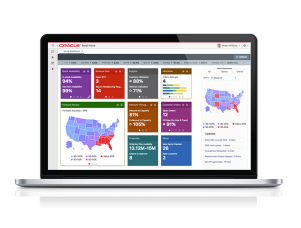
Oracle Retail Home brings
together the most insightful data and applications per role in your retail
enterprise, with a sophisticated and flexible, yet simple, user experience.
Oracle Retail Cloud Services
and Business Agility
Oracle Retail Home is hosted
in the Oracle Cloud with the security features inherent to Oracle technology
and a robust data center classification, providing significant uptime. The
Oracle Cloud team is responsible for installing, monitoring, patching, and
upgrading retail software.
Included in the service is
continuous technical support, access to software feature enhancements, hardware
upgrades, and disaster recovery. The Cloud Service model helps to free customer
IT resources from the need to perform these tasks, giving retailers greater
business agility to respond to changing technologies and to perform more
value-added tasks focused on business processes and innovation.
Oracle Retail Software Cloud
Service is acquired exclusively through a subscription service (SaaS) model.
This shifts funding from a capital investment in software to an operational
expense. Subscription-based pricing for retail applications offers flexibility
and cost effectiveness.
Client System Requirements
The following technology is
supported:
Browser Support
n
Mozilla
Firefox ESR 60+
n
Microsoft
Internet Explorer 11
n
Microsoft Edge
44+
n
Google Chrome
(Desktop) 73+
Enhancements
The enhancements below are included in this release.
Domain Removal
Domains are no longer created
and maintained in Retail Home; instead, configuration is done at the
application level.
|
Impact Any configuration you
specify at the domain level will be ignored - it must be specified by
application instead. There may be some impact to configuration steps. See the
Administration Guide for more information. |
Seed Known Applications
Retail Home now includes a
seeded list of known RGBU cloud applications, and provides a way to specify
URLs for these applications at configuration time.
Streamlined Configuration UI
The configuration UI has been
updated to reduce URL duplication in application, dashboard, and tile
configuration.
Retail Insights Support for
4/6 Metric Tiles
4/6 metric tiles on the
dashboard now support data coming from Retail Insights.
Dashboard Configuration from
PSRAF
Retail Home now supports
pulling Dashboard configurations from a connected application's PSRAF services.
This allows application teams to preload their JSON dashboard configurations
into their own RAF schema and have Retail Home pull that configuration when the
application is set up or refreshed in Retail Home.
|
Impact Older configuration
methods still work for now, but eventually application teams should package
configuration JSON to set up dashboards instead of using SQL scripts or other
configuration methods |
Convert Jetty Authenticator
to Directly Call IDCS
The Docker deployment of
Retail Home now calls IDCS directly instead of through the PSRAF identity
service. This is one step toward removing Retail Home's dependency on an
external PSRAF instance.
|
Impact A wallet containing
IDCS credentials must be provided to the Retail Home container at startup
time. |
Totals Chart to Support
Negative Data
The totals chart in Retail
Home dashboard tiles now handles negative data input gracefully.
Bug Fixes
n
Login issues
caused by a "headers too large" error in Retail Home's Docker
deployment have been fixed.
n
When
publishing Application Navigator changes, Retail Home now removes duplicate App
Navigator entries it had previously created.
n
Retail Home
now displays the correct error message when stale data errors are encountered.
n
Various UI
layout issues have been fixed.
Known Issues
The known issues described
below remain in this release.
|
Table
1 Known Issues |
|
|
Known Issue/Defect |
Defect Number |
|
The Docker container
deployment of Retail Home is not compatible with GBUCS 1.0 environments, as
these environments do not use IDCS for authentication, which is required by
the Retail Home Docker container. |
N/A |
|
In some cases when stale
data is encountered from a platform services call, the error message is still
incorrect in the Retail Home UI. This will be fixed in a future release of
platform services. |
N/A |
Related Documentation
For more information, see the
following documents in the Oracle Retail Home documentation set:
n
Oracle Retail Home User Guide
n
Oracle Retail Home Administration Guide
n
Oracle Retail Home Security Guide
Documentation Accessibility
For information about
Oracle's commitment to accessibility, visit the Oracle Accessibility Program
website at http://www.oracle.com/pls/topic/lookup?ctx=acc&id=docacc.
Access to Oracle Support
Oracle customers that have
purchased support have access to electronic support through My Oracle Support.
For information, visit http://www.oracle.com/pls/topic/lookup?ctx=acc&id=info or visit http://www.oracle.com/pls/topic/lookup?ctx=acc&id=trs if you are hearing impaired.
Oracle Retail Home
Release Notes, Release 19.0.001.1
F29919-01
Copyright © 2020,
Oracle and/or its affiliates. All rights reserved.
This software and
related documentation are provided under a license agreement containing
restrictions on use and disclosure and are protected by intellectual property
laws. Except as expressly permitted in your license agreement or allowed by
law, you may not use, copy, reproduce, translate, broadcast, modify, license,
transmit, distribute, exhibit, perform, publish, or display any part, in any
form, or by any means. Reverse engineering, disassembly, or decompilation of
this software, unless required by law for interoperability, is prohibited.
The information
contained herein is subject to change without notice and is not warranted to be
error-free. If you find any errors, please report them to us in writing.
If this is software or
related documentation that is delivered to the U.S. Government or anyone
licensing it on behalf of the U.S. Government, then the following notice is
applicable:
U.S. GOVERNMENT END
USERS: Oracle programs, including any operating system, integrated software,
any programs installed on the hardware, and/or documentation, delivered to U.S.
Government end users are "commercial computer software" pursuant to
the applicable Federal Acquisition Regulation and agency-specific supplemental
regulations. As such, use, duplication, disclosure, modification, and
adaptation of the programs, including any operating system, integrated
software, any programs installed on the hardware, and/or documentation, shall
be subject to license terms and license restrictions applicable to the
programs. No other rights are granted to the U.S. Government.
This software or
hardware is developed for general use in a variety of information management
applications. It is not developed or intended for use in any inherently
dangerous applications, including applications that may create a risk of
personal injury. If you use this software or hardware in dangerous
applications, then you shall be responsible to take all appropriate fail-safe,
backup, redundancy, and other measures to ensure its safe use. Oracle
Corporation and its affiliates disclaim any liability for any damages caused by
use of this software or hardware in dangerous applications.
Oracle and Java are
registered trademarks of Oracle and/or its affiliates. Other names may be
trademarks of their respective owners.
Intel and Intel Xeon
are trademarks or registered trademarks of Intel Corporation. All SPARC
trademarks are used under license and are trademarks or registered trademarks
of SPARC International, Inc. AMD, Opteron, the AMD logo, and the AMD Opteron
logo are trademarks or registered trademarks of Advanced Micro Devices. UNIX is
a registered trademark of The Open Group.
This software or
hardware and documentation may provide access to or information about content,
products, and services from third parties. Oracle Corporation and its
affiliates are not responsible for and expressly disclaim all warranties of any
kind with respect to third-party content, products, and services unless
otherwise set forth in an applicable agreement between you and Oracle. Oracle
Corporation and its affiliates will not be responsible for any loss, costs, or
damages incurred due to your access to or use of third-party content, products,
or services, except as set forth in an applicable agreement between you and
Oracle.
Licensing
Note: This media pack includes
a Restricted Use license for Oracle Retail Predictive Application Server (RPAS)
- Enterprise Engine to support Oracle® Retail Analytic Parameter Calculator for
Regular Price Optimization only.
Value-Added
Reseller (VAR) Language
Oracle
Retail VAR Applications
The following
restrictions and provisions only apply to the programs referred to in this
section and licensed to you. You acknowledge that the programs may contain
third party software (VAR applications) licensed to Oracle. Depending upon your
product and its version number, the VAR applications may include:
(i) the MicroStrategy Components developed and licensed by
MicroStrategy Services Corporation (MicroStrategy) of McLean, Virginia to
Oracle and imbedded in the MicroStrategy for Oracle Retail Data Warehouse and
MicroStrategy for Oracle Retail Planning & Optimization applications.
(ii) the Wavelink component developed and licensed by Wavelink
Corporation (Wavelink) of Kirkland, Washington, to Oracle and imbedded in
Oracle Retail Mobile Store Inventory Management.
(iii) the software
component known as Access Via™ licensed by Access Via
of Seattle, Washington, and imbedded in Oracle Retail Signs and Oracle Retail
Labels and Tags.
(iv) the software
component known as Adobe Flex™ licensed by Adobe
Systems Incorporated of San Jose, California, and imbedded in Oracle Retail
Promotion Planning & Optimization application.
You acknowledge and
confirm that Oracle grants you use of only the object code of the VAR
Applications. Oracle will not deliver source code to the VAR Applications to
you. Notwithstanding any other term or condition of the agreement and this
ordering document, you shall not cause or permit alteration of any VAR
Applications. For purposes of this section, “alteration” refers to all
alterations, translations, upgrades, enhancements, customizations or
modifications of all or any portion of the VAR Applications including all
reconfigurations, reassembly or reverse assembly, re-engineering or reverse
engineering and recompilations or reverse compilations of the VAR Applications
or any derivatives of the VAR Applications. You acknowledge that it shall be a
breach of the agreement to utilize the relationship, and/or confidential
information of the VAR Applications for purposes of competitive discovery.
The VAR Applications
contain trade secrets of Oracle and Oracle's licensors and Customer shall not
attempt, cause, or permit the alteration, decompilation, reverse engineering,
disassembly or other reduction of the VAR Applications to a human perceivable
form. Oracle reserves the right to replace, with functional equivalent
software, any of the VAR Applications in future releases of the applicable
program.