This appendix gives you information on functionalities in ALM for Interest Rate Risk in the Banking Book (IRRBB ) regulation.
IRRBB refers to the current or prospective risk to the bank’s capital and earnings a rising from adverse movements in interest rates that affect the bank’s banking book positions. When interest rates change, the present value and timing of future cash flows change. This in turn changes the underlying value of a bank’s assets, liabilities, and off-balance sheet items and hence its economic value. Changes in interest rates also affect a bank’s earnings by altering interest rate sensitive income and expenses, affecting its net interest income (NII). Excessive IRRBB can pose a significant threat to a bank’s current capital base and/or future earnings if not managed appropriately.
Basel Committee on Banking Supervision (BCBS) has prescribed 12 updated principles to banks to manage IRRBB.
The following three main sub-types of IRRBB are defined for these Principles:
1. Gap risk arises from the term structure of banking book instruments, and describes the risk arising from the timing of instruments’ rate changes. The extent of gap risk depends on whether changes to the term structure of interest rates occur consistently across the yield curve (parallel risk) or differentially by period (non-parallel risk).
2. Basis risk describes the impact of relative changes in interest rates for financial instruments that have similar tenors but are priced using different interest rate indices.
3. Option risk arises from option derivative positions or from optional elements embedded in a bank’s assets, liabilities, and/or off-balance sheet items, where the bank or its customer can alter the level and timing of their cash flows. Option risk can be further characteriszed into automatic option risk and behavioral option risk..
All three sub-types of IRRBB potentially change the price/value or earnings/costs of interest-rate-sensitive assets, liabilities, and/or off-balance sheet items in a way, or at a time, that can adversely affect a bank’s financial condition.
BCBS has proposed a standardized approach that supervisor could mandate their banks to follow or a bank could choose to adopt it. The following functionalities have been added to ALM to meet the standardized approach requirements and also enable banks to adopt the advanced approach.
This section discusses the details for IRRBB approach in OFS ALM.
In the standardized approach, interest rate-sensitive banking book positions are allocated to one of the following categories. These categories are used to determine the slotting of cash flows:
· Amenable to standardization
· Less amenable to standardization
· Not amenable to standardization
ALM provides the following to meet these requirements:
· Simple seeded Product Amenability Category dimension.
· The Amenability Category attribute of product dimension is populated in processing (FSI_D) tables for each account so that it can be used in the data filter and conditional assumption.
In the standardized approach non-maturing deposits (NMDs) must be segmented into retail and wholesale categories:
· Wholesale:
Deposits from legal entities, sole proprietorships, or partnerships are captured in wholesale deposit categories.
· Retail:
Retail deposits are defined as deposits placed with a bank by a person.
Deposits made by small business customers and managed as retail exposures are considered as having similar interest rate risk characteristics to retail accounts. These are treated as retail deposits (provided the total aggregated liabilities raised from one small business customer is less than 1 million).
Retail Non-maturing deposits can be further classified into the following categories:
· Transactional:
Retail deposits are considered as held in a transactional account when regular transactions are carried out in that account (such as, when salaries are regularly credited) or when the deposit is non-interest bearing.
· Non-transactional:
Other retail deposits are considered as held in a non-transactional account.
ALM provides the following to meet these requirements:
· Simple Customer Type dimension and attribute.
· The Retail-Wholesale Flag and Transactional Account Flag attributes for checking and savings account (CASA) and ALM account summary:
§ Retail-Wholesale Flag has two values:
R = Retail
W = Wholesale
§ Transactional Account Flag has two values:
Y = Transactional
N = Non transactional
These attributes can be used in conditional assumptions and data filters.
This is used to calculate the Market Valuation (MV) for certain embedded and stand-alone (bare) options. Supported embedded options are Calls, Puts, Caps (caplets), and Floors (floorlets). This option will be enabled only if Market Value, YTM, Duration, DV01/PV01 option is also selected.
Term deposits may be subject to the risk of early withdrawal, also called early redemption risk. To assess this risk and take appropriate action you must be able to identify term deposits where the depositor has no legal right to withdraw before maturity. If the depositor can legally withdraw before maturity then you must be able to identify that so early withdrawals are not resulting in a significant financial loss to the depositor. Penalties normally do not reflect such an economic calculation but instead are mostly based on a simpler formula such as a percentage of accrued interest. In such cases, there is potential for changes to profit or loss arising from differences between the penalty charged and the actual economic cost of early withdrawal. It is not possible to have a standard number that would mean significant financial loss. It is left to the bank to decide what is significant or insignificant..
To address this, the following attributes are available in the FSI_D_TERM_DEPOSITS and FCT_COMMON_ACCOUNT_SUMMARY tables:
· Early redemption permitted flag: This indicates whether the customer as the legal right to withdraw term deposit before maturity or not. This will have two values:
§ Y = Early redemption is permitted
§ N = Early redemption is not permitted
· Significant early withdrawal penalty flag: This indicates whether early withdrawal leads to significant financial loss to customer or not. This will have two values:
§ Y = Significant penalty
§ N = Non-significant or no penalty
IRRBB framework applies to large internationally active banks on a consolidated basis. To enable banks to identify internal and external contracts for consolidation purpose, ALM provides logic to classify each contract into the following categories based on legal entity and customer:
· Intra: If the customer is part of legal entity hierarchy and is a child or descendent of legal entity of account.
· Inter-company: If the customer is part of legal entity hierarchy and is not a child or descendent of legal entity of account.
· External: All other contracts.
A simple dimension Customer Affiliate Category is available, which has the following three seeded values:
· EXTERNAL
· INTRACO
· INTERCO
The Customer Affiliate Category attribute is available in all instrument tables (FSI_D) and FCT_ALM_ACCOUNT_SUMMARY tables. These tableshave values 1, 2, or 3 and will be populated by T2T when data moves from staging to processing. The attribute can be used in conditional assumption and data filter wherever applicable in the application.
The Customer ID attribute in Legal Entity (LE) Dimension is used to identify the customer ID of a legal entity that is used to book contracts in the source system.
The Behavior Pattern Loader allows you to enable automatic load of behavior patterns into ALM, which moves the data from model output to ALM. This is required to distinguish between the stable and the non-stable parts of each non maturing deposit category.
For more information, see the Behavior Pattern Loader section in the Data Model Utilities guide.
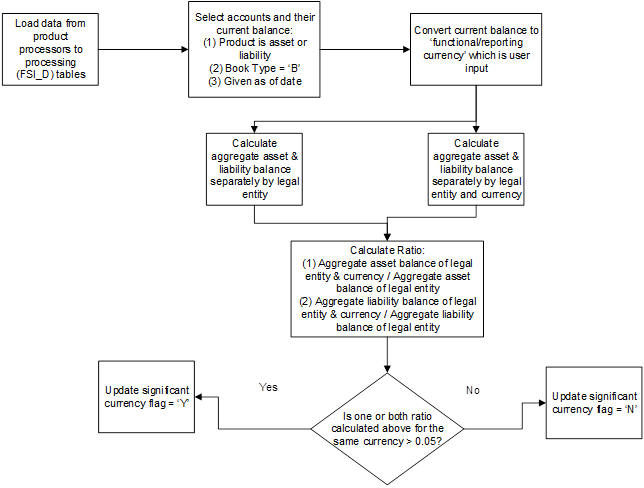
In the standardized approach, the loss in the economic value of equity is calculated for each currency with material exposures. Material exposure is defined as accounting for more than 5% of either banking book assets or liabilities."
ALM provides the following to meet this requirement:
1. Identify Banking Book assets and liabilities: For this, the Book Type Indicator attribute is provided in all instrument tables (FSI_D) and FCT_ALM_ACCOUNT_SUMMARY to identify the banking book asset and liability. This attribute has the following three values and will be populated by T2T when data moves from stage to processing:
§ ‘B’ for banking book
§ ‘T’ for trading book
§ ‘O’ for others
This attribute can be used in conditional assumption and data filter wherever applicable in ALM.
The attribute is also available in aggregate tables used by the stratification engine.
2. Aggregate Banking Book assets and liabilities for each legal entity.
3. Aggregate Banking Book assets and liabilities for each legal entity and currency.
4. Calculate the ratio of numbers obtained in steps 2 and 3. For more details, see the below flowchart. If the ratio is more than 5%, then that currency is marked as ‘currency with material exposure’ for that legal entity.
Perform this calculation for each As of Date.
Flowchart
Description of Flowchart for Calculation as follows
Products with following account types are considered as asset:
· Earning Asset (100)
· Other Asset (200)
· Off-balance Sheet (800) and leg type is ‘receivable’ (2)
· Off-balance Sheet Receivable (110)
Products with the following account types are considered as liability:
· Interest bearing liabilities (300)
· Other Liabilities (400)
· Off-balance Sheet (800) and leg type is ‘payable’ (1)
· Off-balance Sheet Payable (310)