This section describes the steps that you must follow to define and execute the end-to-end Hedge Management Process. Oracle Hedge Management is based on the Oracle Financial Services Analytical Applications Infrastructure (OFSAAI). OFSAAI is the central, integrated data source and Administration layer on which Oracle Financial Services Analytical Applications (OFSAA) are built. This description of the Oracle Hedge Management Process assumes that your system administrator has setup the OFSAAI data repository and has populated it with your enterprise-wide business data.
Topics:
Oracle Financial Services Hedge Management and IFRS Valuations feature the ability for users to classify a financial instrument into any one of the prescribed valuation categories and to reclassify as another on an as-needed basis in the future. The application supports the calculation of Effective Interest Rate (EIR) to amortize the premium or discount and additional fees related to the financial instrument. The solution also supports the fair valuation of on- and off-balance sheet financial instruments using a time-tested cash flow engine, common among other Oracle Financial Services Analytical Applications (OFSAA).
Topics
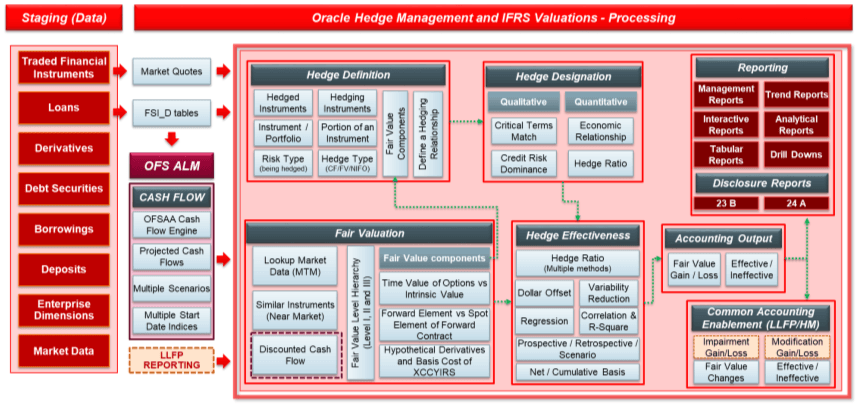
The following diagram depicts the architecture of the OFS HM application.
Figure 2: The OFS HM Application Architecture
IFRS 9 requires a fair value measurement to be categorized within the three levels of the fair value hierarchy for disclosure purposes. The categorization within the fair value hierarchy is based on the inputs to valuation techniques used to measure the fair value. In principle, the observability and market activity determine the categorization of an input. IFRS 13 notes that valuation techniques should maximize the use of observable inputs and minimize the use of unobservable inputs.
Financial instruments are grouped into the following three levels, according to the IFRS 13 guidelines:
· Level 1: Unadjusted quoted prices in active markets for identical assets and liabilities that the entity can access at the measurement date.
For example:
§ Financial instruments (shares, exchange-traded options, futures contracts, and so on) traded on active markets.
§ Commodities (corn, soybeans, crude oil, gold, silver, and so on) traded on active markets.
· Level 2: Other observable inputs not included within Level 1 of the fair value hierarchy.
For example:
§ Recently observed prices in markets that are not active (quoted prices in inactive markets).
§ Quoted prices for similar assets or liabilities in active markets (inputs derived from yield curves when observable at commonly quoted intervals).
§ The unadjusted price per square meter for a building derived from observable market data (prices derived from observed transactions involving comparable buildings in similar locations).
· Level 3: Unobservable inputs for the asset or liability.
For example:
§ Credit spread calculated using unobservable internal data.
§ Management's cash flow projections (future revenue level and other financial forecasts).
§ Adjustments to the price per square meter for similar buildings derived from observable market data (adjustments reflecting differences in physical conditions and location of the properties).
For more information on HM Valuations, see the HM Valuations Processing chapter.
Hedge Effectiveness testing consists of four criteria. Effectiveness testing is triggered by selecting the appropriate fair value definition run and the required date.
For a hedge to be effective, each of the three or four parameters based on the user selection has to be effective. If anyone of the parameter is ineffective, then the entire hedge is ineffective.
This section describes the user roles present in the Risk Management Cell of a financial institution with their responsibilities and rights for multiple tasks or UIs to ensure security.
Topics
HM Admin has the following rights and responsibilities:
· Delegates the responsibility of configuration of the HM application, definition, and maintenance of the standard business rules.
· Setting up the HM application in a functional manner.
· Works as a business user with the System Administrator in carrying out certain tasks.
· HM Admin sets the standard definitions for various preferences. These definitions are used in the HM Process.
HM Analyst has the following rights and responsibilities:
· Maintains some or all of the assumptions within the HM application.
· Uses the application to make the changes in assumptions on an ongoing business.
· Maintains the HM application on a routine basis, this includes defining or modifying new or existing assumptions for classification or reclassification, and so on.
An HM Auditor can view definitions in the Read-Only mode.