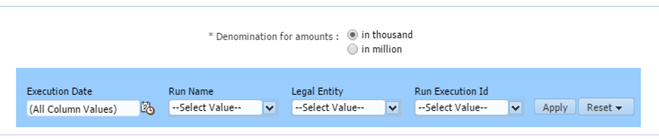
The OFS LLFP application uses the Oracle Dashboard reporting tool for generating the CECL reports. The reports are in graphical and tabular form. The reports are generated by using the following filters:
Figure 110: The Dashboard Filters
· Execution Date: It refers to the FIC_MIS_DATE on which the run was executed.
· Run Name: This is the name of the Run. When you select this filter, only those runs that fall under the execution date that you selected in the Execution Date field appear in the drop-down menu.
· Legal Entity: This is the legal entity that corresponds to the run that you selected in the Run Name field.
Run Execution Id: This is the run execution ID of the run that you selected in the Run Name field.
This section provides a summary of the different CECL reports and dashboards available in the application. All the reports are segregated in the following dashboards:
· Troubled Debt Restructured (TDR) Accounts
· PD Term Structure and Loss Rate
· AFS
· Reinsurance Claims Outstanding versus ACL Report
This section details the Disclosure reports. It includes the Disclosure by Vintage – Report 1, Disclosure by Vintage – Report 2, Disclosure by Vintage – Report 3, and Disclosure by Vintage – Report 4 reports.
NOTE:
You can select Check Bod adjacent to the TDR Status field to include or exclude Troubled Debt Restructured accounts.
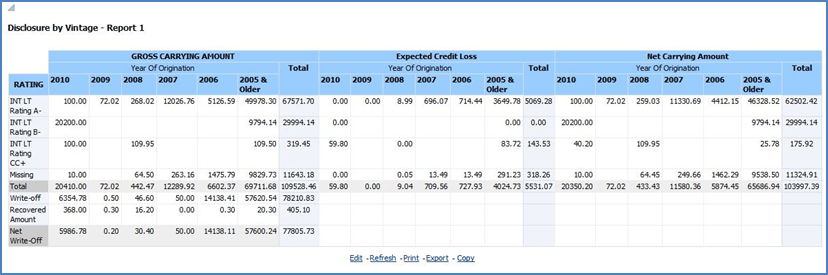
This report displays the Gross Carrying Amount, ECL Amount, and Net Carrying Amount for a particular rating grade across different years of origination. The last two rows provide the recovery amount and the net write-off across different years of origination.
Figure 110: The Disclosure by Vintage – Report 1 Report
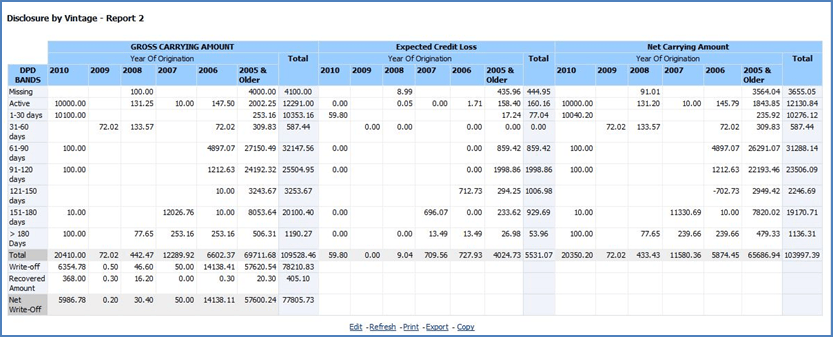
This report displays the Gross Carrying Amount, ECL Amount, and Net Carrying Amount for a particular Days Past Due bucket across different years of origination. The last two rows provide the recovery amount and the net write-off across different years of origination.
Figure 111: The Disclosure by Vintage – Report 2 Report
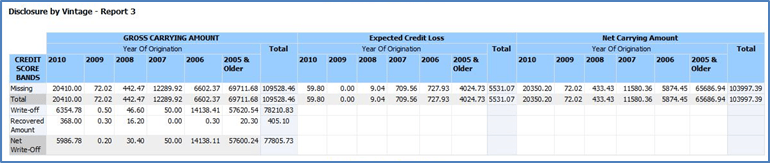
This report displays the Gross Carrying Amount, ECL Amount, and Net Carrying Amount for a particular Credit Score Band across different years of origination. The last two rows provide the recovery amount and the net write-off across different years of origination.
Figure 112: The Disclosure by Vintage – Report 3 Report
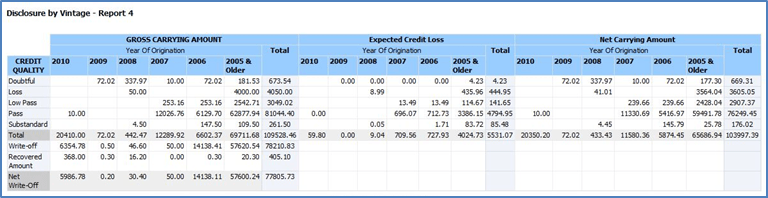
This report displays the Gross Carrying Amount, ECL Amount, and Net Carrying Amount for a particular Credit Quality Status across different years of origination. The last two rows provide the recovery amount and the net write-off across different years of origination.
Figure 113: The Disclosure by Vintage – Report 4 Report
This section details the Vintage Report reports. It includes the Expected Credit Loss Based on Origination Year and Allowance and Provision reports.
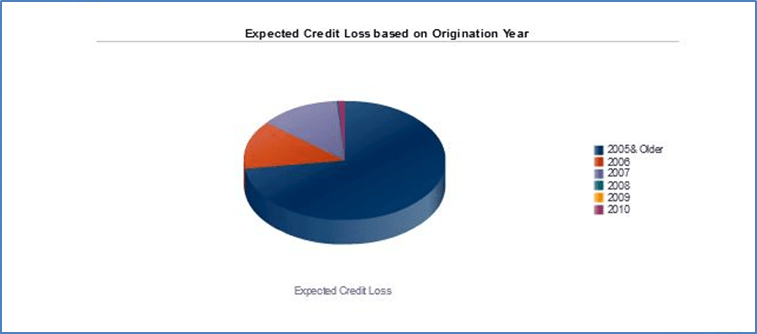
This report displays the Expected Credit Loss (ECL) percentage contribution of a particular year of origination to the cumulative ECL, the total for all the years of origination.
Figure 114: The Vintage Report – Expected Credit Loss Based on Origination Year Report
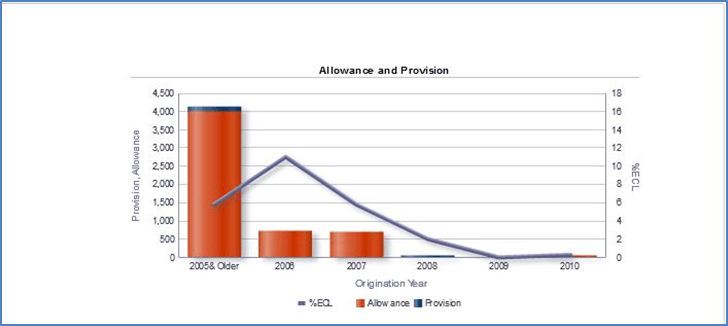
This report displays the trend of provisions and allowance for different years of origination.
Figure 115: The Vintage Report – Allowance and Provision Report
This section details the Expected Credit Loss reports. It includes the EXPECTED CREDIT LOSS, EXPECTED CREDIT LOSS, WRITE-OFFs, and RECOVERIES, and TREND REPORTS reports.
NOTE:
You can select Check Bod adjacent to the TDR Status field to include or exclude Troubled Debt Restructured accounts.
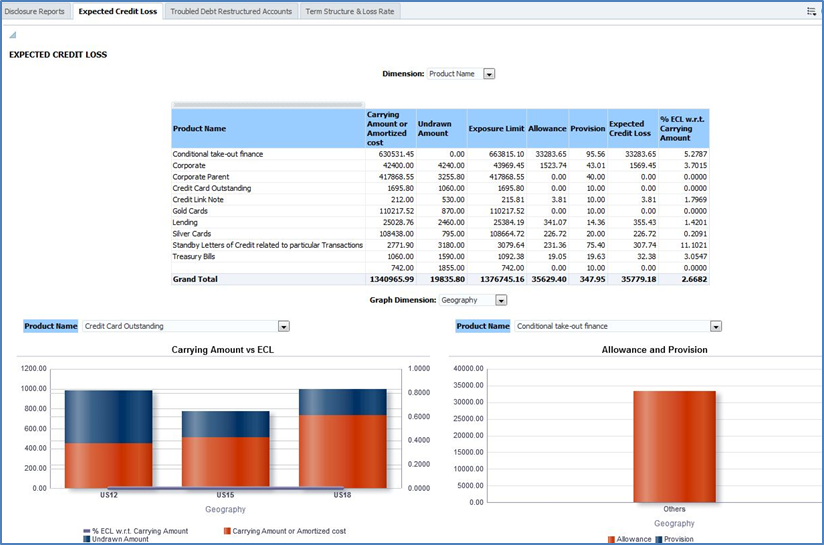
This report displays ECL, Ratio of ECL to Carrying Amount, Provision and Allowance amounts for various dimensions like Products, Geography, and Industry, and so on.
Figure 116: The Expected Credit Loss Report
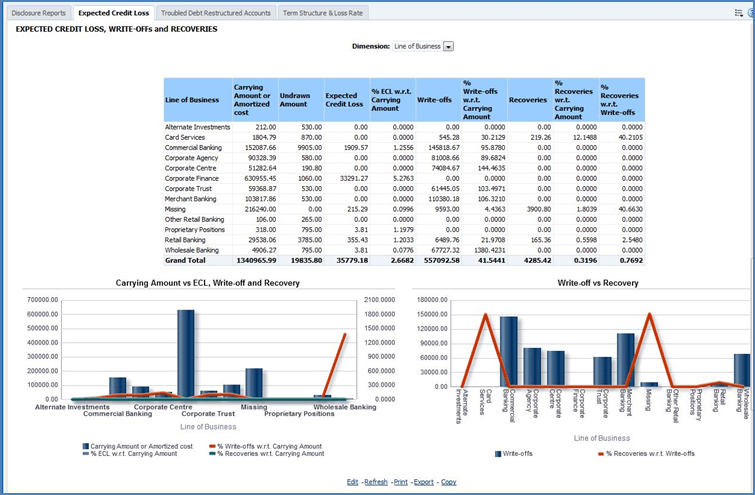
This report displays the ECL, Write Off amount, Recovery, and the corresponding ratios to the Carrying amount across different dimensions like Line of Business, Product Type, and so on. There are additional charts that describe the relationship between the Carrying Amount versus ECL, Write-off, and Recovery and Write-off versus Recovery, across different dimensions.
Figure 117: The EXPECTED CREDIT LOSS, WRITE-OFFs, and RECOVERIES Report
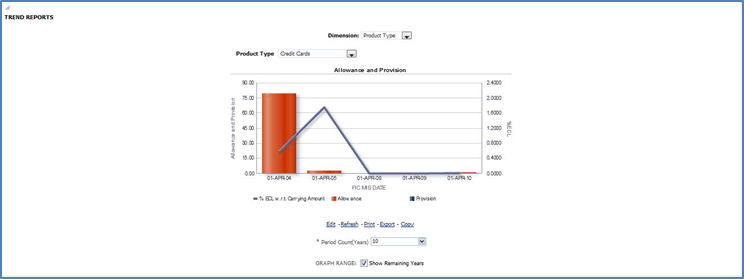
This report displays the trend of Allowance, Provision, and Ratio of ECL to Carrying amount over a period across different dimensions.
Figure 118: The TREND REPORTS Report
This section details the Troubled Debt Restructure (TDR) Accounts report. It includes the TDR report.
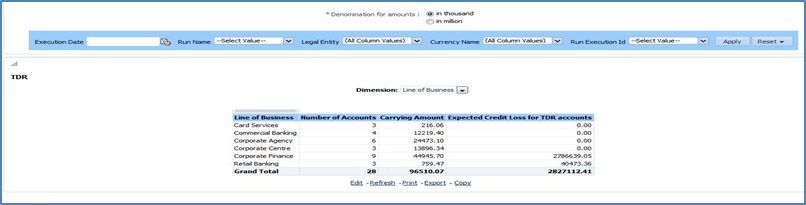
This report displays an overview of the restructured portfolio across different dimensions. Each row in the report provides the total number of TDR accounts and the ECL amount for these TDR accounts for a particular dimension.
Figure 119: The TDR Report
This section details the PD Term Structure and Loss Rate reports. It includes the Historic Periodic Loss rate and PD TERM STRUCTURE reports.
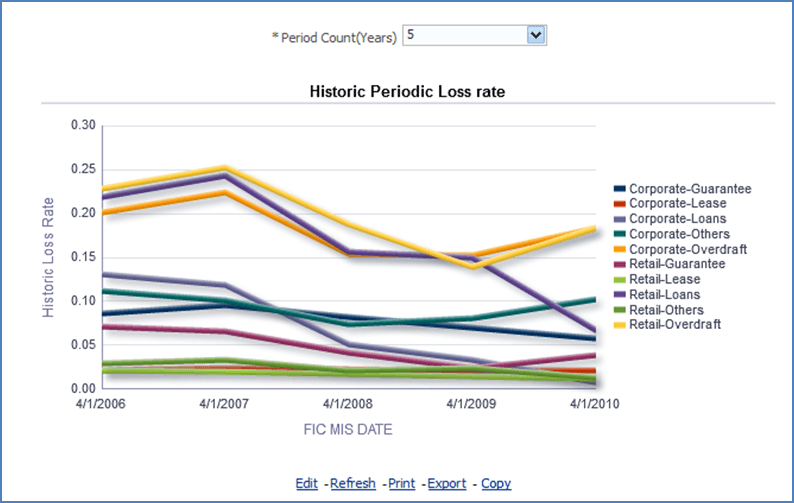
This report displays the trend of the historical loss rate over a period of time across different dimensions.
Figure 120: The Historic Periodic Loss Rate Report
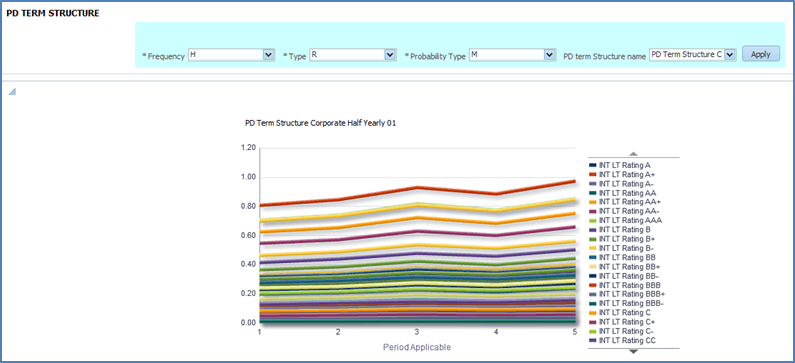
This report displays various probabilities of default curves based on a selected portfolio and time horizon. A single line chart, a single PD curve, plots the PD for each period over the selected horizon for the selected portfolio.
Figure 121: The PD Term Structure Report
The TDR Trend report provides you the Troubled Debt Restructuring reports for the amortized carrying amount.
This report lists the Premodification Outstanding Amortized Carrying Amount and Postmodification Outstanding Amortized Carrying Amount for all the accounts in various Product Types.
This report lists the Amortized Carrying Amount for all the accounts in various Product Types.
This section details the Roll Forward reports. It includes the Roll Forward and Roll Forward with Q&E Adj reports.
This report displays Beginning ECL, Current Period ECL, Initial ACL on PCD, Write-off, Recoveries, and Ending Balance ECL details of Various Product Types.
This report displays the Available for Sale and Held to Maturity details of Beginning ECL, Incremental ECL, Incremental ACL on PCD, Write-off, Recoveries, and Ending Balance ECL for various Segments.
This report is further drilled-down to display the details such as Beginning ECL, Beginning ECL Reserve Adjustments, Total Beginning ECL, Incremental ECL, Incremental ACL on PCD, Write-off, Recoveries, Change in Reserve Adjustments, Total Ending ECL, Ending Balance ECL, Ending ECL Reserve Adjustments, and Total Ending ECL.
This section details the Non-Accrual report.
This report displays the Amortized Cost at the BOP, Interest Income, Amortized cost of assets in financial difficulty and Non-Accruing, and Amortized Cost at the EOP for various Product Types.
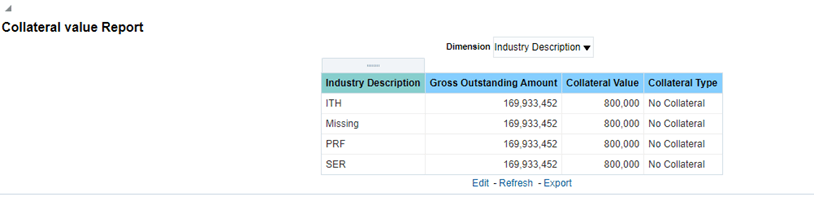
This section details the Collateral Dependent Assets report. It includes the Collateral Value report.
This report displays the Gross Outstanding Amount, Collateral Value, and Collateral Type of various Product Types.
Figure 122: The Collateral value Report
This section details the AFS report. It includes the AFS Debt Securities report.
This report displays the Amortized Cost, Fair Value, Unrealized Losses (OCI), and Allowance for Credit Loss of various Product Types. You can generate reports for various combinations of Execution Date, Run Name, Legal Entity, Currency Name, and Run Execution ID
This section details the Reinsurance Claims Outstanding versus ACL reports. It includes the Reinsurance Claims Outstanding versus Allowance for Credit Loss (at the Reinsurers Rating level) and the Reinsurance Claims Outstanding versus Allowance for Credit Loss (at the Reinsurers level) reports.
This report displays the reinsurance claims outstanding versus the allowance for credit loss based on the reinsurer's rating level. You can select two different dates to get this report. The values in the table are aggregated based on the rating of the reporting dates.
This report displays the reinsurance claims outstanding versus the allowance for credit loss based on the reinsurer level. You can view the rating, claim outstanding, and allowance for the credit loss of the reinsurer for two different reporting dates.