Regulatory reports make use of data available across several
fact tables in the OFSAA data foundation model and these result tables
are either loaded from the raw data sourced from source systems via out
of the box T2Ts or processed data output from various OFSAA applications.
For example, FACT FTP Account Summary and FACT REG FTP Account Summary
which stores account level measures computed by FTP application.
FACT FTP Account Summary table needs to be populated manually if OFS FTP
application is not available.
APRA/MAS/HKMA/RBI provides a PMF Run that can be executed to populate FACT
REG FTP Account Summary from FACT FTP Account Summary.
For more information, see APRA/MAS/HKMA/RBI RUN CHART.
From the OFSAA technical infrastructure standpoint, the mentioned options are available to the customer to design and implement the custom ETL process explained above. OFSAA strongly recommends the below options to maintain consistency in terms of data lineage in Metadata browser as the configured metadata can be made available in the meta-model via MDB publish:
· Data Integration Hub (DIH) Connectors
· Data Mapping (T2T) option in Application Infrastructure
· Data File Mapping (F2T) option in Application Infrastructure
Topics:
· Data File Mapping (Flat File to RDBMS Target - F2T)
If you have a licensed DIH to source the data from the external systems into OFSAA, a DIH connector is the recommended approach to load the data into results. The Source data could either reside in a relational structure or a file structure. The mappings maintained in DIH are logical and they abstract the physical references including the Dimensional lookups seamlessly without the need for any additional join or configuration.
See the Data Integration Hub (DIH) User Guide, for more information about loading the data into a result area table.
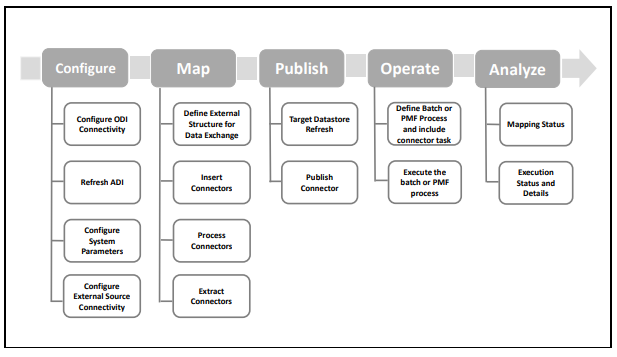
Figure 42: DIH Connectors
Data Mapping refers to the process of retrieving unstructured data from data sources for further data processing, storage, or migration. This feature is commonly known as RDBMS source to RDBMS target (T2T) framework in the OFSAA world and can be leveraged when source data is available in the Oracle database. Dimensional lookups must be handled via the T2T’s join condition and expressions. See Oracle Financial Services Advanced Analytical Applications Infrastructure Application Pack User Guide for more details on configuring a T2T.
If the source data is available in file structures, the OFSAA F2T component can be used to bring the data in the OFSAA ecosystem. As lookups cannot be configured in an F2T, this component must be used in conjunction with the T2T component, that is, data is first loaded from the file to an interim staging structure using the F2T component followed by data load to the target result area table using the T2T component. This is the least recommended approach as there is a need for interim table structure in the data model and involves multiple data hops that add to the overhead.
See the Oracle Financial Services Advanced Analytical Applications Infrastructure Application Pack User Guide on OHC for more details on configuring an F2T.