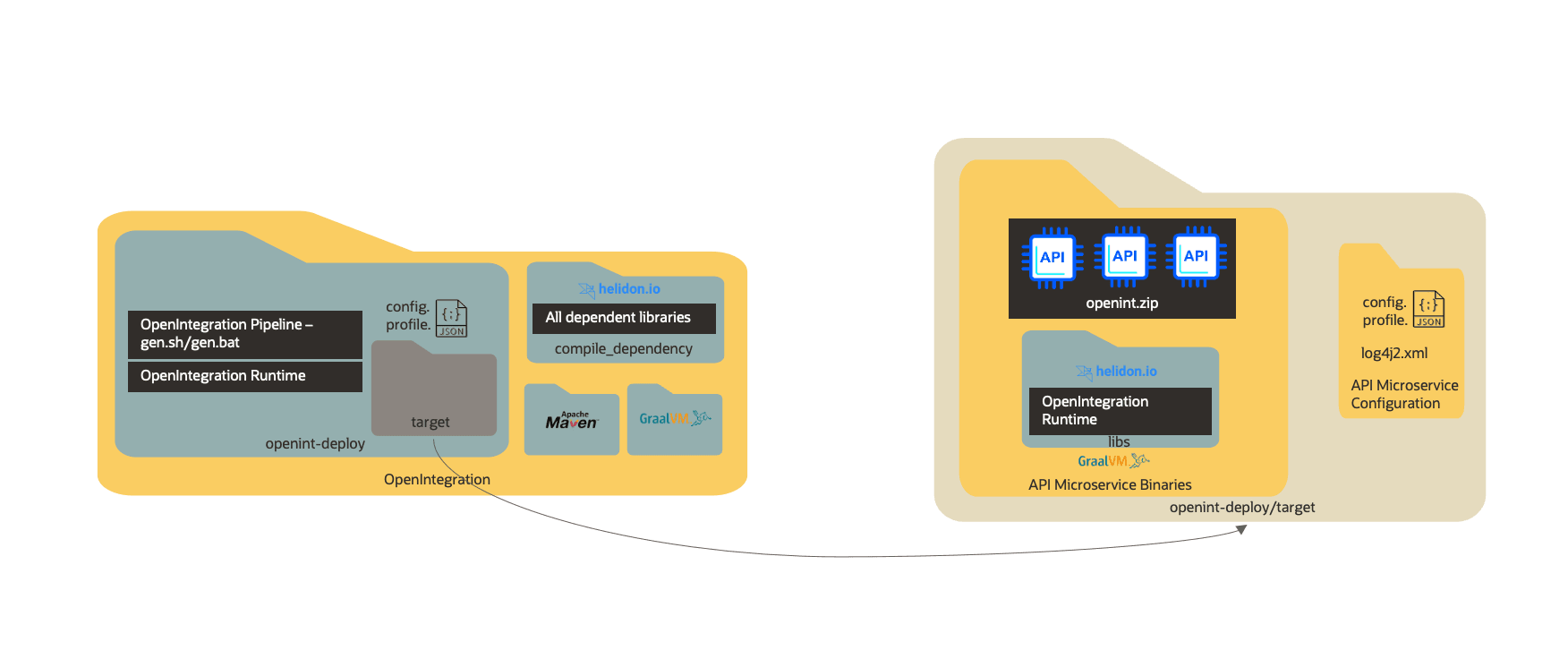
Design Time Flow and Description of Artefacts
Siebel Open Integration projects consist of below main artifacts.
- openint_deploy - This is the main project for openintegration. Configuration of
required artifacts, generation of source, generation of compiled target and
dependencies are present here.
- config.json - Configuration file of openintegration project. Section apigen.resources is used to provide artifacts to be exposed via REST needs to be provided in respective sections based on type (ui/data/service/workflow). Section app.siebel is used for configuring if a cloud gateway(CG) deployment is available, if not then provide profile.json path, connect-string and loginpath.
- profile.json - Configuration file of Siebel OpenIntegration project. Section server is used for configuration of port, provide keystore, keystore type. Section security is used for configuring OIDC, Perimeter, ABAC and encryption of the security details. Refer the Configuring Siebel Open Integration to review additional configuration in the profile.json
- gen.bat/sh - This starts the pipeline process to generate the executable
project in target folder.
- At the end of the pipeline execution, the 'Pipeline error summary' will be displayed on the console, so that user will know the pipeline executed with some errors if any. Users can review these errors and rectify any issues related to configuration of resources and failed OpenAPI fetches for a corresponding resource etc and re-run the pipeline. If there are no errors during pipeline execution, the summary displays success message.
- Only when there are any errors, the pipeline will create error.log in the current folder, that will have more information on the error occurred for the failed commands. If there are no errors, this error.log will not be present/created. This log file will be refreshed across every pipeline execution.
- At the end of every pipeline execution, the error-summary.log will be created in the current folder, that has an execution summary which will be displayed on the console. This file will be refreshed across every pipeline execution.
- This program accepts --start parameter. --start parameter is used to specify that after compilation and generation of target same needs to started in the system so that application is ready for accepting requests. The 'Pipeline error summary' will be displayed on the console at the end. The server startup logs will be redirected to server_output.log in the current folder. User can check the server_output.log file for the server startup and continuous console logs of the server.
- target
- libs - contains all the 3rd party runtime dependencies of the project
- logs - stores the log file
- config.json - config.json used/configured earlier is copied here and used
- profile.json - profile.json used/configured earlier is copied here and used
- log4j2.xml - log4j xml used for configuring log severity.
- openint.jar - executable generated from the design time pipeline process.
- start.bat/sh - used to start openint application
- compile_dependency - contains all compile and runtime dependencies of the project. These dependencies are downloaded and repository is maintained so that there is no need for any additional dependencies.
- apache-maven - build tool used for openintegration application.
- settings.xml.template - settings.xml.template file needs to be renamed to settings.xml.
- graalvm-jdk - GraalVM JDK bundled for compilation and for runtime execution.