7.3 Call Flow
The following image shows Account ID attached to MSISDN and IMSI value is not a part of this entry.
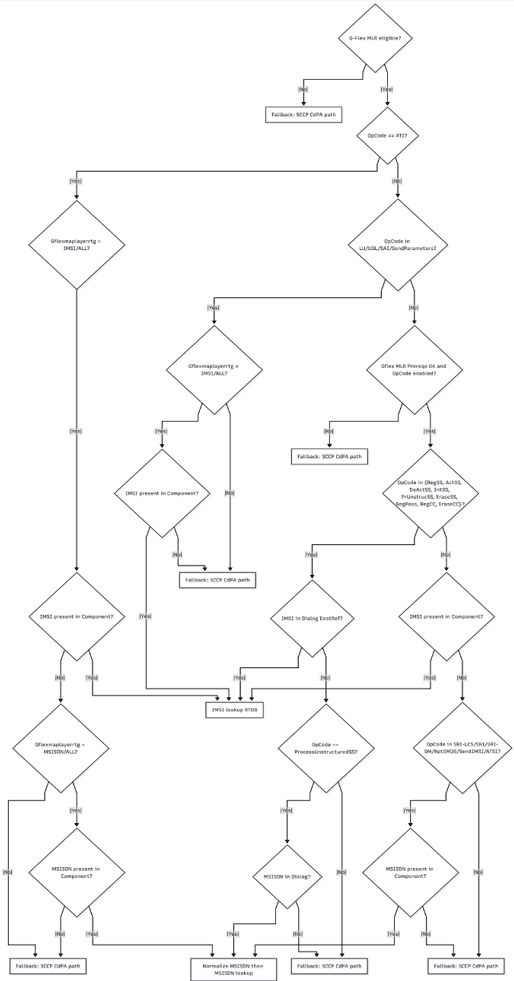
Figure 7-1 G-Flex Relay Flow Chart (MLR Functionality)
IMSI Verification for certain opcodes:
When the opcode is not RegSS, ActSS, DeActSS, IntSS, PrUnstrucSS, EraseSS, RegPass, RegCC, or EraseCC, the following opcodes are validated for IMSI in the component portion:
- purgeMS
- restoreData
- AuthenticationFailureReport
- sriLCS
- readyforSM
- sriGPRS
- failureReport
- statusReport
- istAlert
- beginSubActivity or
- noteMSF or GPRS
Fallback: SCCP CDPA Path in G-Flex Relay Feature Flow Chart (MLR Functionality) leads to exit 2 and the flow for this path is present in G-Flex Relay Feature Flow Chart - Modified.
When Original G-Flex Functionality Is Used: The MLR functionality within the context of the GSM Flexible Numbering Feature. G-Flex MLR functionality takes precedence over the original G-Flex functionality (entry at connection 1). The original G-Flex functionality is performed (exit to connection 2) when:
- The G-Flex MLR feature is not active.
- The received message does not include an operation of interest.
- The operation does not contain an IMSI parameter.
- The operation does not contain a valid MSISDN parameter.
- For messages with all opc codes supported.
- If GTI is TT_NUM_ENCODING_NATURE(4) and SCCP CdPA NP is present and is not equal to E.214, or GSMOPTS:MAPLYRRTGON option is not set for the Opcode. Otherwise, the RTDB will be searched, and the message will be modified according to the results of that search (exit to connection 3). The last criteria is a pre-requisite for G-Flex MLR for all opcodes except:
- anyTimeInterrogation
- updateLocation
- sendAuthenticationInfo
- updateGPRSLocation and
- sendParameters
- If GTI is TT_NUM_ENCODING_NATURE(4) and SCCP CdPA NP is present and is not equal to E.214, or GSMOPTS:MAPLYRRTGON option is not set for the Opcode. Otherwise, the RTDB will be searched, and the message will be modified according to the results of that search (exit to connection 3). The last criteria is a pre-requisite for G-Flex MLR for all opcodes except:
The following image shows the modified flowchart for GSM Flexible Numbering Feature. It has been modified from the original in the following ways:
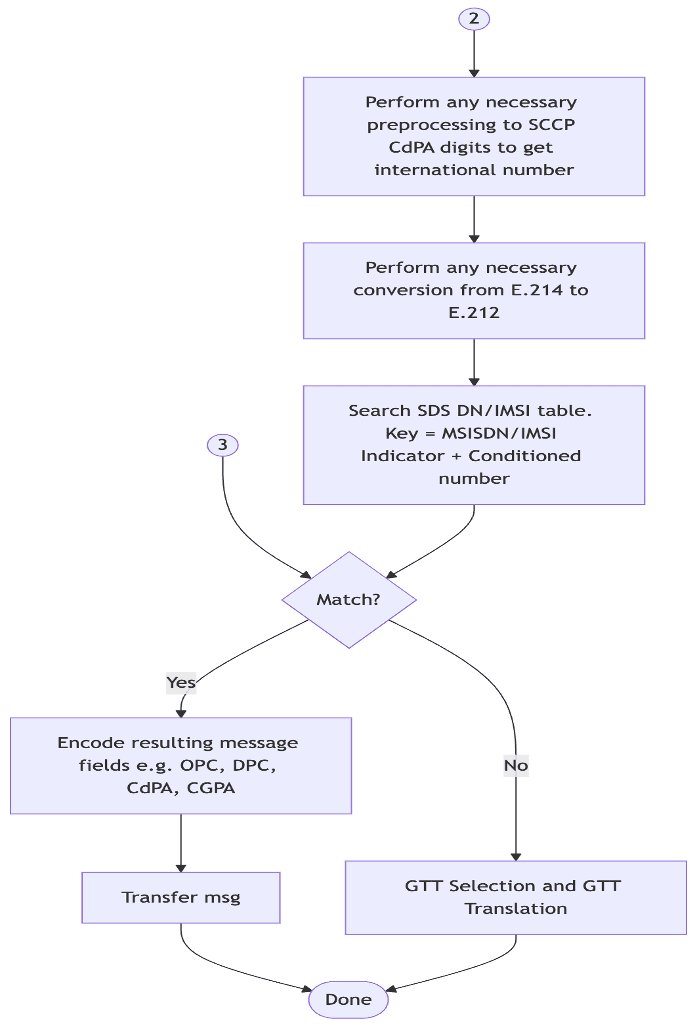
- The main connection point number has changed from 1 to 2 because the G-Flex MLR Functionality now takes precedence over the original G-Flex functionality.
- Connection 3 has been added to allow a message to be modified using SDS information in the same manner as it is for the original G-Flex functionality.
Figure 7-2 G-Flex Relay Feature Flow Chart - Modified