2.3 SDS Interaction with VSTP for HLR-Router
The HLR-Router feature in Virtual Signal Transfer Point (vSTP) retrieves information from the Subscriber Data Server (SDS) and uses them to route messages to SS7 network. It ensures SS7 messages reach the SS7 users with consistent accuracy and reliability.
2.3.1 Architecture Overview
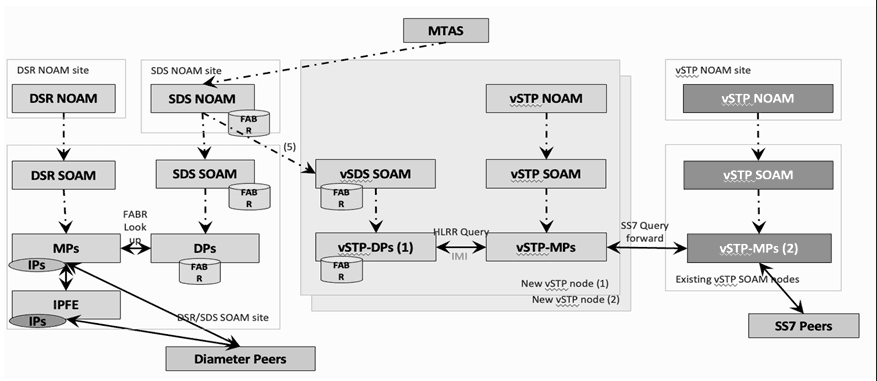
The architecture includes mated vSTP nodes that will be deployed on virtual servers, each vSTP node consists of the following components:
- vSTP NOAM (Network Operations, Administration, and Maintenance)
- vSTP SOAM (System Operations, Administration, and Maintenance)
- vSTP MPs (Message Processors)
- vSDS SOAM site (Subscriber Database Server System Operations, Administration, and Maintenance)
- vSTP-DPs (Data Processor)
Subscriber data is first loaded to the SDS NOAM and then automatically replicated to all SOAM and vSDS SOAM sites. When the network receives an SS7 message, the vSTP MP (Message Processor) checks the vSDS DP for the information. The vSDS DP looks for the routing information in its database and informs the vSTP MP where to send the message.
The enhancement allows vSTP to check SDS for subscriber information directly using MSISDN or IMSI (for destination type it is ImsHss). SDS sends back the Network Entity ID, which is then matched in a new reference table inside vSTP to get the full HLR details needed for routing.
Figure 2-3 Architecture
2.3.2 HLR-Router Functionality
This enhancement extends VSTP functionality to support integration with SDS, allowing it to query subscriber information (through MSISDN/IMSI) and obtain the required HLR details directly from SDS. The new capability specifically allows vSTP service to communicate with the SDS system, while other features remain integrated with SDS. SDS returns only the Network Entity ID of the HLR. To accommodate this, vSTP has introduced a new reference table that stores HLR metadata, including Network Entity ID, point code, SSN, and related parameters. When VSTP receives an SDS response, the returned Network Entity ID is mapped to this vSTP HLR table to resolve the complete HLR details for the given MSISDN/IMSI.
Key Points
- The measurement data of FABR and vSTP calls are same. No new measurements are added in SDS for vSTP calls.
- Both SDS sites operate independently, FABR traffic goes to the SDS SOAM site, while VSTP traffic goes to the vSDS SOAM site.
- For FABR, the comagent connection group is "DPSvcGroup", and for vSTP, it is "GflexSdsSvcGroup".
- For FABR, the routed service is "DPService", and for vSTP, it is "GflexSdsService".
- SDS shall support 80k MPS for VSTP traffic.
- Destination map table data is now replicated till C-level servers.