Overview
Learn key concepts about the Oracle AI Database@Azure service and resources in this section.
Oracle Exadata Database Machine is an integrated, preconfigured, and pretested full-stack platform for use in enterprise data centers. For Oracle AI Database@Azure, Oracle and Microsoft jointly identify Azure Regions based on customer demand and install Oracle Exadata infrastructure in selected Azure data centers. An Oracle Cloud Infrastructure (OCI) managed network is configured between Azure data centers and the nearest OCI region. When an Azure region begins offering Oracle AI Database@Azure, you can deploy Oracle Exadata Database Service on Dedicated Infrastructure or Oracle Autonomous AI Database using the Azure console.
To use the service, you configure it within your Azure subscription through a process referred to as onboarding. To begin onboard, contact your Oracle representative and request a Private Offer. After you agree on pricing, terms and conditions, you complete the purchase through Azure Marketplace. After the purchase is complete, you link your Azure subscription with an OCI tenancy. This is called multicloud linking.
One OCI tenancy can support multiple Oracle AI Database@Azure private offers and Azure subscriptions from the same Azure tenant. Each private offer has its own OCI subscription, base compartment, and generated IAM policies. The predefined OCI IAM groups are shared across the tenancy. Each Azure subscription can be associated with only one private offer. This capability does not extend to subscriptions from different Azure tenants.
After you complete onboarding, you can begin provisioning the Oracle AI Database@Azure system resources for Exadata Database Service on Dedicated Infrastructure and Autonomous AI Database Serverless. Provisioning starts with creating an Azure Virtual Network (VNet) with Delegated subnet and Exadata infrastructure. Based on your workloads and requirements, you then create either an Exadata VM cluster for the Oracle Exadata Database Service, or an Autonomous AI Database Serverless.
When your database resources are available, you establish a connectivity between your application VNet and the Oracle Database through a network construct called Delegated subnet. This enables a direct, secure, and low latency connection between applications and Oracle AI Database@Azure.
Architecture
The following diagram shows the Oracle AI Database@Azure architecture.
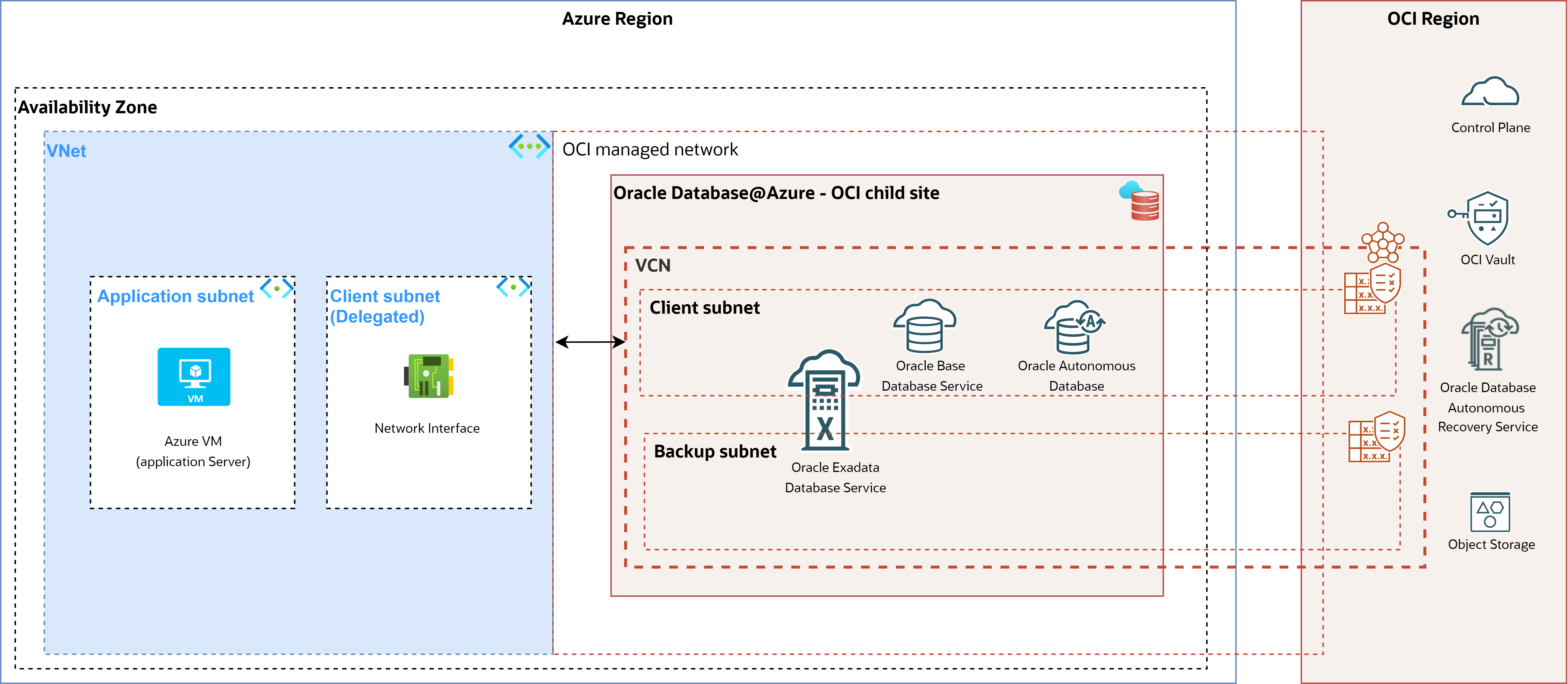
The key components of this architecture are the following:
- Azure Region: An Azure Region is a geographical area that has a cluster of data centers known as Availability Zones. Each region is isolated from other regions to ensure data sovereignty, fault tolerance, and low-latency performance for workloads deployed in that geographical area.
- Azure Availability Zone: An Azure Availability Zone (AZ) is a distinct, isolated location within an Azure Region, consisting of one or more data centers with redundant power, networking, and connectivity. AZs provide a highly available and fault-tolerant environment for your applications and services.
-
Azure Virtual Network and Subnet: An Azure Virtual Network (VNet) lets you launch Azure resources into a virtual network you've defined. This virtual network resembles a traditional network that you operate in your own data center, with the benefits of using the scalable infrastructure of Azure. After you create an VNet, you can add subnets.
A subnet is a range of IP addresses in your Azure VNet. You can create Azure resources, such as Azure VM instances, in specific subnets.
-
OCI Region (Parent Site): An OCI region is a geographic area that has one or more data centers known as availability domains. In the Oracle multicloud model, an OCI region connected to a paired Azure region is called a Parent Site. While OCI has regions worldwide, Oracle AI Database@Azure is available only in the regions discussed in Regional Availability.
Each OCI region operates independently of other regions, providing fault tolerance and disaster recovery capabilities. Each region consists of one or more availability domains. An OCI Availability domain (AD) is one or more data centers within an OCI region. In regions that have multiple ADs, the ADs are physically isolated from each other. They don't share infrastructure, power, cooling, or internal networking, so a failure in one AD is unlikely to affect other ADs in the same region.
- OCI Child Site: An OCI child site is a data center that extends an OCI Availability domain (AD) to an Availability Zone (AZ) in an Azure region. With the OCI child site model, the Exadata infrastructure used for Oracle AI Database@Azure physically resides in an Azure data center (an AZ within an Azure region), but is logically mapped to an OCI region and its network components.
- Delegated Subnet: A delegated subnet in Oracle AI Database@Azure is a specific Azure virtual network subnet that is assigned exclusively for the Oracle database service. Delegation allows Azure to grant the Oracle-managed service full control over the subnet, so the service can deploy and manage network resources inside it.
When deploying an Oracle AI Database@Azure resource, you must select a VNet and identify a delegated subnet that has been preconfigured for Oracle.Database delegation, ensuring secure and isolated connectivity for the database traffic. The Azure VNet and delegated subnet maps directly to the network that exists within the OCI child site and enables communication between Azure and OCI. In Oracle's multicloud architecture, the delegated subnet provides network connectivity for the OCI components that are part of the Oracle AI Database@Azure service.
- Oracle Exadata Infrastructure: Oracle Exadata infrastructure is a high-performance, integrated hardware and software platform designed for running Oracle Databases. Exadata is a pre-configured and pre-tested full-stack platform, meaning all the necessary hardware and software components are integrated and optimized to work together seamlessly.
Exadata features a scale-out architecture with database servers and intelligent storage servers that can be independently scaled to meet changing workload demands. Exadata storage servers go beyond traditional storage by having their own CPUs and specialized software that enable them to perform database operations such as SQL query processing close to the data. Exadata uses a high-bandwidth, low-latency network fabric (such as RDMA over Converged Ethernet or RoCE) to connect database servers and storage servers, ensuring rapid data access and transfer rates. In Oracle multicloud architecture, Exadata infrastructure is the underlying hardware for both Oracle Exadata Database Service and Oracle Autonomous AI Database.
- Oracle Exadata Database Service: Oracle Exadata Database Service on Dedicated Infrastructure lets you to leverage the power of Exadata in the cloud. The service delivers proven Oracle Database capabilities on purpose-built, optimized Oracle Exadata infrastructure in the public cloud. Built-in cloud automation, elastic resource scaling, security, and fast performance for all Oracle Database workloads helps you simplify management and reduce costs.
- Oracle Base Database Service: Oracle Base Database Service is a fully managed cloud solution that enables organizations to quickly deploy, manage, and scale Oracle databases in the cloud. It provides automated provisioning, patching, backups, and monitoring, freeing users from administrative overhead and allowing them to focus on application development and innovation. The service is designed for high performance, security, and seamless integration with other Cloud services, making it an ideal choice for both transactional and analytical workloads.
- Oracle Autonomous AI Database Serverless: Oracle Autonomous AI Database Serverless is a fully managed cloud database service that automatically handles provisioning, tuning, backups, patching, and scaling without any user intervention. It elastically scales compute and storage up or down based on workload demand, so you can only pay for what you use. Because it is serverless, there is no need to manage underlying infrastructure - the service transparently optimizes performance, availability, and security.
- OCI Virtual Cloud Network (VCN) and Subnet: A Virtual Cloud Network (VCN) is a customizable, private network that you set up in an OCI tenancy within a specified Oracle Region. It provides a secure and scalable network environment where you can deploy and manage your OCI resources, such as compute instances, databases, and storage.
A VCN acts as a virtualized version of a traditional network, including key components like subnets, route tables, and gateways. VCNs let you to isolate and segment your cloud resources within logically separated networks, enhancing security and manageability. VCNs are divided into subnets, which are smaller subdivisions that allow you to segment resources and control traffic at a finer level. Subnets can be either public (allowing public IP addresses and internet access) or private (restricting direct internet access). In Oracle multicloud architecture, when an Oracle database resource created with Azure VNet and delegated subnet in an Azure region, a corresponding OCI VCN with subnets is automatically created in your OCI tenancy in the paired OCI region.
- Network security group (NSG): In OCI, a Network Security Group (NSG) is a feature that acts as a virtual firewall for a set of cloud resources that share the same security posture. NSGs apply security rules to a specific group of Virtual Network Interface Cards (VNICs) within a Virtual Cloud Network (VCN), rather than applying rules to an entire subnet. In Oracle multicloud architecture, an NSG is used to control network traffic to Oracle Databases.
- OCI Vault: OCI Vault is a managed cloud service provided by OCI for securely storing and managing encryption keys and secrets. OCI Vault integrates with Oracle AI Database@Azure in multicloud setup, enabling secure data-at-rest encryption. OCI Vault offers a rich set of REST APIs to manage vaults and keys. In Oracle multicloud architecture, OCI Vault is offered to securely store the Customer Managed Keys (CMK).
- Oracle Database Autonomous Recovery Service: Oracle Database Autonomous Recovery Service at OCI is a fully managed cloud backup solution designed to protect Oracle Databases. Oracle Database Autonomous Recovery Service is a key service within OCI for ensuring data protection and availability. The service aims to minimize data loss by providing real-time transaction protection, providing recovery to within less than a second of an outage or attack. This significantly reduces the recovery point objective (RPO) compared to traditional backup methods. In Oracle multicloud architecture, Oracle Database Autonomous Recovery Service at OCI is offered as one of the automatic backup destinations for Oracle Exadata Database Service.
- OCI Object Storage: OCI Object Storage is a service offered by OCI for storing and managing large volumes of unstructured data. Object Storage is a scalable, durable, and cost-effective solution for various data types, including images, video, backups, and archives. OCI Object Storage offers virtually unlimited storage capacity, allowing you to scale as your data grows without worrying about capacity limitations. In Oracle multicloud architecture, OCI Object Storage is offered as one of the automatic backup destinations.