Exascale Database
To delete an existing Exascale Database, follow these steps.
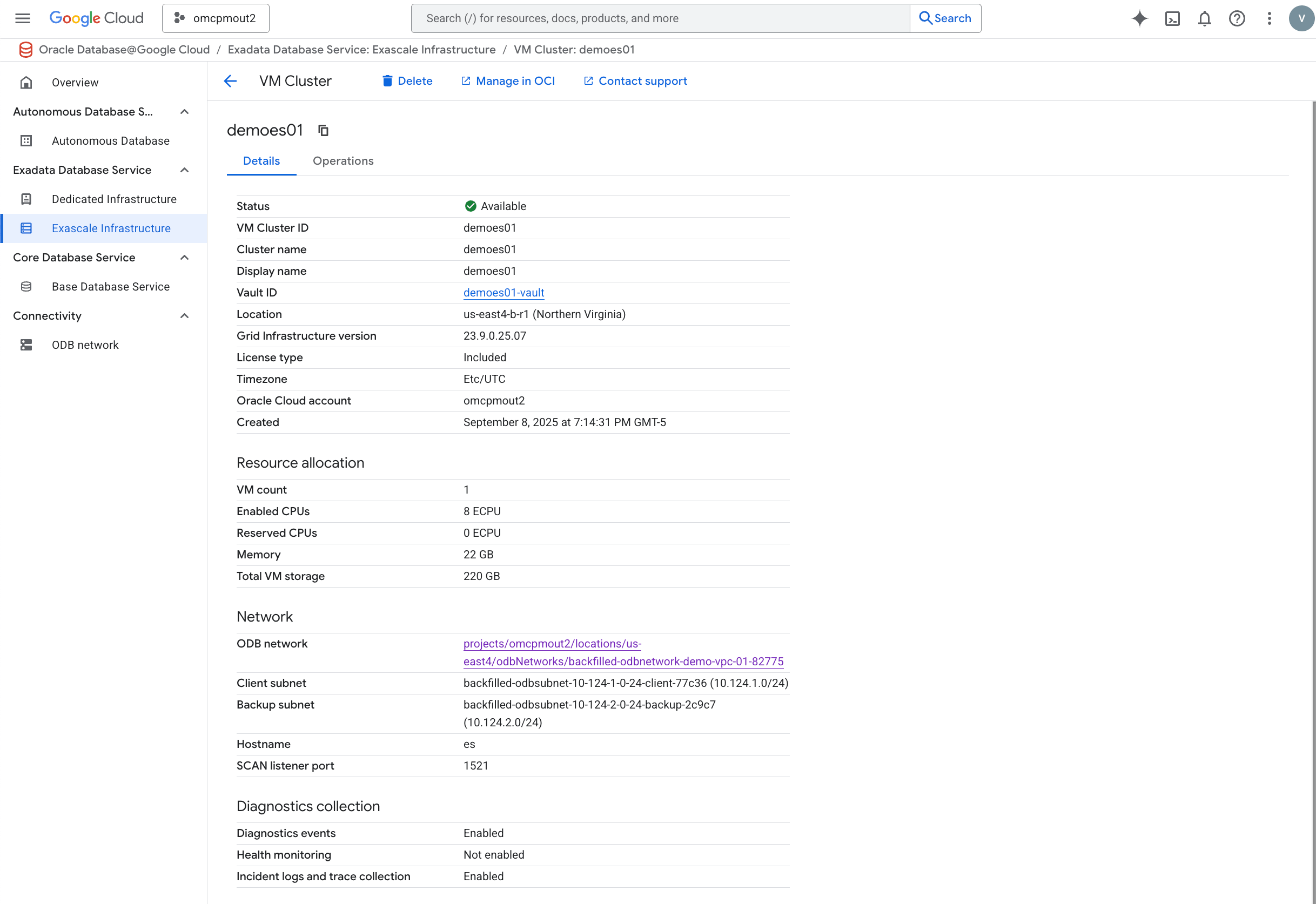
- From the Oracle AI Database@Google Cloud dashboard , select Exadata Database Service > Exascale infrastructure from the left-menu.
- Select the Exascale VM Cluster from the list.
- Select the Manage in OCI link.
- From the VM Cluster Details page, select the Container databases tab and the Database you need to modify.
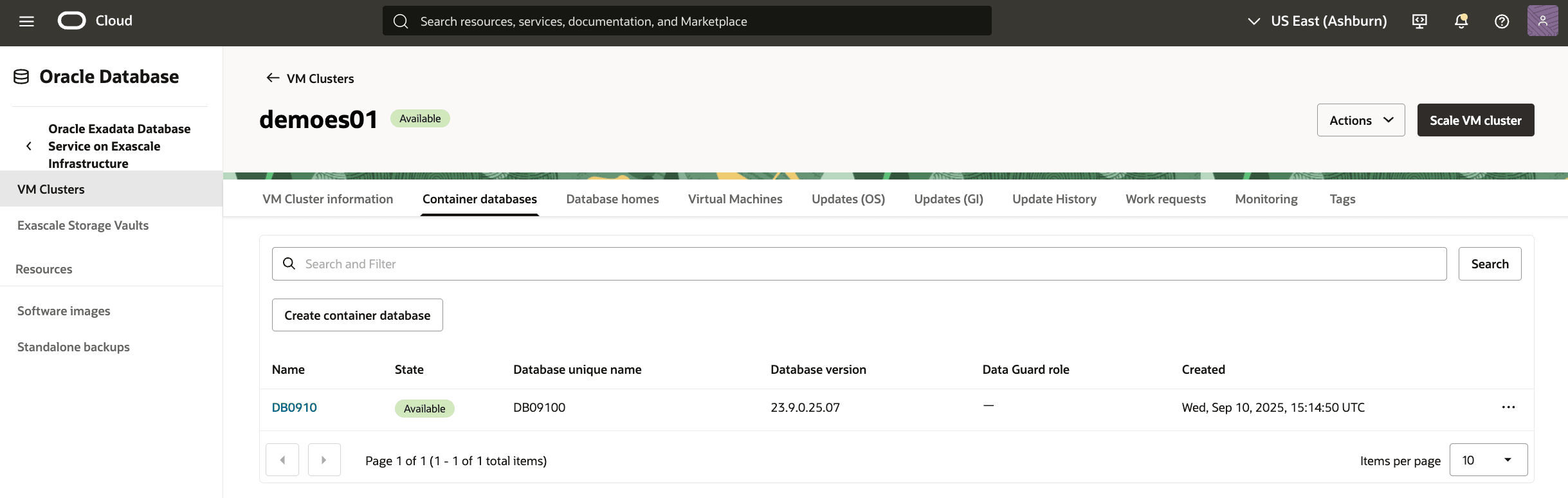
- To perform a management operation, in the OCI console for the selected Exascale Database, select the Actions button and then the Management action from the list.
Action Description Configure automatic backups For more information, see Back Up and Recovery. Create Database from Backup For more information, see Create a database from a backup. Move Database to Another Home The move operation is done in a rolling manner across nodes and does not cause downtime. For more information, see Move a database to another Database Home. Manage encryption key For more information, see Manage Encryption Keys. Manage passwords For more information, see Manage Administrator and TDE Wallet passwords. Upgrade For more information, see Upgrading Databases. Add Tags Add tags to organize your resources. For more information, see Overview of Tagging - For more information on how-to manage container databases (CDBs), see Provisioning and Managing Exadata Databases.
- For more information on how-to manage pluggable databases (PDBs), see Create and Manage Exadata Pluggable Databases.
- From the VM Cluster Details page, select the Container databases tab and the Database you need to modify.
There is currently no content for this page. Oracle AI Database@Google Cloud team intends to add content here, and this placeholder text is provided until that text is added. The Oracle AI Database@Google Cloud team is excited about future new features, enhancements, and fixes to this product and this accompanying documentation. We strongly recommend you watch this page for those updates.
There is currently no content for this page. Oracle AI Database@Google Cloud team intends to add content here, and this placeholder text is provided until that text is added. The Oracle AI Database@Google Cloud team is excited about future new features, enhancements, and fixes to this product and this accompanying documentation. We strongly recommend you watch this page for those updates.
You can modify an Exascale Database in Google Cloud using OCI Terraform provider.
Prerequisites- Terraform or OpenTofu installed
- OCI credentials configured
- HashiCorp OCI provider version >=7.0 (For more information, see the Create ODB Network Terraform page)
- Exascale Database is created using Terraform
Sample Terraform Configuration using OCI Terraform Provider
# Modify Database Home
resource "oci_database_db_home" "db_home" {
  vm_cluster_id   = "ocid1.exadbvmcluster.oc1.iad.anuwcljtou6knayanpsxxxxxxxxxxxxxxxj74msrv4t53fkgrrspyxm3ona"
  source          = "VM_CLUSTER_NEW"
  display_name    = "dbhome-26ai"
  db_version      = "23.9.0.25.07"
  freeform_tags   =  {
    "env" = "dev"
    "lob" = "sales"
  }
}

# Modify Container and Pluggable Database
resource "oci_database_database" "exascale_database" {
  db_home_id                      = oci_database_db_home.db_home.id
  source                          = "NONE"
  database {
    db_name                       = "democdb"
    # db_unique_name              = var.database_database_db_unique_name
    pdb_name                      = "demopdb"
    # database_software_image_id  = oci_database_database_software_image.test_database_software_image.id
    admin_password                = "********************" # Enter a strong password
    db_backup_config {
      auto_backup_enabled         = true
      auto_backup_window          = "SLOT_TWO"
      auto_full_backup_day        = "TUESDAY"
      auto_full_backup_window     = "SLOT_TWO"
      backup_deletion_policy      = "DELETE_IMMEDIATELY" # Possible values: DELETE_IMMEDIATELY, DELETE_AFTER_RETENTION_PERIOD
      backup_destination_details {
        type                      = "OBJECT_STORE" # Possible values: OBJECT_STORE, RECOVERY_APPLIANCE
      }
      recovery_window_in_days     = 7
      run_immediate_full_backup   = true
    }
    tde_wallet_password           = "********************" # Enter a strong password
    # sid_prefix                  = var.database_database_sid_prefix
    character_set                 = "AL32UTF8"
    ncharacter_set                = "AL16UTF16"
    freeform_tags                 =  {
      "env" = "dev"
      "lob" = "sales"
    }
  }
}