Create a Database Management Private Endpoint for Oracle Cloud Databases
You can create a private endpoint to connect Database Management to an Oracle Cloud Database in the Base Database Service, ExaDB-D, or ExaDB-XS.
The information in this topic is only applicable for Oracle Cloud Databases in the Base Database Service, ExaDB-D, and ExaDB-XS and not for Oracle Cloud Databases in ExaDB-C@C.
The private endpoint is a representation of Database Management in the VCN in which the Oracle Cloud Database can be accessed, and acts as a VNIC with private IP addresses in a subnet of your choice. The private endpoint created in a VCN can be used to enable Database Management Diagnostics & Management for the Oracle Cloud Databases available in the same VCN and it cannot be used across multiple VCNs. The private endpoint does not have to be on the same subnet as the Oracle Cloud Database, although it must be on a subnet that can communicate with the Oracle Cloud Database.
In Database Management, you can create the following types of private endpoints:
- Private endpoint for single instance Oracle Cloud Databases: You can create a maximum of seven Database Management private endpoints in your tenancy (per region) to connect to single instance Oracle Cloud Databases in the Base Database Service. There's no restriction on the number of single instance databases for which you can enable Diagnostics & Management using a single private endpoint. The private endpoint for single instance Oracle Cloud Databases has only one private IP address.
- Private endpoint for RAC Oracle Cloud Databases: You can create three Database Management private endpoints in your tenancy (per region) to connect to RAC Oracle Cloud Databases in the Base Database Service, ExaDB-D, and ExaDB-XS. The private endpoint for RAC Oracle Cloud Databases has two private IP addresses.
Note that you can create one private endpoint of each type in a VCN, which means that you can create one private endpoint for single instance databases and one for RAC databases. If you need more private endpoints than the default limit of seven single instance private endpoints and three RAC private endpoints in a tenancy, you can request for an increase to the private endpoint limit. For information, see Errors Encountered When Enabling Diagnostics & Management for Oracle Cloud Databases.
Here's a diagram that provides an overview of how a Database Management private endpoint communicates with the Oracle Cloud Database.
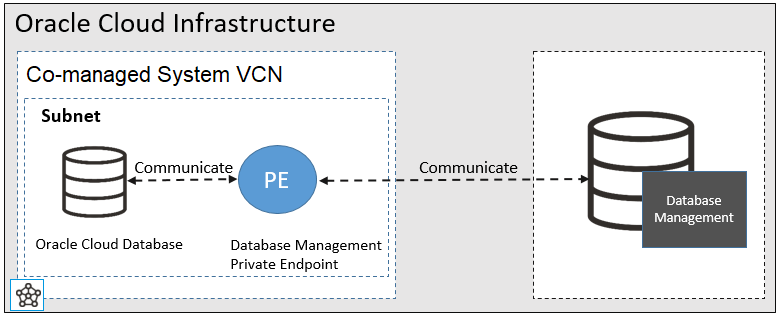
For information on private endpoints, see About Private Endpoints.
Before you create a Database Management private endpoint in the VCN, you must obtain the permissions required to work with virtual networking resources in Oracle Cloud Infrastructure and create a Database Management private endpoint. For information, see Permissions Required to Enable Diagnostics & Management for Oracle Cloud Databases.
To create a Database Management private endpoint:
To view details of the Database Management private endpoint, click its name. On the Private endpoint details page, you can:
- View details such as the associated VCN and subnet and the private IP addresses assigned to the Database Management private endpoint. Note that the private IP address information is required to configure security rules.
- View the associated databases in the Databases section on the Details tab.
- Monitor the work requests pertaining to the private endpoint on the Work requests tab. You can click a particular work request to view work request information, log messages, and error messages, if any.
- Perform tag-related tasks on the Tags tab.
Manage Security Attributes for Private Endpoints
You can optionally add Zero Trust Packet Routing (ZPR) security attributes to private endpoints to control access through ZPR policies. ZPR evaluates these attributes together with existing network controls.
For more information on security attributes and ZPR, see Security Attributes and Overview of Zero Trust Packet Routing.
If you add security attributes to a private endpoint, verify that the required ZPR policies are in place, otherwise, intended traffic can be blocked.
Setup
Before you add security attributes to a private endpoint, complete the required ZPR setup and verify that the network configuration allows the intended traffic.
- Ensure that the required IAM permissions, security attribute namespaces, security attributes, and ZPR policies are already configured. For more information, see Zero Trust Packet Routing IAM Policies, Security Attributes, and Zero Trust Packet Routing Policy.
- Decide which security attributes to add to the private endpoint so that the applicable ZPR policies allow the intended traffic.
Important Considerations
- Administrators must set up security attribute namespaces and security attributes in the tenancy before users can apply security attributes to private endpoints.
- When security attributes are used, access to the private endpoint is governed by ZPR policies together with existing network controls, such as security lists and NSGs.
- A security attribute is effective only when appropriate ZPR policies are defined. If you add a security attribute without corresponding policies, access to the private endpoint is denied by default, even if NSGs or security lists would otherwise allow the traffic.
- You can add up to three security attributes to a private endpoint. If you aren't sure which attributes to use, contact your network administrator.
Add Security Attributes
You can add security attributes when you create a private endpoint or from the Private endpoint details page after the private endpoint is created.
To add security attributes from the Private endpoint details page:
- Go to the Private endpoint details page for the private endpoint.
- On the Security tab, in the Security attributes section, click Add.
- Specify the security attribute namespace, key, and value.
- Click Add security attributes.
List Security Attributes
To view the security attributes added to a private endpoint, go to the Private endpoint details page for the private endpoint, and then click the Security tab. The Security attributes section lists the security attributes added to the private endpoint.