Manage Recurring Orders for Same Projects and Tasks
The Oracle E-Business Suite G-Invoicing solution lets you perform and invoice similar work periodically by assigning the same project and top task to many recurring orders. This feature simplifies the handling of recurring orders and maintenance services by eliminating the need to set up a new project and top task for each order.
With this capability, Oracle E-Business Suite G-Invoicing solution allows for such repeated orders to be executed from the same project and top task. The ability to use a single framework for repetitive orders improves the accuracy of performance tracking and financial reporting. An example use case can be a company tasked with regular maintenance of a power grid, receiving periodic orders to conduct maintenance and overhauling. By utilizing this feature, the company can systematically manage these repetitive periodic orders, ensuring timely execution and accurate billing, while leveraging historical data to inform future project planning and execution.
Steps to enable and configure
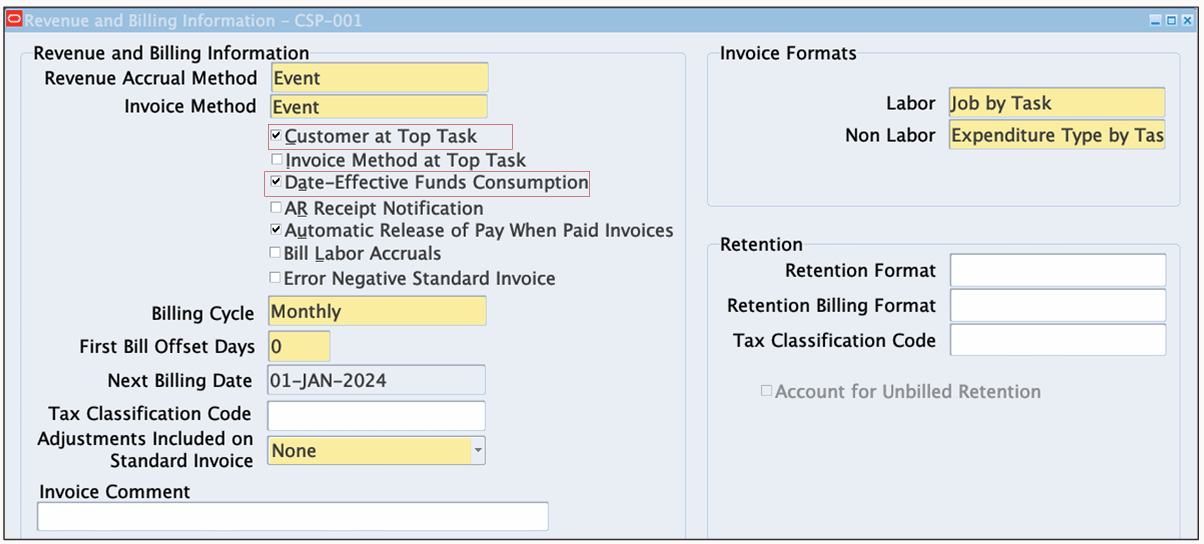
Setting up Project Type for Non-Overlapping Date Effective Funds (NODEF)
To setup the project type for NODEF, perform the following steps:
- In the Project Types window, select Contract for the Class field.
- The Billing Information tab appears.
- Select Top Task for the Funding Level field.
- Click and enable the Date Effective Funds Consumption.
In the Project Setup page, choose Non-Overlapping Date Effective Fund for the Funding Method for NODEF projects.
Manage Periodic Recurring Orders
Key resources
Oracle E-Business Suite G-Invoicing Process Guide
Topic: Manage Periodic Recurring Orders