Creating Available Content Using the Available Content Button in Reference Files
You can create available content from a reference file quickly and easily using the Available Content button in the Narrative Reporting ribbon in Oracle Smart View for Office.
Using the Available Content button , the underlying named range is automatically created for you based on the range you select in Excel. You have only to apply a name and optional description to the new content.
Note:
- This feature requires the 24.02+ version of the Narrative Reporting extension
- You can also create available content using Excel named ranges that you define, as described in Creating and Embedding Available Content from Excel Named Ranges in Reference Files.
-
Click Inspect in the Narrative Reporting ribbon to open the
Properties dialog box.

You can also select the doclet in the report package panel, and then click Properties to open the Properties dialog box.
-
In Properties , select the Embedded
Content tab,
 , and then click on Available Sources.
-
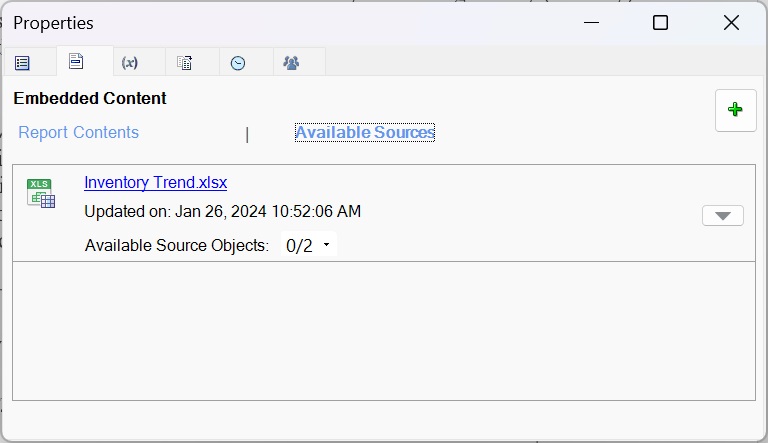
Under Available Sources, click on the reference file
name to launch the Excel file.
In the following example, clicking on Inventory Trend.xlsx launches the Excel file named
Inventory
                            Trend.xlsx
.
In the Narrative Reporting ribbon, notice that only two buttons are displayed: Upload, which should be disabled because doclet from which you launched the reference file should not be checked out; and the Available Content button, which is enabled.
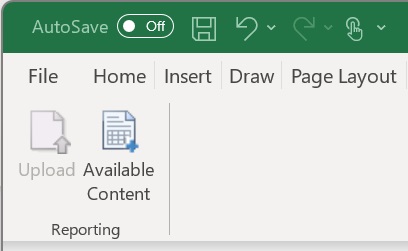
If the Available Content button is not enabled, ensure that the doclet to which the reference file is registered is checked in, and then close Excel and repeat the previous steps.
-
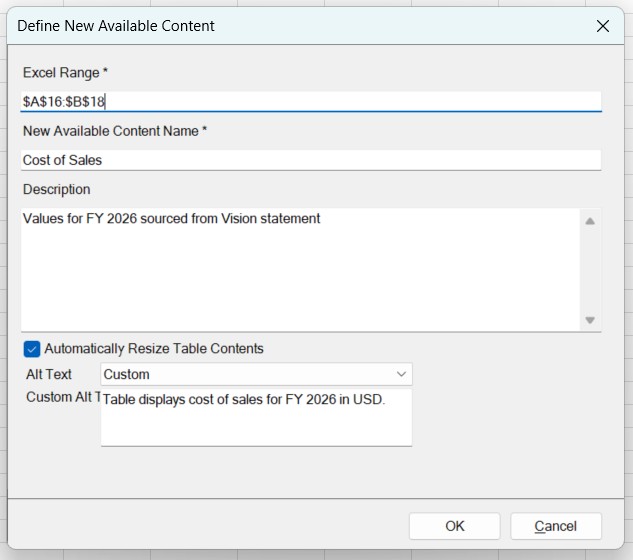
In the Define New Available Content dialog box, provide
the following details for the new available content.
- Excel Range: The range you selected is entered by default in the Excel Range text box. Or, you can type a valid range.
- New Available Content Name: Enter a name for the available content.
- Description: Enter a description for the available content.
- Alt Text Options: Select what should appear as
alt text when the available content embedded in reports is accessed in
Word and PowerPoint. By default, the None option
is selected.
- Select Name to display the New Available Content Name as the alt text.
- Select Description to display the Description of the available content as the alt text.
- Select Custom and enter the desired alt text in the Custom Alt Text field.
- Automatically Resize Table Contents: Selected by
default. Applies to Excel ranges.
Word tables have a default option, Automatically Resize Table Content, which adjusts the column widths and row heights for optimal rendering. This resizing may introduce discrepancies between the embedded table in a Word doclet and the source table or grid.
Clear the Automatically Resize Table Contents check box to minimize the variations between the embedded Word table and the source reference table or grid.
In the following example, the "Cost of Sales" is the name provided for the available content, along with description and custom alt text.