Learning About Cohort, Population, and Division
Enrollment management targets are set up using a three-level structure that consists of the following elements: cohort, population, and division. These terms can mean whatever you need them to mean. Cohort, population, and division are different levels, from highest to lowest, that you set up, define, link to one another and for which you set targets. They are conceptually similar to the three-level structure found in communications.
This diagram illustrates the enrollment management level structure.
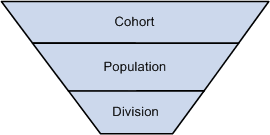
Cohort is the highest of the three levels. The cohort is the starting point for your target development. An example of a cohort level that you can define is the entire group of students in an academic year. You can define a cohort level of 2005 and set an enrollment target of 500 students for that academic year. Alternatively, you can break this up into a cohort level for academic terms of Fall 2005 and Spring 2006.
Population is the next level down the hierarchy. You can define a population level by academic career. Alternatively, you can define a population level by school or college. It is entirely up to you how you define each level.
Division is the final bottom level in the enrollment management target setup. You can define a division level, for example, by gender, ethnicity, academic program, admit type, or program status. There are numerous options for how to break down and define enrollment management levels.