Recording the Accounting Entries for Transfer Prices
During demand fulfillment, the MSR is located in the IN_DEMAND table. Once the transfer price has been calculated by the Deplete On Hand Qty process, the transfer price is located in a child table, IN_DEMAND_TPRC, where it is broken out into several parts by cost elements. Cost elements can be created for material costs, landed costs, and additional transfer costs. Estimated transfer price details can be viewed using the Transfer Price Inquiry component. While the stock is in the intransit account, the material, landed, and additional transfer costs are all included in the total transfer price. The transfer price details are retained when the stock is received by the destination business unit. During putaway, the additional transfer costs can be included in the material cost of the stock or the additional transfer costs can be expensed.
The following transaction groups can be used for an interunit transfer:
-
022 IBU Transfer Receipts
-
025 InterCompany Receipts
-
031 InterBU Transfer Shipments
-
035 InterCompany Transfers
-
042 IBU Transfer Adjustments
-
300 Gain/Loss on Transfer Price
-
301 InterCompany Cost of Goods
Transfer prices and additional transfer costs can also be used for Shipment On Behalf Of transactions using the following transaction groups:
-
034 Shipments on Behalf of Other BU
-
302 ShipOnBehalf Gain/Loss
See Designing Shipment On Behalf Of.
Transfer prices only can be used with interunit expense issues using the following transaction groups:
-
036 InterUnit Expensed Issue
-
026 Expensed Issue Return
Example of the Transfer Pricing Table
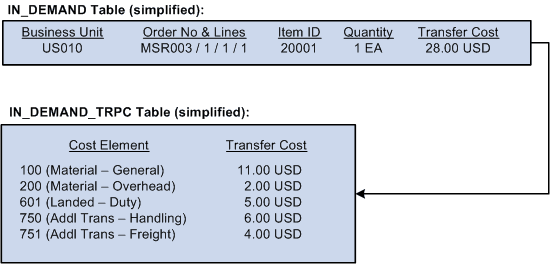
Once the Deplete On Hand Qty process calculates the transfer price for a standard, actual, or average cost item, the total transfer price is stored in the TRANSFER_COST field of the IN_DEMAND table; the transfer price details, broken out by cost element, are stored in the IN_DEMAND_TRPC table. To record the material cost of the transferred items, the system used the cost element in the Default Cost Element field in the Define Business Unit Item - General: Common page.
The following diagram illustrates a simplified example of a material stock request with an interunit transfer price (transfer cost).
Note:
The terms transfer price and transfer cost both refer to the same value.
The above example displays an item with more than one material cost element, a landed cost element, and two additional transfer cost elements. Your purchased items may only have one material cost element, however, your make (manufactured) items may have multiple material cost elements. The setup for landed cost is located in the "Structuring Landed Costs" topic.
Example of an InterBU Transfer Shipment (Transaction Group 031)
The following diagram illustrates a simplified example of the accounting entries generated in the source business unit after the Deplete On Hand Qty process and the Cost Accounting Creation process are complete. For the transaction group 031 (InterBU Transfer Shipments), the Cost Accounting Creation process determines any difference between the item's cost and the transfer price by comparing cost element to cost element. The typical shipping accounting entry debits the intransit inventory account at the item's transfer price and credits the inventory account at the item's cost. Any difference between the transfer price and cost creates an additional entry associated with the transaction group 300 (gain or loss on transfer price).
The following diagram illustrates a gain on transfer price for the source business unit.
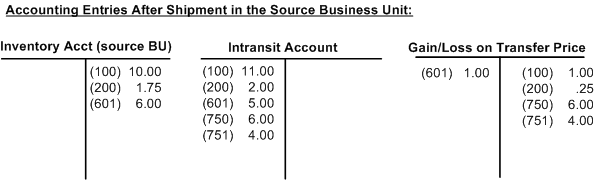
In the above example, note that the cost element detail is included in the accounting entry. The Cost Accounting Creation process uses the IN_DEMAND_TRPC table when creating accounting entries for interunit transactions.
Note:
The above example does not address an intercompany transfer or an interunit transfer using interunit receivable and payable accounts. More detailed examples are given later in this topic.
Examples of Inventory Business Unit Transfer Receipts (Transaction Group 022)
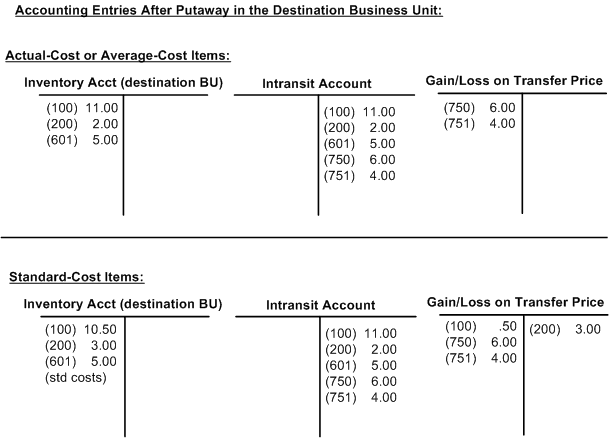
The following diagram illustrates a simplified example of the accounting entries generated in the destination business unit after the Load Staged Items process (INPSSTGE) and the Cost Accounting Creation process are complete. The Cost Accounting Creation process uses the transaction groups 022 (IBU Transfer Receipts) and 300 (gain or loss on transfer price).
In both of these examples:
-
The source business unit owns the stock while it is in the intransit account.
-
The destination business unit has elected to write-off the additional transfer costs rather than include them in the inventory stock's cost.
For items using one of the weighted average costing methods, the material and landed cost portions of the transfer price are weighted into the new average cost for the item in the destination business unit. For items using the actual cost method, the material and landed cost portions of the transfer price becomes the actual cost for the receipts at the destination business unit. Note that for both the actual and average cost methods, you can choose to include the additional transfer costs in the cost of the item rather than write off these amounts.
For standard cost items, a gain or loss is calculated for the difference between the transfer price (material and landed cost portions only) and the item's standard cost maintained in the destination business unit. This difference is recorded in a gain/loss on transfer price account. The interunit stock is recorded into the inventory account at the standard cost, and the additional transfer costs are written off to a gain and loss on transfer price account.
Note:
The previous example does not address an intercompany transfer or an interunit transfer using interunit receivable and payable accounts. More detailed examples are given later in this topic.