Rolling Up Costs with Multiple Outputs
If the output of a production run is more than one item, then the cost is allocated. Multiple outputs include:
-
Co-products.
-
By-products.
Costing Co-Products
If a single manufacturing process generates multiple items, you can allocate the batch cost across the primary and co-products to determine the per unit cost of each end item. When it explodes a co-product for a multiple output BOM during Cost Rollup process, the system uses the Associated Primary BOM to determine the correct lower-level structure. An associated primary must therefore exist in this case for the rollup to occur. The BOM and routing code combination that the system used to explode the co-product must also exist.
Note:
The system calculates a co-product's cost by multiplying the total cost of the batch (including the recycle and waste by-product costs) by the cost percentage for the co-product (as specified on the BOM Maintenance - Outputs page), then dividing by the expected output quantity of the co-product.
Costing By-Products
By-products can be of two types: recycle and waste. The system calculates cost relief for recycled by-products by multiplying the quantity and the cost of the recycle by-product. This cost relief is subtracted from the lower-level costs. The system treats recycled by-products as a negative cost, because they can be used as an input to another process. The cost used is determined by the purchase cost as specified for the cost type that you selected on the Cost Rollup page.
Note:
A recycled by-product must have the same cost element (with a cost category of material) as another component or waste by-product; otherwise, the item is not costed. This reduces the chance of a material element producing a negative value. If the cost element becomes negative, due to a recycle by-product cost relief, the system does not cost the item and an error message is printed on the Cost Rollup Audit page.
The system treats waste by-products as positive or zero cost. They either add to the cost of the product, such as the cost of disposing it, or have no associated cost. The system determines the cost used for waste by-products by multiplying the quantity and the cost of the waste by-product. It adds this cost to the material costs.
This diagram illustrates an example of a cost rollup with multiple outputs.
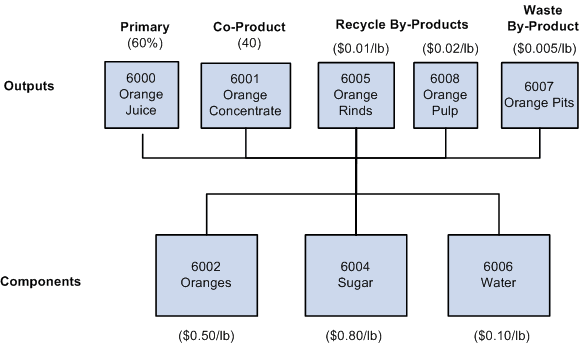
In this example for orange juice processing, you have these outputs: primary (orange juice), co-product (orange concentrate), recycle by-products (orange rinds and orange pulp), and waste by-product (orange pits). The components are oranges, sugar, and water.
Calculate the material costs by multiplying the quantity of each component by the standard cost:
Oranges: (5lb * 0.50) = 2.50
Sugar: (1lb * 0.80) = 0.80
Water: (10Gal * 0.10) = 1.00
Total Material Costs = 4.30
Calculate the by-product costs as:
Orange Rinds: (2lb * 0.01) = -0.02 (Cost is negative, because the recycled by-products are viewed as a cost benefit.)
Orange Pulp: (1lb * 0.02) = - 0.02
Orange Pits: (2lb * 0.005) = 0.01 (Cost is positive, because it is a disposal cost.)
Total By-Product costs = - 0.03
Total Costs = Material Costs + By-Products Costs = 4.30 + (-0.03) = 4.27
To determine the primary and co-product costs, multiply the total costs by the cost percentage.
Orange Concentrate = 40% * 4.27 = 1.71
Orange Juice = 4.27 − 1.71 − 2.56
Calculate the standard cost of the primary and co-product by dividing the apportioned costs by the output quantity of each item.
Related Topics