Transferring Interunit Stock Using the Interunit Sales Approach (Intercompany)
These examples illustrate different types of accounting transactions that can be generated for intercompany transfers.
Example 3.1
This example illustrates an intercompany inventory transfer from business unit US002 to business unit US013. These business units all use the same base currency. These inventory business units post to different general ledgers; inventory unit US002 reports to the GL unit US001 and inventory unit US013 reports to the GL unit US003. The inventory unit US013 assumes ownership at the time of shipment. The item is standard costed for US013 and can be any cost type for US002. In this case, there are differences between the item cost in the source business unit, the item transfer price, and the item cost in the destination business unit. Here is what the setup looks like for this example:
| Field or Control | Description |
|---|---|
|
US002 (source BU) Cost |
5.00 |
|
Transfer Price |
7.00 |
|
US013 (destination BU) Std Cost |
6.00 |
This diagram illustrates the accounting entries in PeopleSoft Inventory and PeopleSoft Billing after shipment. These entries belong to the transaction group 301 (Intercompany Cost of Goods).
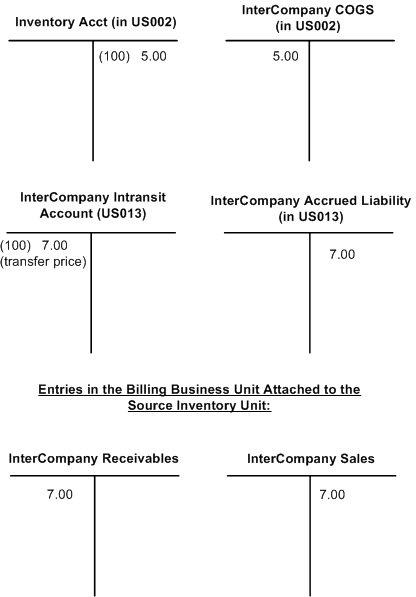
The above accounts are derived from the following sources:
-
Inventory account in source unit: If the location accounting check box is deselected in the source business unit, the inventory account is derived from the Accounting Rules page (Account Distribution page) for the Intercompany Cost of Goods transaction group (301). If the location accounting check box is selected, the inventory account is derived from the storage area from which the inventory is shipped.
-
InterCompany Cost of Goods Sold (COGS) account: The COGS account is the source interunit account defined for the inventory business unit combination on the InterUnit Pair page or InterUnit Template page of the centralized interunit and intraunit processor.
-
InterCompany Intransit account: The intercompany intransit account is defined on the Interunit Ownership page. This transaction belongs to the InterCompany Transfers transaction group (035).
-
InterCompany Accrued Liability account: The intercompany accrued liability account, in the destination business unit, is the destination interunit account defined for the inventory business unit combination on the InterUnit Pair page or InterUnit Template page of the centralized interunit and intraunit processor. This transaction belongs to the Intercompany Transfers transaction group (035).
Note:
The source inventory business unit doesn't use the gain or loss on transfer price transaction group (300); the margin between the cost of the inventory transferred and the transfer price is intrinsic in the difference between the intercompany sales and the intercompany cost of goods sold.
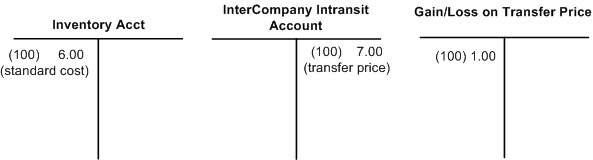
Here is what the accounting entries for PeopleSoft Inventory look like upon putaway in the destination business unit (US013). These entries belong to the transaction group 025 (InterCompany Receipts).
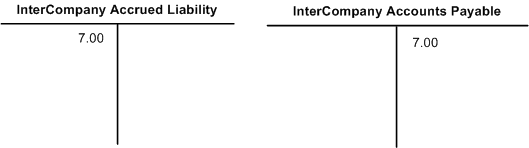
Here is what the accounting entry looks like for PeopleSoft Payables upon voucher processing.
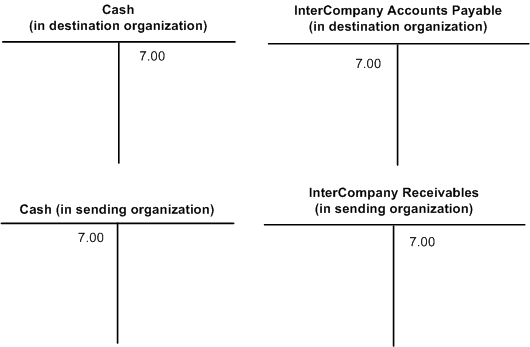
Here is what the accounting entry looks like for the open payable and receivable settlement.
Example 3.2
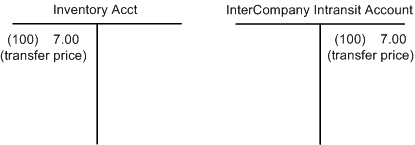
This example has the same conditions as example 3.1 except the item ID uses the actual or average-cost method in the destination business unit.
This example differs from example 3.1 only in the accounting entries for PeopleSoft Inventory upon putaway. In this example, the item is an actual or average cost item for US013. Here is what the accounting entries look like in PeopleSoft Inventory upon putaway.
Example 3.3
This example illustrates an intercompany inventory transfer from business unit US012 to business unit FRA02. These inventory business units post to different general ledgers; inventory unit US012 reports to the GL unit US003 and inventory unit FRA02 reports to the GL unit FRA01. In addition, these business units have different base currencies; USD and EUR. The inventory business unit FRA02 assumes ownership at the time of shipment. The item uses the standard-cost method for FRA02 and can be any cost method for US012. In this case, there are differences between the item cost in the source business unit, the item transfer price, and the item cost in the destination business unit.
| Field or Control | Description |
|---|---|
|
US012 Cost |
5.00 (in USD: US012 base currency) |
|
Transfer Price |
7.00 (in USD: US012 base currency) |
|
FRA02 Std. Cost |
6.00 (in EUR: FRA02 base currency) |
|
Exchange Rate |
1.05 (one unit of USD-US012 base currency = 1.05 units of EUR-FRA02 base currency) |
Here is what the accounting entries look like in PeopleSoft Inventory upon shipment using the transaction group 301 (Intercompany Cost of Goods).
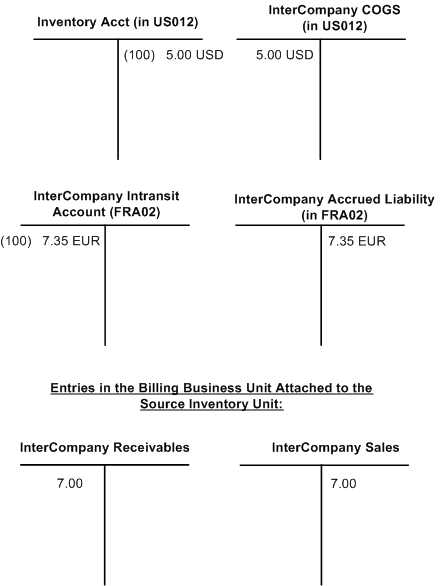
The above accounts are derived from the same sources as in example 3.1; however, the amount recorded in the FRA02 business unit is in FRA02's base currency of EUR. The intransit amount is the transfer price (7.00 USD) multiplied by the exchange rate (1.05) resulting in 7.35 EUR.
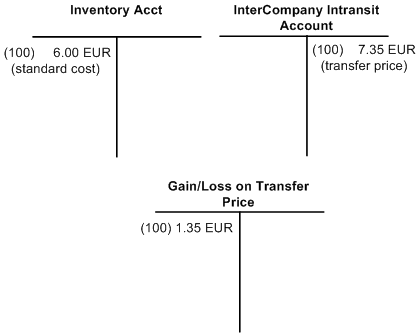
Here is what the accounting entries look like for PeopleSoft Inventory unit FRA02 upon putaway using the transaction group 025 (InterCompany Receipts).
Note:
Entries are in FRA01 base currency of EUR.
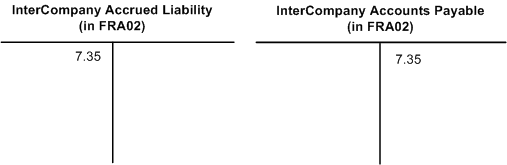
Here is what the accounting entry looks like for PeopleSoft Payables upon voucher processing.
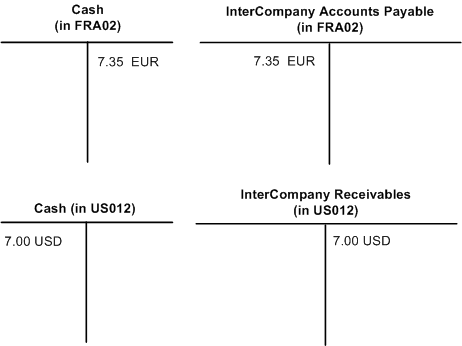
Here is what the accounting entry looks like for open payable and receivable settlement.
Example 3.4
This example has the same conditions as example 3.3 except the item ID uses the actual or average-cost method in the destination business unit (FRA02).
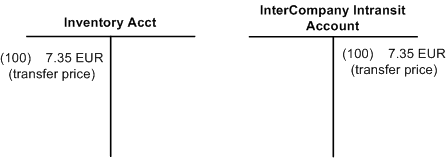
This example differs from example 3.3 only in the accounting entries for PeopleSoft Inventory upon putaway. In this example, the item is an actual or average cost item for FRA02. Here is what the accounting entries look like in PeopleSoft Inventory upon putaway.
Note:
Transaction Group 042 (IBU Transfer Adjustments) works the same for intercompany receipts as it does for interunit receipts.