PeopleSoft Payables Control Hierarchy
In PeopleSoft Payables, business units are the highest level of a hierarchy of defaults, called the control hierarchy, which facilitates both voucher entry and payment processing. As you formulate the PeopleSoft Payables structure, consider the five components of the control hierarchy that are key to PeopleSoft Payables.
Five components of the control hierarchy that are key to PeopleSoft Payables.
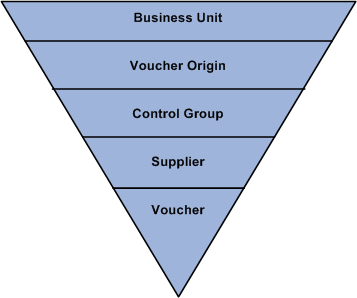
Default values entered at the business unit level appear automatically at the voucher level, unless you override the defaults with values stored at an intermediate level (namely, the voucher origin, control group, or supplier level). This hierarchy provides increased flexibility and control to fit unique business needs. For example, instead of requiring a PeopleSoft Payables user to enter the same default values repeatedly on vouchers, the system uses the control hierarchy to enter the predetermined values automatically. Then the user can override these values on the voucher.
When you enter default values and select processing rules at the levels that govern the control hierarchy, the system initially validates the information for you. The system then validates the data again during transaction processing to verify that it has the correct values assigned at the level that you designate.
This section reviews the components of the control hierarchy and their role in a PeopleSoft Payables implementation. As you set up control tables and prepare to process vouchers and payments, you need to understand how the control hierarchy works.
This section discusses:
-
Business units
-
Voucher origins
-
Control groups
-
Suppliers
-
Vouchers