Reschedule Payments Process
Rescheduling payments is a common business process in some countries. The Reschedule Payments Application Engine process (which includes both the AP_SMT_SEL and AP_SMT_SPLIT Application Engine processes) provides the functionality in PeopleSoft Payables.
To run the Reschedule Payments process, first set up reschedule payments conditions—which define agreements between you and suppliers—and reschedule payments options for suppliers—which associate suppliers with the Reschedule Payments process.
Generally, reschedule payments is a settlement method that profiles the payment methods, conditions, and amounts, depending on the total number of transactions in a certain period of time.
In some countries, such as Japan, customers usually do not issue a payment to their suppliers for each transaction. Instead, the supplier summarizes the transactions and charges for the total amount of the transactions based on prior agreements. The supplier summarizes the transactions and charges for the total amount of the transactions. Then, the customer issues a payment to the supplier on a specific date. Suppose that you made an agreement with a supplier to issue a payment on the 20th day of the next month for all transactions in that month. The supplier charges you for the total amount of transactions in the month, and you issue a payment on the 20th day of the next month. The period of time for transactions is usually one month, which can start on any day (the 1st, 15th, 20th, 25th, and so forth).
Split Multiple Payment Terms diagram.
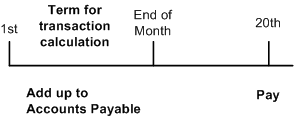
Different payment conditions and methods are applied depending on the total amount of the invoices, as illustrated by the following examples.
Example 1
If the total amount of the invoices is less than or equal to 10,000,000 JPY, pay in EFT at the end of the next month. If the total amount of the invoices is over 10,000,000 JPY, pay in customer initiated draft at the end of the next month.
Example 1
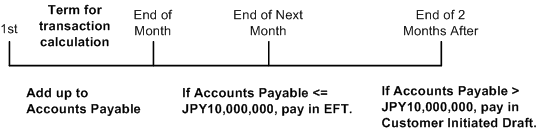
Example 2
You could choose to reschedule the total amount of invoices and apply different payment methods and conditions to each amount.
If the total amount of the invoices is less than or equal to 10,000,000 JPY, pay in EFT at the end of the next month. If the total amount of the invoices is over 10,000,000 JPY, reschedule the total amount into portions of 60 percent and 40 percent. Then pay the 60 percent amount in EFT at the end of the next month and pay the 40 percent amount in customer initiated draft at the end of two months.
Example 2
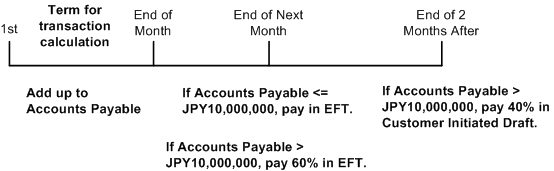
Example 3
In a more complicated scenario, you might run the Reschedule Payments process several times in a certain period of time.
Run it on the 15th and at the end of the month. On the 15th, reschedule the total amount of the invoices into two portions: pay in EFT for 60 percent, and then pay in customer initiated draft for 40 percent with a due date of the 10th of the next month. At the end of the next month, you pay the sum of the amount corresponding to 40 percent in the previous process and the amount of the invoices that come after the 15th in customer initiated draft.
Example 3
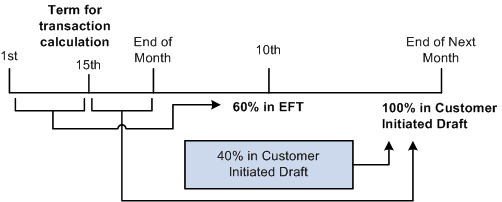
Processing Vouchers with Reschedule Payments Processing
For example, you run the Reschedule Payments process twice every month (on the 15th and at the end of the month) for the vouchers with due dates in the month that you run it. Use the 10th as the basis date when you run the Reschedule Payments process on the 15th and use the 20th as the basis date when you run it at the end of month.
The total amount of vouchers for a supplier that you process with the Reschedule Payments process is 15,000,000 JPY on July 15, 2006.
In this case, the Reschedule Payments process reschedules the total amount into portions of 60 percent and 40 percent because the basis date is July 10, 2006. For vouchers for 60 percent (9,000,000 JPY), the end of the month (July 31, 2006) is set as the payment condition and EFT is set as the payment method. For vouchers for 40 percent (6,000,000 JPY), the end of the month (July 31, 2006) is set as the payment condition, customer initiated draft is set as the payment method, and MONT3 (October 31, 2006) is set as the draft sight. The system recalculates the due date, scheduled pay date, and draft maturity date based on the basis date of July 10, 2006.
New vouchers worth 14,000,000 JPY are entered after July 15, 2006. Because the Reusable check box for vouchers for 40 percent (6,000,000 JPY) was selected in the previous process, the vouchers worth 6,000,000 JPY plus newly entered vouchers worth 14,000,000 JPY are processed by the Reschedule Payments process this time. Therefore, the vouchers worth 20,000,000 JPY are split into portions of 50%, because the basis date is July 20, 2006. For vouchers for one half (10,000,000 JPY), the 10th of the next month (August 10, 2006) is set as the payment condition and CHK is set as the payment method. For vouchers of the other half (10,000,000 JPY), the 10th of the next month (August 10, 2006) is set as the payment condition, the customer initiated draft is set as the payment method, and MONT3 (November 10, 2006) is set as the draft sight. The due date, scheduled pay date, and draft maturity date are recalculated based on the basis date of July 20, 2006.
Related Topics