The Funds Distribution Rule
Each effective dated rule defines the type of costs to distribute and how to distribute them. Sequences are defined to represent a specific approved or funded amount. Distribution percentages and ChartFields are specified for each sequence.
This example illustrates the fields and controls on the Example of multiple threshold amount on target. You can find definitions for the fields and controls later on this page.
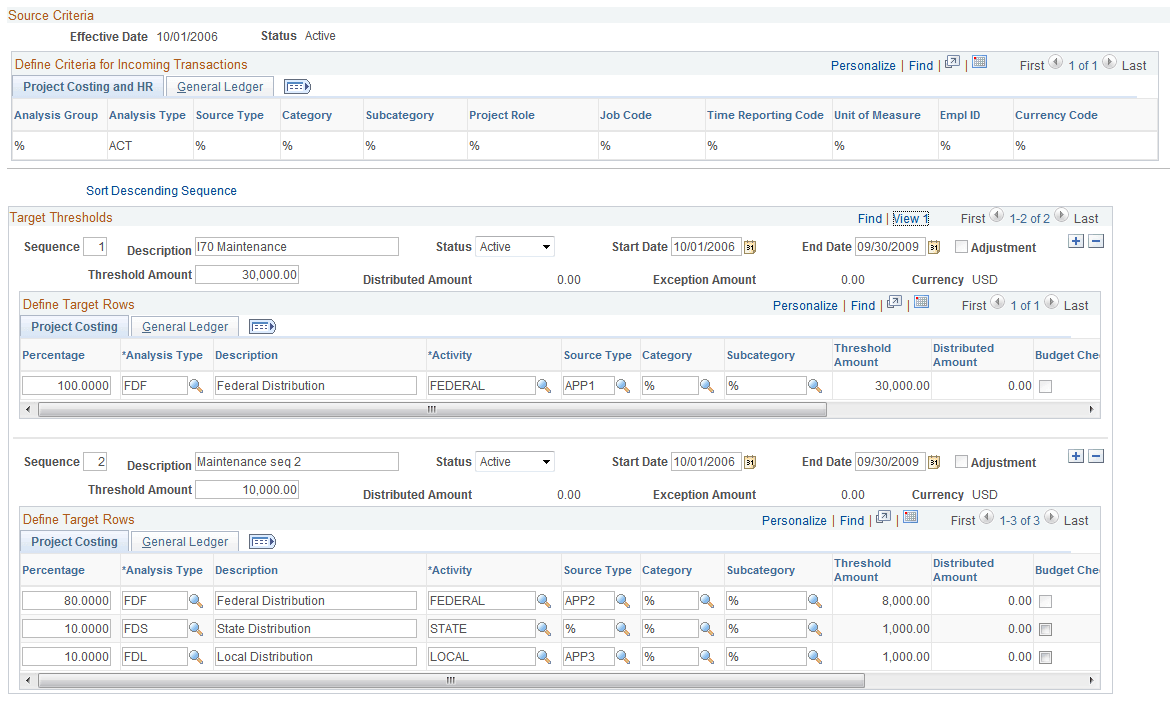
In this example, 100 percent of the first 50,000 USD of costs are distributed to activity FED and the other ChartFields selected based on sequence 1. Costs from 50,000 USD to 100,000 USD are distributed between the FED and STATE-General Fund activities using the percentages specified in the Rate Amount fields under sequence 2. A cost that exceeds the total threshold amount of 100,000 USD is treated as an ODL amount. The system creates a separate row for the excess amount and assigns the row an analysis type of ODL.
The system can split transactions between more than one sequence. Therefore, in this example, if the first transaction processed is 55,000 USD, then the first 50,000 USD is distributed according to sequence 1 and the remaining 5,000 USD is distributed according to sequence 2.
If a transaction causes the distributed amount of the highest active sequence to exceed its threshold, the amount that does not exceed the threshold is distributed and the remainder is treated as an ODL amount. A separate row with an analysis type of ODL is created for the overage.
Distributing Credits
The system distributes credit amounts beginning with the highest active sequence that has a remaining distributed amount, until that amount is exhausted. The system then identifies the next highest active sequence that has a remaining distributed amount and applies additional credit amounts, until that amount is exhausted. The system continues this process until the entire credit amount is distributed. If the system does not find a total distributed amount that is greater than or equal to the remaining credit, it creates a negative ODL amount.
Note:
Credits are distributed independently of all related transactions. For example, if a prepayment is distributed to sequence one and the threshold is reached prior to distributing the subsequent credit and voucher, then the credit and voucher could be distributed to a different sequence. This could result in the credit and voucher being distributed to different ChartFields than the prepayment.