Organizational Hierarchies
The first step in setting up transorganizational accounting or organizational-sharing accounting is to define the organizational hierarchy, which you use to determine which rules apply to a given situation. The organization can be as simple as a GL business unit (which is the minimum required), or it can be broken down further into four additional groups and subgroups using ChartFields to designate each organizational entity. This enables you to apply different rules (for accounting across or sharing between entities) to organizational entities depending on their size.
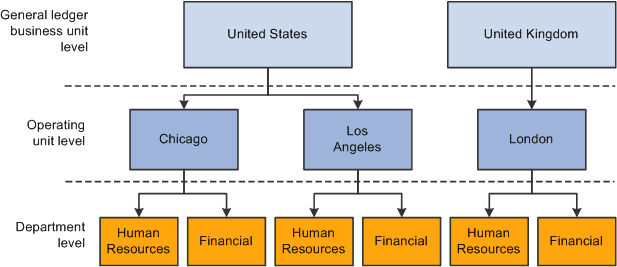
This diagram shows an example of an organization that is defined first by GL business unit, and then by operating unit and department:
Examples of a three tiered hierarchy. General ledger business unit at the top, operating unit in the middle, and departments at the bottom.
The GL business unit is always first in the organizational hierarchy when you apply accounting rules to a human resource who is working on a project or activity in another part of the company. A human resource from one GL business unit working in another GL business unit always follows interbusiness unit rules, regardless of the departments and operating units that are involved.
The human resources system defines which organization owns a particular human resource. The system automatically attaches both the GL business unit and the department to a human resource. You must populate other ChartFields that you include in an organizational definition in transactions that are sent to the Project Transaction table.