Creating a Continuous Improvement Environment
This diagram illustrates how the functions and features within Quality (characterize, stabilize, maintain, and improve) help you meet the requirements within a continuous improvement model:
This diagram illustrates how the functions and features within Quality.
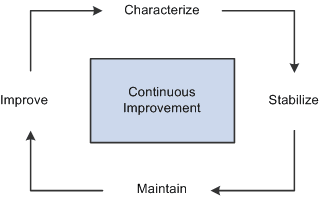
This model incorporates four main continuous activities. Each activity validates the previous activity.
Characterize
The starting point. In this phase, Quality provides tools for an initial set of data to determine what the process or product looks like, statistically and graphically. At this stage, you determine important characteristics, the distribution shape, the measurement system capability, the initial process capability indices, the starting process yield, and Pareto analysis of defects. In addition, you can design the control chart to determine the correct subgrouping, sample frequency, control test sensitivity, and chart type. Ultimately, you'll use Quality to establish a baseline and optimum method of control.
Stabilize
Once the baseline is established, you'll use Quality to help stabilize the process. A process is any set of conditions or system of causes that produce a given result, such as a manufactured product. You must control these conditions to minimize the variation within a process. With Quality, you can monitor this variation by using control charts, analyzing the data for significant changes, and taking immediate corrective action.
Maintain
When a process is first analyzed, it's usually out of control. You can initially monitor and control the process offline, while reducing any negative impact to the operation. After gaining stability, you use online activities to identify and contain less frequent out-of-control occurrences.
To maintain stabilized processes, you monitor for special causes that creep into the process before they cause nonconforming products. You use automatic control-limit assessment, control testing, and alarm notification to keep processes in check.
Improve
A process in statistical control doesn't guarantee quality output, only predictable output. A stable process may still not be capable of producing products that conform to specification. You can explore process data, find new ways to improve quality, and verify improvements using an analytical toolbox.
As you introduce new people, machinery, equipment, and methods into the process, the control charts are the first indicators of success. Quality helps you recharacterize and restabilize the process at new levels of performance.