Using Basic Statistics
The set of basic statistics includes measures of central tendencies, measures of dispersion, and the other descriptive statistics, as shown in the following table:
| Equation | Statistic | Alternate Equation Forms |
|---|---|---|
|
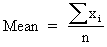
The mean is the arithmetic mean (average) of a sample. |

See References. |
|
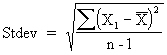
The standard deviation is the root-mean-square of a sample. |

See References. |

|
The observation is the total number of values in a sample. |
None |

|
The summation is the total of all the values in a sample. |
None |

|
The minimum is the smallest value in the sample. |
None |

|
The maximum is the largest value in the sample. |
None |

|
The range is the largest value minus the smallest value in the sample. |
None |
|
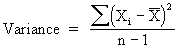
The variance is the square of the standard deviation. |

See References. |
|
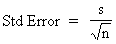
The standard error of the mean is the standard deviation of the mean. It measures the extent to which a sample mean can be expected to vary. |

See References. |
|
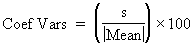
The coefficient of variation is the standard deviation of a sample expressed as a percentage of the mean. It is a measure of relative dispersion. |
See References. |
|
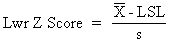
The lower Z-score is the number of standard deviations that the lower specification limit (LSL) is from the mean. |
None |
|
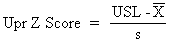
The upper Z-score is the number of standard deviations that the upper specification limit (USL) is from the mean. |
None |
|
Lwr 3 sigma = deviate at probability 0.00135 |
The lower 3 sigma represents three standard deviations from left of the mean. |
None |
|
Upr 3 sigma = deviate at probability 0.99865 |
The upper 3 sigma represents three standard deviations from right of the mean. |
None |