Understanding the Transformation Framework
When an application sending a service operation uses a message structure different than the application receiving it, the message must be transformed in order to be accepted by the target application. HCM Transformation Framework uses definitional logic to transform messages. Using information you set up, the transformation framework applies the correct transformation logic to produce a message that complies with the target application requirements.
HCM Transformation Framework enables seamless integration among PeopleSoft applications as well as with third-party applications such as Oracle, SAP, and Siebel. Transformation schemas are associated with transformation maps, enabling you to quickly locate and modify a schema to respond to external changes.
The transformation map registry is made up of transformation maps. The transformation map defines the message properties of the message for both the target and source application. For each transformation map, create a transformation schema, an XML document that defines the message structure mapping between two applications.
When a message needs to be transformed in order to be successfully received by an application, you need to assign a transformation program with the message on the Integration Broker Relationships component (IB_RELATIONSHIP).
There are six transformation programs supported by the transformation framework:
-
HTMF_TR_IA, for inbound asynchronous communications.
-
HTMF_TR_IS, for inbound synchronous communications.
-
HMTF_TR_ISR: for the inbound synchronous response.
-
HTMF_TR_OA, for outbound asynchronous communications.
-
HTMF_TR_OS, for outbound synchronous communications.
-
HMTF_ TR_OSR for outbound synchronous responses.
Based on the type of transaction, choose the appropriate transformation program to associate with your message.
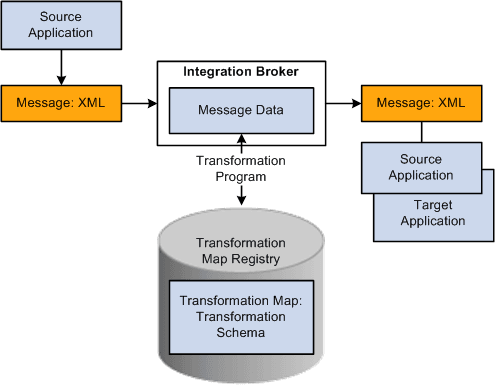
When an application publishes a message that requires transforming, PeopleSoft Integration Broker invokes the transformation program associated with the message. The transformation program determines which transformation map corresponds to the target message and applies the transformation schema to the message data using XSLT, an XML translation language. The transformation schema can modify the metadata or the message data itself to comply with the target application requirements. PeopleSoft Integration Broker repackages the transformed message data into an XML document that is structurally compliant with the target application. The Integration Broker can then deliver the message to the receiving application.
This diagram illustrates the flow of information from one application to another using HCM Transformation Framework:
See PeopleTools: PeopleSoft Integration Broker, "Applying Filtering, Transformation and Translation"