Severance Tax Calculation
This diagram illustrates the flow of severance tax calculation:
This diagram illustrates the flow of severance tax calculation.
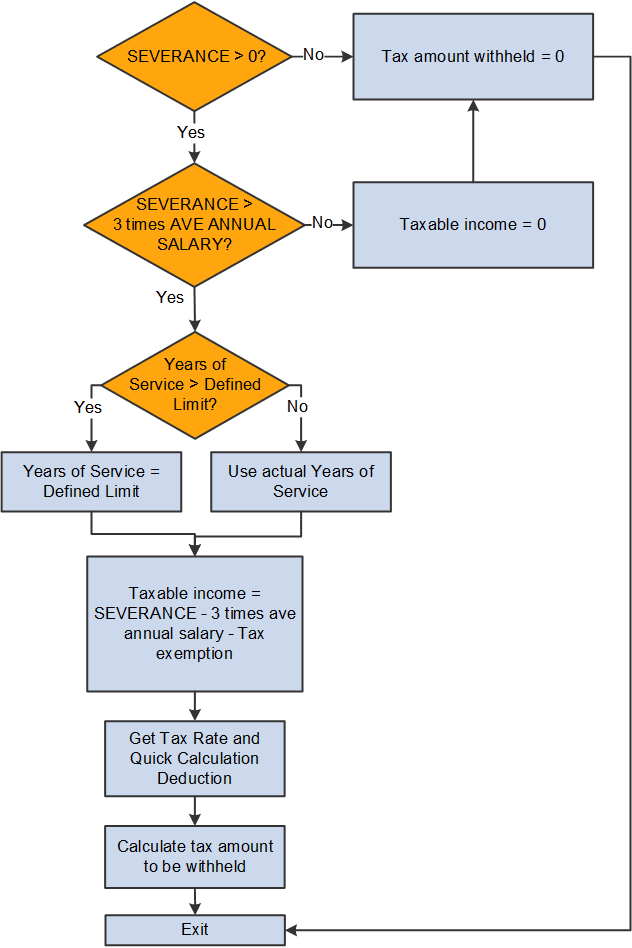
The SEVERANCE TX deduction invokes the formula CN FM CALC SEV TAX, which derives severance tax from the calculated severance payment. CN FM CALC SEV TAX then calls formula CN FM CALC TAX to calculate tax.
The formula CN FM CALC SEV TAX:
-
Calculates taxable income.
-
If severance pay is below 3 times the city average annual salary, the system exempts it from tax. In this case, taxable income = 0.
-
If severance pay is 3 times higher than last year's city average annual salary, the system calculates tax based on the amount above 3 times the city average annual salary of last year by allocating the amount into the number of months equivalent to total years of service for the current employer. If years of service is more than the defined limit, the formula caps the value at that limit. In this case, taxable income = (severance pay – 3 times city average annual salary).
Note:
PeopleSoft Global Payroll for China delivers a years-of-service limit of 12. When determining years of service for a payee, the system rounds up to the nearest integer.
-
-
Calls formula CN FM CALC YR TAX, which:
-
References the bracket BR TAX RATE YR to obtain the tax rate and quick calculation deduction to derive the withholding amount for the payee's severance pay for one pay period in the current financial year.
-
Subtracts the reduction from the tax amount if the payee is eligible for disability reduction. If a payee override exists, the assumption is that it overrides an amount; otherwise, the formula CN FM TXYR REDUCT uses the percent value retrieved from the bracket CN BR TX EXEMPTION.
Therefore, if an override exists, the tax withheld equals the tax amount from step 2a minus the override amount. If the tax withheld is less than zero, the formula sets the tax to zero. If no override exists, the formula subtracts the reduction percent from the tax withheld from step 2a.
-
-
Multiplies calculated tax by the years of service to calculate the final amount of tax withheld.
-
Subtracts any severance tax already calculated in the month.