Seniority
Companies often calculate seniority by subtracting the seniority date from the payroll period end date. This is the PeopleSoft-delivered calculation method, but you can change it to fit your company's needs. If you want to change the calculation method, specify a custom duration or formula to calculate seniority years for a labor agreement on the Labor Agreement - Seniority page or modify the code of formula CLI FM ANTIG DESDE.
Note:
Absences can decrease seniority years based on the number of months absent.
You can measure seniority pay in different ways. Typically, you measure seniority in multiples of three years (trienniums) or four years (cuatrenniums). You can also measure seniority as a mixture of years.
PeopleSoft Global Payroll for Spain delivers trienniums and cuatrenniums, but you can create a different seniority measurement by adding a new earning using one of the existing earnings as a template. If you define a new seniority measurement, add it on the Seniority Earnings page and identify those new seniority earnings with value 5–ANTIGDAD in the Custom Field5.
The most common way to determine seniority is to associate an amount with a triennium or cuatrennium. For example, an employee could get 18 EUR per month for the first triennium and 21 EUR per month for the second triennium. So if an employee has six years of seniority, he would get 39 EUR per month in seniority earnings.
Another typical seniority calculation method is a percentage over the base salary or base salary plus a complement.
Here's an example:
Assume that you have a programmer who is at Salary Level 4, earning 700 EUR per month. The labor agreement defines seniority as a cuatrennium that is 4 percent of the base salary. The programmer has eight years of seniority, which is equal to two cuatrenniums. His seniority earnings per month is calculated as:
-
Number of cuatrenniums x (Percentage x Base) = Seniority earnings.
-
2 (cuatrenniums) x (0.04 x 700 EUR) = 56 EUR per month.
Consolidated Seniority (Antigüedad consolidada)
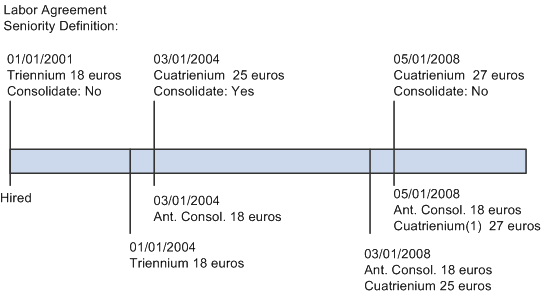
Sometimes, the labor agreement establishes a change in the measurement of seniority, for example, from trienniums to cuatrenniums. When this happens, part of the seniority amount can appear as another earnings element called consolidated seniority (antigüedad consolidada). The consolidated seniority element must reflect the total amount that the employee was receiving until the date of the change. This occurs if you select the Consolidation check box when adding a new effective-dated row on the Labor Agreement - Seniority page. If you don't select this check box, the seniority calculation considers only the new values or percentages when calculating the total amount to be paid for seniority.
Example
This example shows how consolidated seniority can affect an employee's seniority earnings:
Related Topics