Preparing for Automatic Enrolment
Following are the steps to prepare for automatic enrolment:
-
Identifying the staging date - Staging dates are determined by the number of employers in the employer’s largest Pay As You Earn (PAYE) scheme. Smaller schemes automatically have the same staging dates. It is each employer’s responsibility to identify the staging date by which they must be ready for the new enrollment duties. Employers can advance their staging date in order to align with their other key business dates. However, staging must commence on the 1st of the month. Employers can identify their staging date by entering their PAYE references into a ‘Staging date tool’ offered by the Pension Regulator.
-
Workforce assessment - Employers need to check if they employ anyone classified as a ‘worker’ and they need to assess their contractual relationships. When an employer has identified a worker, the next step is to ascertain the type of the worker so that they can determine if enrolment is required. There are two main categories of workers - jobholders and entitled workers. Jobholders can be further classified into eligible and non-eligible job holders.
The following are definitions of the different worker categories:
-
Worker: An employee or individual who has a contract to perform work or services personally, and is not undertaking the work with the employer as part of an own business.
-
Job holder: A worker aged between 16 and 74, working or ordinarily works in the UK under a contract, and has qualifying earnings.
-
Eligible jobholder: A jobholder aged between 22 and the state pension age, and has qualifying earnings above the earnings trigger for automatic enrolment.
-
Non-eligible job holder: A jobholder aged between 16 and 21 or between the state pension age and 74, and has qualifying earnings above the earnings trigger for automatic enrolment; or aged between 16 and 74 and has qualifying earnings below the earnings trigger for automatic enrolment.
-
Entitled worker: A worker aged between 16 and 74, working or ordinarily works in the UK under a contract, and does not have qualifying earnings.
The workforce assessment includes the following steps:
-
Assessing the worker’s age: Employers need to identify if the worker meets the age brackets for automatic enrolment.
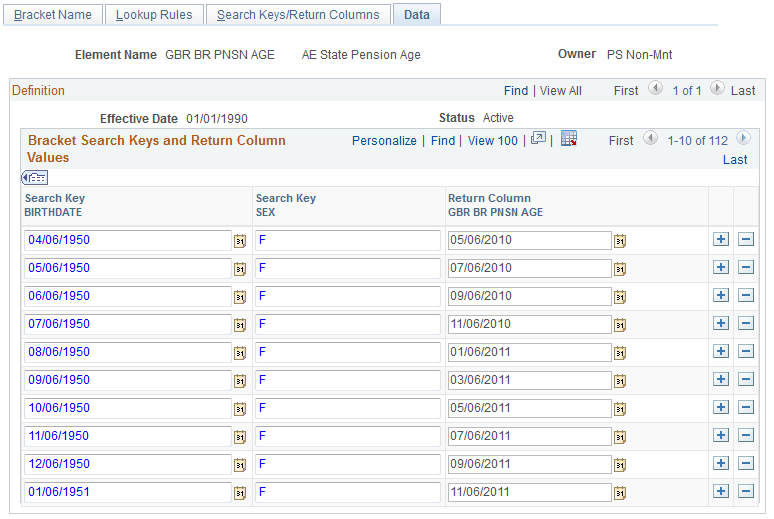
This example illustrates the Brackets - Data page displaying the state pension age for automatic enrolment.
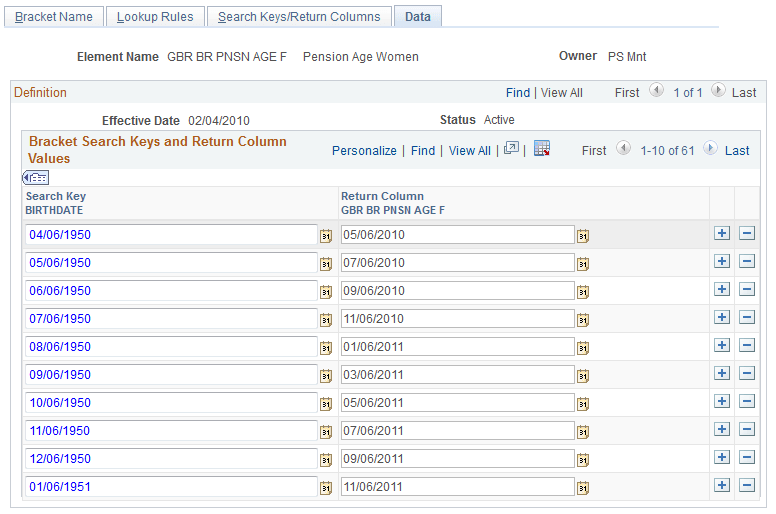
This example illustrates the Brackets - Data page displaying the state pension age for women for automatic enrolment.
-
Identifying where the worker is based: Employers need to identify if the worker is working or ordinarily works in the UK under their contract.
-
Assessing the worker’s earnings: Employers need to identify if the worker’s earnings qualify them for automatic enrolment.
This example illustrates the Brackets - Data page displaying the earnings thresholds for 2014 - 2015.
-
-
Reviewing pension arrangements: Employers need to identify and understand the type of pension scheme required. Employers can choose an automatic enrolment scheme, a qualifying scheme, or a combination of the two. Employers may have existing pension schemes and they need to check that the minimum requirements are covered in their existing pension related processes.