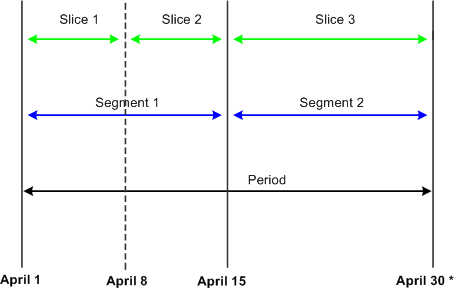
Relationship of Period, Segment, and Slice Dates
For every pay period, the system generates begin and end dates for:
-
Periods
Pay periods—monthly, biweekly, or weekly—are used to group and calculate a payee's earnings. Each period has a begin and end date and can be sliced or segmented.
-
Segments
A sub-period of time within the normal pay period that is created due to period segmentation. Each segment represents a separate gross-to-net calculation of every element in the period and has begin and end dates. Individual elements can be sliced within a sub-period.
-
Slices
The span of time into which an element is segmented due to element segmentation. Unlike a segment or period, it does not represent a separate gross-to-net process, because it affects only a limited set of elements in a period or segment. Like a segment, a slice has begin and end dates.
All three sets of dates (period, segment, and slice) are generated every time a payroll is processed, regardless of whether a period is sliced or segmented. The begin and end dates for periods, segments, and slices, are stored in the output result tables for the period and made available as system-computed elements for use in other calculations.
Example 1: Unsegmented Period
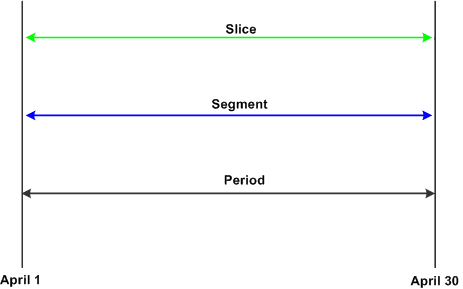
In an unsegmented period the number of periods equals the number of segments, which equals the number of slices. All three have identical begin and end dates.
This diagram illustrates the relationship between period, segment, and slice begin and end dates in an unsegmented period.
Example 2: Segmented Period
This diagram shows a period with two segments; segment 1 contains a sliced element.