Segmentation and Payee Overrides
You can define two types of overrides at the payee level:
-
Primary element overrides.
-
Supporting element overrides.
Both type of overrides are called payee level overrides, and the system follows the same basic rules for applying these overrides to segmented and unsegmented periods. Generally, when a pay period has period or element segmentation, payee overrides are applied to a segment based on the segment end date and the end date of the override, following the rules below. The rules are the same for primary and supporting element overrides at the payee level; only primary element overrides are discussed here. Any minor differences in these two types of overrides are clarified in the following examples.
The rules for applying overrides at the payee level are:
-
Primary element overrides apply to earning, deduction, absence entitlement, and absence take elements, and the overrides must have begin dates. End dates are not required.
Supporting element overrides apply to elements such as variables, formulas, arrays, and brackets.
-
If an override is to apply to a segment, the end date of the override must equal or be greater (or blank) than the end date of the segment or slice (see @ Overrides 3 and 4 in the diagram that follows)
-
An override can apply to more than one segment if the end date of the override is greater than one segment's or slice’s end date and greater than or equal to the subsequent segment's or slice’s end date(or blank) (see Override 3 in the diagram that follows).
-
If the end date of the override is less than the end date of the segment or slice, the override doesn't apply to that segment (see Overrides 1 and 2 in the diagram that follows).
-
Primary element overrides are prorated if the element is defined to be prorated.
With supporting element overrides, the supporting element is prorated if it's a component of an element that's defined to be prorated and that element is segmented.
-
Payee overrides must be Active as of the segment or slice end date.
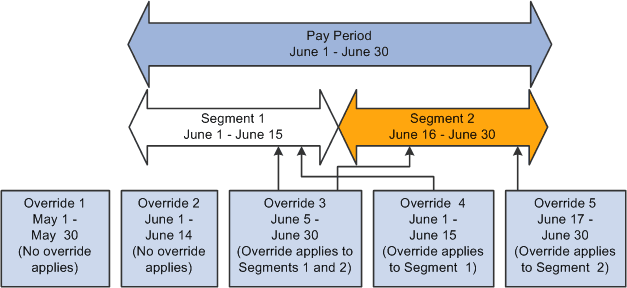
This diagram shows an example of a primary element override.
-
Overrides 1 and 2 apply to neither segment, because their end dates come before the end dates of Segments 1 and 2.
-
Override 3 applies to Segments 1 and 2 equally, because its end date is greater than the first segment's end date and greater than or equal to the second segment's end date.
-
Override 4 applies to Segment 1 because its end date is greater than or equal to the end date of Segment 1 and less than the end date of Segment 2.
-
Override 5 applies to Segment 2, because its end date is equal to the end date of Segment 2 and its begin date is after the end date of Segment 1.
The following examples offer a more detailed view of how payee overrides are applied to segmented and unsegmented periods:
Scenario: Two payees are eligible to receive an earning element (E1) whose value is 100. Assume that Payee 1 has no segmentation and that Payee 2 has period segmentation in the January pay period. The segment dates for Payee 2 are January 1, 2005−January 15, 2005 and January 16, 2005 – January 31, 2005. The payees have identical supporting element overrides, and the pay period being processed is January 1, 2005 – January 31, 2005. This table lists cases that show how the system applies primary element overrides:
Note:
In this example, override is abbreviated Over.
| Case | Over. Begin Dt | Over. End Dt | Over. Value | Payee 1 Results | Payee 2 Results | Reasons |
|---|---|---|---|---|---|---|
|
1 |
Jan. 1, 2000 |
Dec. 31, 2004 |
200 |
100 |
100 |
End date is less than period/segment end date. |
|
2 |
Jan. 1, 2000 |
Jan. 5, 2005 |
200 |
100 |
100 |
End date is less than period/segment end date. |
|
3 |
Jan. 1, 2005 |
Jan. 5, 2005 |
200 |
100 |
100 |
End date is less than period/segment end date. |
|
5 |
Jan. 5, 2005 |
Jan. 20, 2005 |
200 |
100 |
S1=200 S2=100 |
For Payee 2, Segment 1 uses the override because the end date is greater than Segment 1's end date. |
|
6 |
Jan. 20, 2005 |
Jan. 25, 2005 |
200 |
100 |
100 |
The override's begin date is greater than Segment 1's end date and its end date is less than Segment 2's end date, so the override doesn't apply to either segment of Payee 2. For Payee 1, the override's end date is less than the end date of the period, so no override applies. |
|
7 |
Jan. 5, 2005 |
Jan. 31, 2005 |
200 |
200 |
S1=200 S2=200 |
The override's begin date is before the end date of Segment 1, and its end date is greater than or equal to the end dates of both segments, so it applies to both segments. |
|
8 |
Jan. 20, 2005 |
Feb. 1, 2005 |
200 |
200 |
S1=100 S2=200 |
For Payee 2, Segment 1 doesn't use the override, because the override's begin date is greater than Segment 1's end date. |
Note:
Although these examples refer to period segmentation, the same basic rules apply to element segmentation: if a sliced element is overridden at the payee level, the override applies to the slices just as it applies to segments with period segmentation.
Related Topics