Methods of Determining Training Demand
Four methods are available for establishing training demand, as shown in the following table:
| Demand Method | Purpose |
|---|---|
|
General Demand |
Define the number of employees to be trained in certain departments and for certain job codes. |
|
Departmental Demand |
Define the number of employees to be trained in a specific course for a particular department. |
|
Employee Demand |
Define training requirements for individual employees. |
|
Employee Demand by Course |
Define the number of employees to be trained in a particular course. |
Note:
Demand is established for a particular budget period.
Using these methods, you can:
-
Get complete training information, from the training needs of your entire organization to those of the individual employee.
-
Establish only one type of demand or one of each type.
For example, you can define general demands only and not work with departmental or employee demands. You can set up training budget scenarios and develop a training plan using just one method or all four methods. If you work in a decentralized way, departmental- or employee-level demand forecasting works best. If you work in a centralized way, global-level forecasting works best.
-
Determine the costs that are associated with a demand for training in a particular course—not just how many employees need the training, but the cost to your organization in terms of wages or lost billable time.
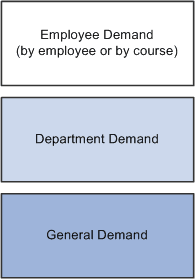
This diagram shows the layers of training needs, with general demand as the foundation layer, department demand at the next level up, and employee demand (by employee or course) at the top level:
For each type of demand, you define:
-
Whom to include when the system calculates the training demand for a course.
-
The cost of training the employees for the specified demand.
This cost is either the average training cost, if you're working with a general or department demand, or the specific cost per employee, if you're working in the Employee Demand or Employee Demand by Course components.