Understanding German Public Sector and Payroll Interface with ADP PAISY
Oracle’s PeopleSoft HCM and ADP PAISY integrate together to fulfill German Public Sector requirements and address collective labor agreements. The two systems share and exchange HR information to perform payroll interface processing. PeopleSoft HCM manages the HR data side while PAISY identifies the rules and the payroll processes.
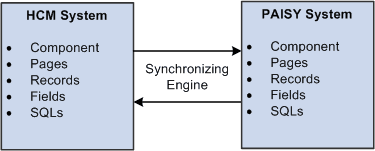
Since both the HCM and PAISY systems reside in the same environment, PAISY can access any HCM data directly while processing. The communication between the two systems is synchronized. PAISY uses a synchronization engine to monitor data changes significant to the PAISY interface.
Use of synchronization engine to monitor data changes that are significant to the PAISY interface
Triggers
In the HCM Payroll system, triggers are used to detect online changes to data that should result in some type of system action. Examples of common data changes that might use triggers are the hiring of a new payee, a change in pay rate, or a change in job location.
PAISY uses a synchronization engine at the HCM database level to monitor these data changes. These triggers are defined by query structures and the engine generates dedicated triggers that collect the trigger events and make them available for later processing to PAISY.
The configuration of the engine on the PAISY side reflects the following:
-
The RECVR_DEFN/RECVR_FIELD holds the predefined PAISY metadata that describes the interface points.
-
The SENDR_DEFN/SENDR_RECORD/SENDR_FIELD/SENDR_CALC holds the user-defined query, which defines the outbound dataset.
PeopleCode for the application engine program retrieves the sync-events and processes them. The engine monitors the changes at the field level using effective dated logic.
PeopleSoft HCM delivers triggers as sample data. Review the delivered triggers and adjust existing triggers, or define your own triggers based on your company's needs.