Checklist for Identifying Pay Groups
As you define pay groups, use this checklist to verify that the employees you're grouping together should be in the same pay group. All employees:
-
Belong to the same company.
-
Are paid at the same pay frequency.
-
Use the same check form or direct deposit advice form.
-
Have the same check date.
-
Share the same pay period begin and end dates.
-
Work in the same country.
-
Are paid by the same bank.
-
Are assigned the same work schedule for proration.
-
Are assigned the same minimum net pay.
-
(USA) Are similarly affected by the Fair Labor Standards Act (FLSA) (FLSA either applies or does not apply to all employees).
If FLSA applies, all FLSA rules (FLSA Calendar ID and FLSA Salaried Hrs Use—for example) must be the same for all employees.
-
Are assigned to the same earnings program, the same retro pay program, and the same retro pay trigger program.
When processing payrolls, group multiple pay groups together only if they can be scheduled and completed concurrently.
Pay Group Setup Example
Here is an example of setting up pay groups for a company:
| Pay Group | Description |
|---|---|
|
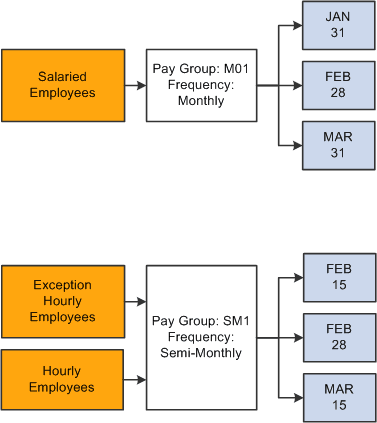
MO1–Monthly |
Employees who are paid monthly and share the same pay period, which ends on the last day of the month, can belong to the same pay group. Salaried employees at CCB are paid monthly. |
|
SM1–Semimonthly |
Employees who are paid semimonthly, and share the same pay periods (ending on the 15th and last day of the month) can also belong to the same pay group. Exception hourly and hourly employees at CCB are paid semimonthly. |
This diagram shows an example of pay group setup for salaried, exception hourly, and hourly employees:
This diagram shows an example of pay group setup for salaried, exception hourly, and hourly employees.