Understanding State Records
You assign variables for your Application Engine program through state records, while sections, steps, and actions pass values to subsequent program steps through state records.
You can have up to 200 state records associated with a particular Application Engine program. However, only one record can be the default state record. You can specify both work (derived) and physical (SQL table) records to be used as state records. The only difference is that derived state records cannot have their values saved to the database at commit time, and so the values are lost during a restart. Therefore, Application Engine erases the contents of derived state records at commit time if Restart is enabled for the current process.
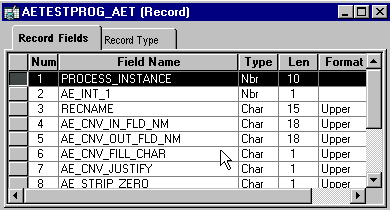
A Application Engine state record must have a process instance defined as the first field and the only key field, and the state record name must end with _AET.
Not all the database columns referenced in your program must be in the state record, just the columns that must be selected into memory so those values can be referenced in a subsequent program action. You may also want to include additional fields to hold pieces of dynamic SQL, to use as temporary flags, and so on.
Application Engine supports long fields, unlike COBOL or Structured Query Reports (SQR). However, it allows only one long field per state record. You set a maximum size for the field in Application Designer and make sure that the data space is compatible with the size of the field that you set.
Application Engine also supports image fields and long text fields.
This is an example of Sample state record.
During batch processing, Application Engine automatically performs all state record updates. When a program starts, it inserts a row into the state record that corresponds to the process instance assigned to that program run. Application Engine updates the record whenever a commit operation occurs. When restart is enabled and a commit occurs, all state records that have been updated in memory are written to the database, except for derived state records, which are initialized instead.
After the program completes successfully, Application Engine deletes the corresponding row in the state record. There is only one row in the state record for each process instance. Multiple programs can use the same state record, and each program has its own row based on the unique process instance key.
To set values in the state record, you use the %SELECT construct in a SQL statement or write PeopleCode that references the state field with the standard record.field notation. To reference fields in the state record, use the %BIND construct.