Push Notification Framework Architecture
- Server layer.
- Web server layer.
- Browser layer
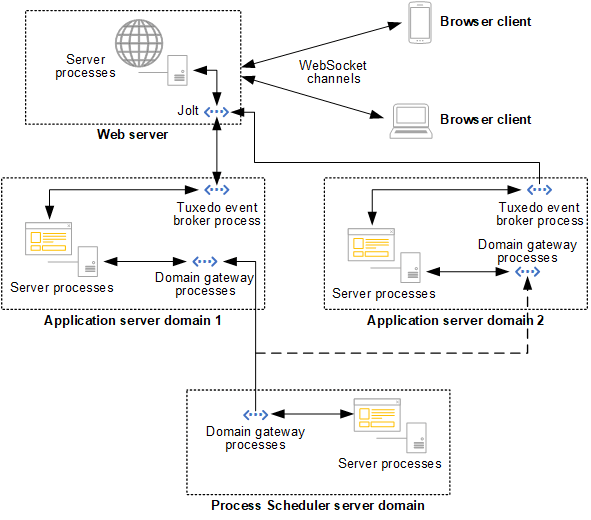
Notifications are generated on the server domains, pushed to the web server, and then on to client browsers.
Server Layer
The server layer of the Push Notification Framework includes these elements:
-
One or more application server domains.
-
(Optional) One or more Process Scheduler server domains.
-
(Optional) Domains gateways for inter-domain communications between the Process Scheduler server and application server domains.
If more than one application server domain is configured per Process Scheduler server domain, then the additional application server can serve as a fail-over server in the event that initial application server becomes unavailable. In the preceding diagram, this fail-over connection is depicted with a dashed line.
-
Event publishers.
-
Tuxedo event broker on the application server to route notifications to Jolt on the web server.
Web Server Layer
The web server:
-
Receives browser endpoint subscriptions via WebSocket.
-
Receives notifications routed by the Tuxedo event broker to Jolt.
-
Routes notifications to subscribing browser endpoints via WebSocket.
Client Layer
Notifications are routed to the clients for display to users:
-
Browser endpoints (the Notification window, pages, and others) are subscribed to events (or event collections).
-
Browser endpoints receive notifications from the web server via WebSocket.