How Related Language Tables Are Used
Related language tables are the primary means of storing language translations in the PeopleSoft system. They store translations of descriptive text for data, such as a standard list of expense categories, and system objects, such as descriptions of fields and records.
Related language tables that store descriptive text for data are generally associated with edit tables that store lists of values that are used for validation and prompting. When a page field prompts against a table that has an associated related language table, and, if the user’s language preference is a non-base language, the description fields that have been translated into the current language appear in place of the base language descriptive text.
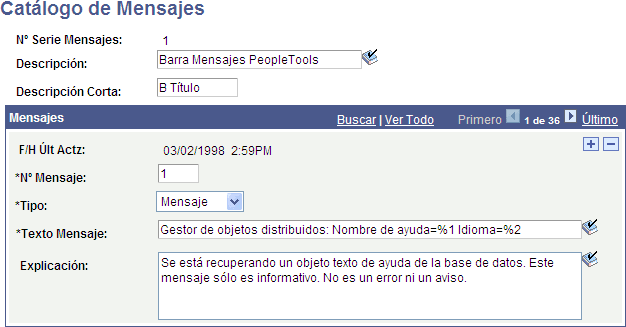
For example, the following Message Catalog page appears when the user’s language preference is Spanish (ESP). The Texto Mensaje (MESSAGE_TEXT) field and the Explicación (DESCRLONG) field present translations from the PSMSGCATLANG related language table.
This is an example of the Message Catalog page in Spanish
Many PeopleTools object definitions, including fields, records, and components, also have associated related language tables. This makes maintenance of multiple language PeopleTools objects, and therefore the system user interface, relatively straightforward. The system uses a single mechanism for maintaining translated data and for maintaining the system objects themselves. Field translation is particularly powerful because translated field descriptions appear on search pages and on pages where the descriptive text for the field is used as the field label.
This is an example of the fields on the ADDRESS2_SBP subpage in Spanish
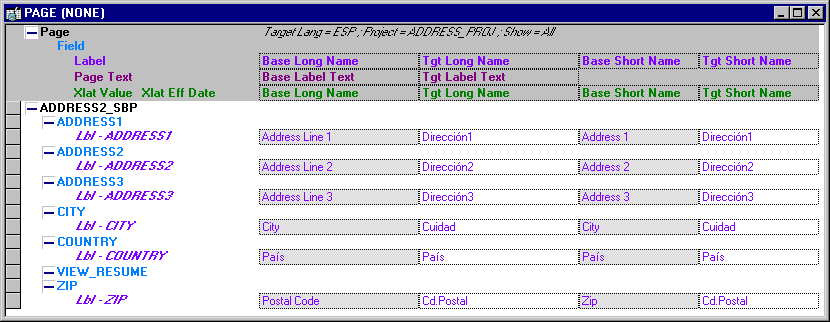
Because the fields are translated, the translated versions of field labels appear when a user whose language preference is Spanish accesses a page that shows the long name or short name of any of these fields. No additional development work on the part of the developer is required.
Of course, whenever the base labels change, you must also update the translations of the object names.