Inbound Integration Broker Security Processing
This section discusses inbound integration broker security processing.
This diagram illustrates security processing for inbound integrations to PeopleSoft Integration Broker. The first type of security processing that may be performed on an inbound service operation occurs on the web server where SSL/TLS encryption processing takes place if it is implemented. As service operation processing moves to the integration gateway located on the web server, it may go through WS-security processing (if implemented). As processing moves to the application server, an inbound service operation my go through nonrepudiation processing (if implemented), then user authentication. After user authentication, node authentication (if implemented) occurs. The final security processing before service invocation is permission list validation.
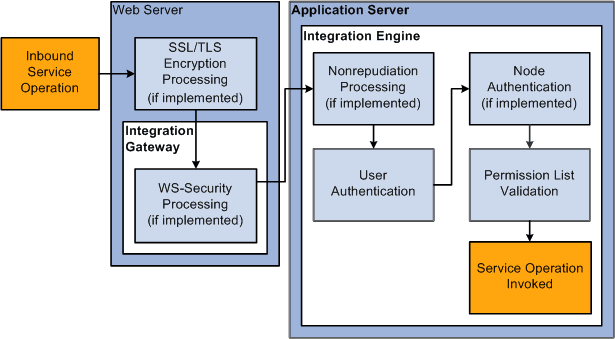
PeopleSoft Integration Broker applies the following security elements to inbound integrations:
Note:
The elements are discussed in the order in which the system applies them.
| Term | Definition |
|---|---|
|
SSL/TLS encryption |
If the inbound service operation is encrypted, the integration gateway decrypts the data. |
|
WS-Security |
On inbound transactions, WS-Security processing includes validating a digital signature (if required), decrypting user information (if required), and passing the extracted user information to the integration engine for authentication. |
|
Nonrepudiation |
Nonrepudiation processing is performed. |
|
User authentication |
The system determines and validates the user ID associated with the inbound service operation. |
|
Node authentication |
If a node password is employed, the system validates that the inbound service operation contains the node password. If certificate authentication is employed, the system authenticates the node certificate. |
|
Permission list validation |
The system matches the user ID passed in with the service operation to the appropriate permission list. |