Understanding Nonrepudiation
PeopleSoft Integration Broker applies nonrepudiation to cross-node messaging by digitally signing service operation requests and their responses.
Nonrepudiation Processing Overview
In PeopleSoft applications, nonrepudiation provides two-way protection; both the request and its response are nonrepudiated. PeopleSoft Integration Broker uses PKI technology to implement nonrepudiation for integrations. Each participating node’s keystore contains its own private key and the public keys of the nodes with which it exchanges nonrepudiation service operations.
Nonrepudiation works in the following manner:
-
Node A generates a number, known as a digest, which uniquely identifies its service operation request.
-
Node A uses its private key to generate a signature based on the digest, and inserts the signature into the nonrepudiation service operation request.
-
Node A sends the nonrepudiation request to Node B.
-
When it receives the nonrepudiation request, Node B uses Node A’s public key in its keystore to confirm the integrity of the digest.
It then separately recreates the digest from the service operation, and compares it to the received digest to confirm the integrity of the service operation.
-
Node B generates a digest that uniquely identifies its response.
-
Node B uses its private key to generate a signature based on the digest, and it inserts the signature into the nonrepudiation response to confirm receipt of the nonrepudiation request.
-
Node B sends the nonrepudiation response to Node A.
-
When the nonrepudiation response is received, Node A uses Node B’s public key in its keystore to confirm the integrity of the digest.
It then separately re-creates the digest from the service operation and compares it to the received digest to confirm the integrity of the service operation content.
Nonrepudiation produces the following results:
-
The sending node cannot repudiate that the service operation was sent, because the receiving node has a copy of the request signed by the sender.
-
The receiving node cannot repudiate that the service operation was received and processed, because the sending node has a copy of the response signed by the receiver.
-
The service operation integrity is verified, because the validated signature of each nonrepudiated service operation assures that the service operation content as received, exactly matches the content as sent.
Inbound Nonrepudiation Processing
This section discusses inbound nonrepudiation processing.
Nonrepudiation processing occurs on the application server in the integration engine.
This diagram illustrates inbound nonrepudiation processing. The diagram shows all possible security processing for an inbound integration to show where in the processing flow nonrepudiation processing occurs. Nonrepudiation processing is highlighted in the foreground of the diagram. The diagram illustrates the nonrepudiation processing steps on an inbound integration, including the validation that nonrepudiation is implemented, the validation of the nonrepudiation digest.
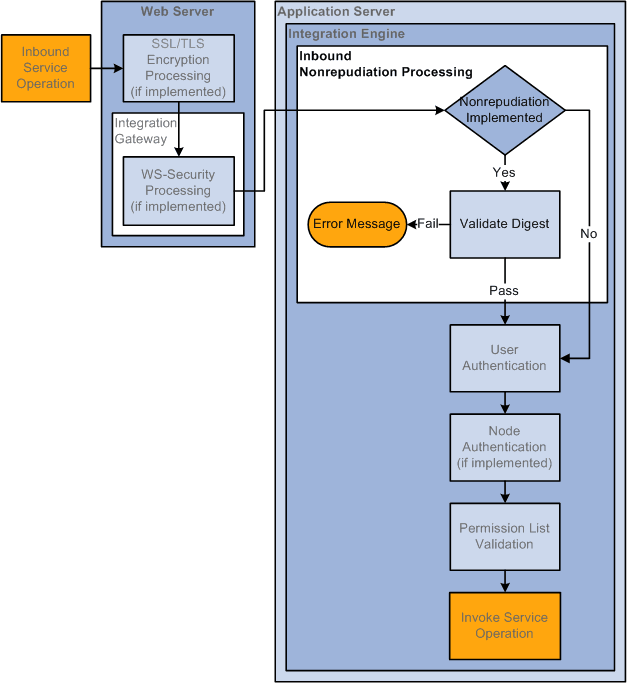
In inbound nonrepudiation processing, the system uses the integration partner's public key to validate the digest attached to the inbound service operation. It then uses its private key to recreate the digest on the service operation to validate the integrity of the service operation content.
If the system is able to validate the integrity of the digest and the service operation content, the service operation then goes through the user authentication process. If the system is unable to validate the digest or the service operation content, the transaction fails.
Outbound Nonrepudiation Processing
This section discusses outbound nonrepudiation processing.
Nonrepudiation processing occurs on the application server in the integration engine.
This diagram illustrates outbound nonrepudiation processing. The diagram shows all possible security processing for an outbound integration to show where in the processing flow nonrepudiation processing occurs. Nonrepudiation processing is highlighted in the foreground of the diagram. The diagram illustrates the nonrepudiation processing steps on an outbound integration, including the validation that nonrepudiation is implemented, the determination if the message is a request or response, and then the generation of the digest and signature for the request or response.
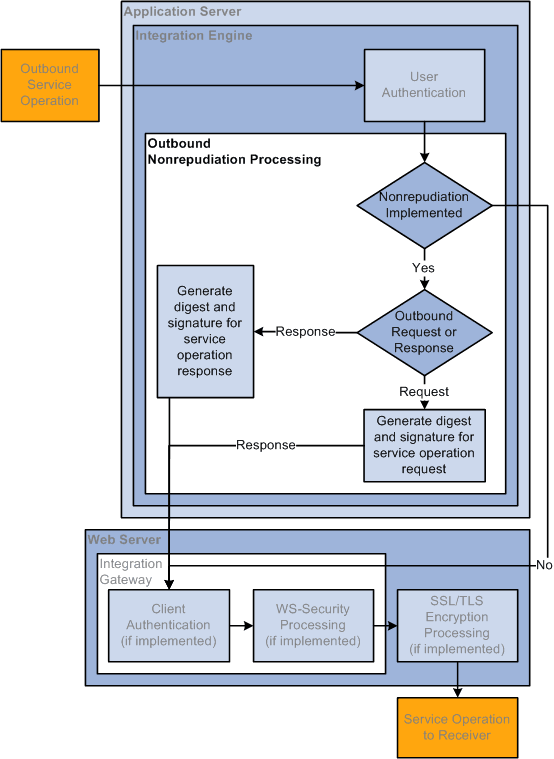
On outbound service operations, the system determines if the service operation is a request or a response.
When the service operation is a request, the system uses its private key to generate a digest and signature, and attaches those items to the request.
When the service operation is an outbound response, the system uses its private key to generate a signature and response and inserts them into the service operation.