Dispatchers and Handlers
Each of the publication broker, publication contractor, and subscription contractor is comprised of two individual server processes that work together to handle incoming requests. One server process functions as a dispatcher, while the other functions as a handler.
This relationship is analogous to the way that the application server handles workstation connections and requests. To handle the incoming client requests, the application server has a listener and a handler (or a pool of handlers). The listener receives the incoming requests and then routes them to an available handler.
Typically, one listener serves many handlers. The relationship between the dispatcher and the handlers is analogous to the relationship between the Jolt Server Listener (JSL) and the Jolt Server handler (JSH). In the case of the application messaging server processes, the dispatcher functions as the listener, and the handler as similar to the JSH.
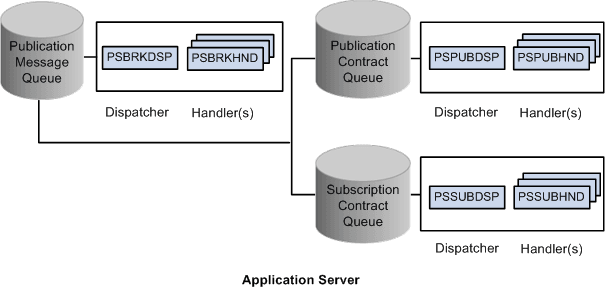
For the services discussed in this section (publication contractor, subscription contractor, and publication broker) there are at least two server processes: a single dispatcher and one or more handlers. The PSxxxDSP server process is the dispatcher, and the PSxxxHND server process is the handler.
Note:
The xxx represents BRK, PUB, or SUB. For example, in the case of the publication broker, PSBRKDSP is the dispatcher and PSBRKHND is the handler.
This example illustrates the messaging server processes grouped by their functions in the messaging architecture: