Scenario Management
In PeopleSoft Optimization Framework, scenario management is the mechanism to manage different source and result data sets using the same tables. A set of source data and associated result data is called an analytic instance. You can break down large optimization problems into smaller, more manageable problems (or analytic instances) that can each be solved independently. Individual analytic instances can share common data.
This concept can be extended to what-if scenarios to plan for potential business situations. Separate analytic instances can be created with what-if data and solved using optimization separately, without fear of affecting live data.
In terms of the exercise example, any number of people might want exercise schedules using the optimization application. Exercise goal data and the optimization-generated exercise schedule data are unique to each person. However, different people share the same set of exercise machines. In this case, it is logical to treat the generation of an individual person's exercise schedule as a separate analytic instance.
In the exercise example, you would mark the data that is specific to each person (such as exercise goals and exercise schedules) as scenario-managed, and the data that is shared by all people (such as exercise machines) as nonscenario-managed. All scenario-managed records must include the PROBINST field as part of the primary key. This 20-character field identifies data that is specific to an analytic instance. During runtime, the optimization engine loads data for scenario-managed records based on the user-specified value for the PROBINST field. At any moment, the optimization engine contains data for only one analytic instance.
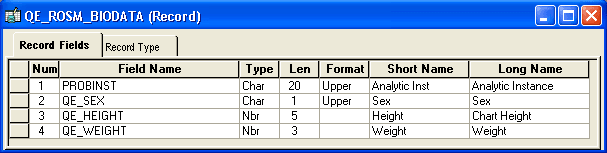
The following record, QE_ROSM_BIODATA, contains the name of a person who exercises, and physical data about the person. This record is read once and is scenario-managed. Notice the use of the PROBINST field:
The following diagram illustrates the Record fields in QE_ROSM_BIODATA Record.