Understanding Lights-out Mode
Some optimization applications can take several hours to run. These are typically run as overnight batch jobs every night when the work load is small to regenerate the optimization solution and have it ready for end users to use in the morning hence the term lights-out mode.
In the current release, application messages communicate between the Application Engine batch job and the online optimization engine. After the Application Engine job completes and the optimization solution has been written to the database, an application message initiates the download of the data from the database batch job to the online optimization engine.
Lights-out mode uses an Application Engine PeopleCode program within PeopleSoft Process Scheduler to send requests to an application server and receive responses from it. Within the application server, the OnRequest PeopleCode runs an optimization engine process.
This diagram illustrates the lights-out process:

This request and response is in the form of a rowset as shown by the example supplied with optimization, the OPT_CALL message. Also supplied as an example is an Application Engine message publish PeopleCode program called PT_OPTCALL.
Important:
Application Engine includes an action of type Log Message, which PeopleSoft Process Scheduler uses to record its activity in the PS_MESSAGE_LOG table. The PeopleCode MessageBox and WinMessage built-in functions also record their activity in the PS_MESSAGE_LOG table.
During lights-out optimization, these processes can conflict with each other or with the optimization engine when one process locks a row of the table, and another process tries to access the same row.
To prevent this conflict, pay close attention to where the MessageBox or WinMessage built-in functions are used in your Application Engine PeopleCode. In general, there can't be any outstanding database updates pending when communicating with the optimization engine using application messages.
The OPT_CALL Message
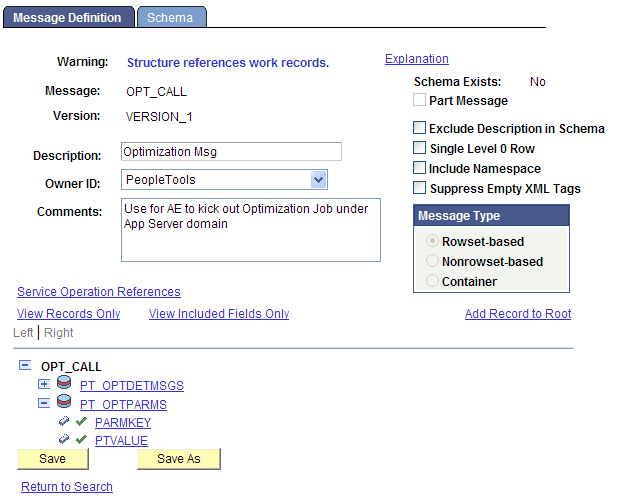
The OPT_CALL message is an example of what the lights-out process uses as the message for optimization. The OPT_CALL message has a structure using a record, PT_OPTPARMS, having the fields PARMKEY and VALUE which represent a name/value pair. These send requests and responses from the Application Engine PeopleCode in PeopleSoft Process Scheduler to and from the message OnRequest PeopleCode in the application server.
The OPT_CALL message also uses a record, PT_OPTDETMSGS, which contains the information needed for processing a detailed message.
This is an example of the Message Definition page (select showing the OPT_CALL message definition:
This example illustrates the fields and controls on the Message Definition page – OPT_CALL message definition. You can find definitions for the fields and controls later on this page.
The OPT_CALL message is associated with the OPT_CALL service operation. The OPT_CALL service operation defines the OPT_CALL application package as a handler. This application package implements the Integration Broker methods needed to handle any messaging PeopleCode.