ADSs Used for Preserving Pivot Grid Configurations and Personalizations
Pivot grid leverages the following ADSs for preserving Pivot Grid configurations and personalizations:
-
ADS relationship framework
Pivot Grid uses the relationship framework that is provided by ADS to create inter-object relationships (with related actions) and intra-object relationships (different records in the Pivot Grid ADS definition).
These relationships are used to:
-
Get the related objects in the source and target.
-
Validate the referential integrity of the Pivot Grid object.
-
-
ADS merge framework
Pivot Grid uses the merge framework that is provided by ADS to:
-
Define the different configuration actions on the Pivot Grid object using merge-able groups.
-
Merge the Pivot Grid object to preserve the customer configurations during compare, copy, and validation.
-
Validate the referential integrity of the Pivot Grid object.
-
Perform the data transformation of the Pivot Grid object to reflect as in the previous release shape.
-
Orchestrate the different steps in the ADS process for the Pivot Grid related object family, which are Pivot Grids and related actions.
-
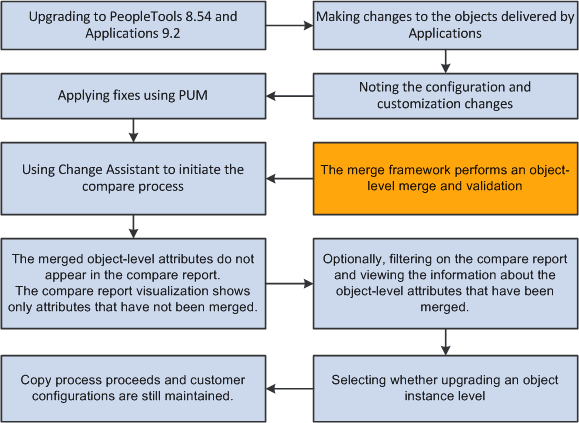
This diagram shows the process of preserving Pivot Grid configurations and personalizations.
Note:
The only relationship that Pivot Grid needs is an ADS definition - related actions. Thus, the Pivot Grid related object family consists of two ADS definitions: Pivot Grid and related actions. The relationships are identified between Pivot Grid and Related Actions ADS definitions. The orchestrator for the Pivot Grid related object family is within the Pivot Grid. Orchestrator can properly sequence the actions of merge, compare, copy, and validate for the Pivot Grid and related action instances.