Overview of Siebel Open Integration Workflow
An Open Integration project includes both design-time and runtime components.
At design time, you define the required service artifacts, profile details, integration
configuration in JSON, Domain-Specific Language (DSL), and transformation mappings. You
can store these configurations in a Git-based repository or define them directly in Open
Integration under openint-deploy.
The configuration files use JSON format.
When the design-time pipeline runs, it performs the following tasks:
- Checks out the configuration files from the Git repository, if Git is used.
- Generates the OpenAPI specification for the configured services and integrations, including Siebel resources where applicable.
- Generates Plain Old Java Objects (POJOs) and supporting classes.
- Builds an executable JAR file.
To use the generated JAR file, the you can:
- Pass an additional parameter to the generation pipeline, or
- Start the application manually by using the provided
startup.batorstartup.shscript.
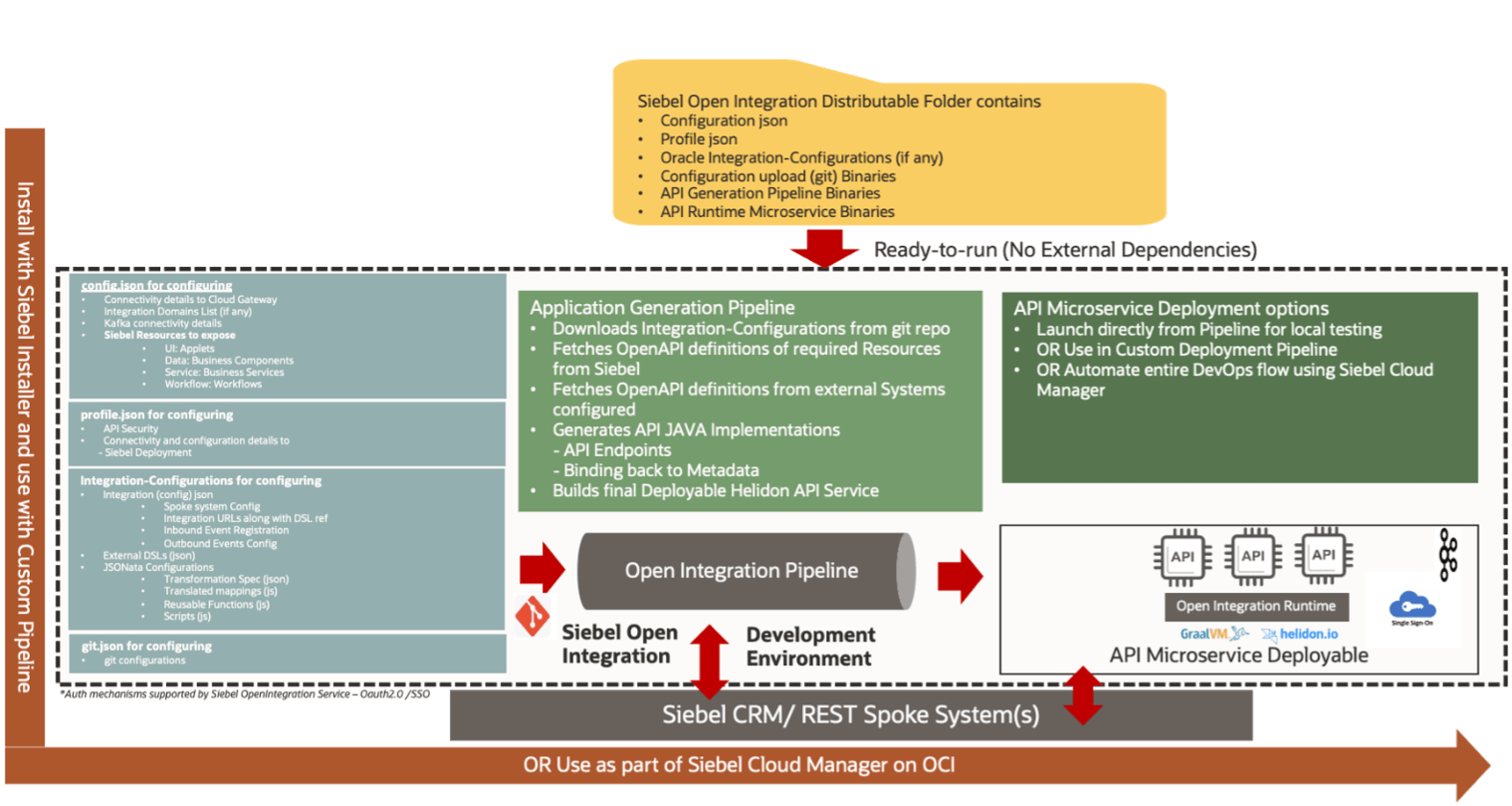
The following diagram illustrates the design-time pipeline communication sequence used to generate an executable JAR file.
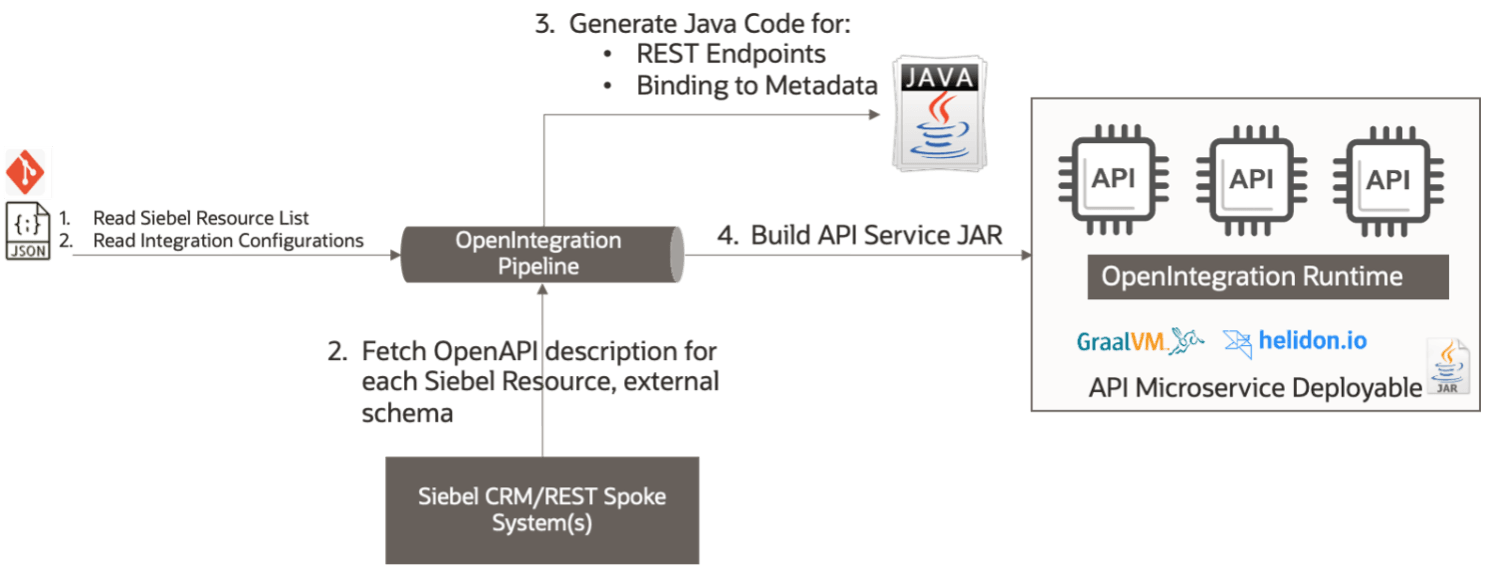
The following points describe how the pipeline uses a Git repository and associated configurations to generate OpenAPI specifications, service artifacts, and the final deployment package for the Open Integration service:
- (Optional) If you use Git, provide the Git repository details for the Open
Integration service.
The pipeline checks out all configurations from the specified Git repository. If Siebel artifacts are configured in
config.json, the pipeline contacts Siebel and retrieves the corresponding OpenAPI specification. - If OpenAPI specifications are downloaded, the pipeline uses them to generate Siebel REST endpoints and bindings to the Siebel configuration.
- For Integration configurations, the pipeline processes the DSL definitions and configurations to generate OpenAPI specifications for the defined DSLs.
- The pipeline generates POJOs and service implementations.
- The pipeline packages the required generated classes into
openint.jar.