Architecture of the Siebel Web Component Framework
The Web Component Framework extends the Siebel Open UI architecture by introducing a client-side rendering model based on Web Components. In this model, the Presentation Model acts as the view model and exposes Siebel metadata, data, and behavior.
User interface composition is defined declaratively through JSON specifications that are provided through a Presentation Model property. Oracle JET Web Components consume this configuration to render the user interface and manage user interaction. When this framework is used, a Physical Renderer is not required for rendering the user interface.
Siebel Open UI supports user interface customization through Presentation Model and Physical Renderer objects that are configured in the manifest for views or applets. The Presentation Model provides a unified interface to Siebel metadata and data, and it supports customization through properties, methods, and event handling. The Physical Renderer supports user interface rendering and integration with third-party plug-ins when required.
The following figure illustrates the Siebel Web Component Framework architecture.
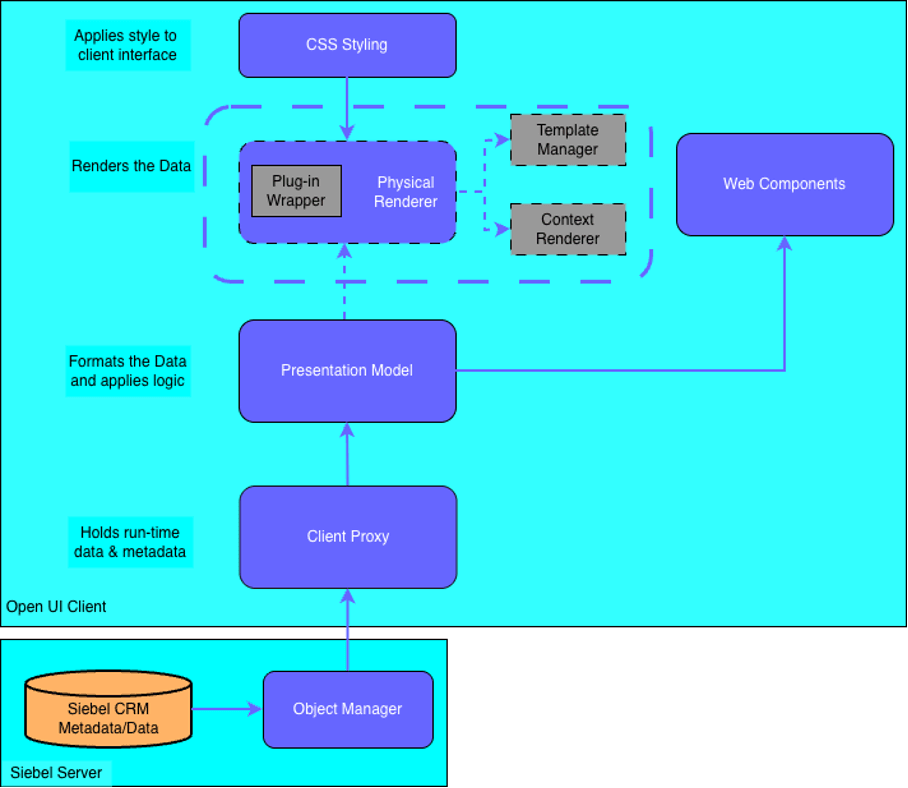
In the figure, a Web Components layer is introduced in parallel with the Physical Renderer (PR). The dotted lines indicate that the Physical Renderer is not required when the framework is used for rendering, but it remains part of the overall Siebel Open UI architecture.
With this architecture, the framework supports seamless integration of Web Components, primarily Oracle JET-based Web Components. The Presentation Model provides access to the data and metadata for the related object, such as an applet, and manages user interaction through properties, methods, and event handlers. The framework also provides a binding interface in the Presentation Model that directly binds Presentation Model properties, methods, and event handlers to Web Component properties, methods, and events.