About Oracle Analytics AI Agents
Oracle Analytics AI Agents enable you to define custom prompt instructions and incorporate organizational knowledge into Oracle Analytics AI Assistant interactions.
AI agents allow the Oracle Analytics AI Assistant to interpret natural-language questions with greater accuracy and deliver more meaningful, context-aware insights. Oracle Analytics AI Agents use Retrieval-Augmented Generation (RAG) to enhance generative AI with enterprise data, enabling large language models (LLMs) to “look up” relevant information before responding.
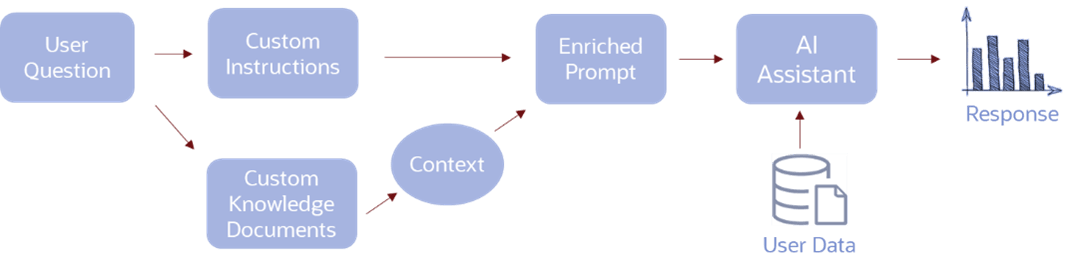
Description of the illustration ai_agent_summary_png.png
AI agents provide reliable, context-rich insights by combining business data with tailored LLM instructions and private documentation. AI agents can help your teams move beyond static analytics content to interactive, conversational analytics that accelerate insight discovery and improve business performance.
- The agent automatically applies additional custom instructions created by the author, adding important context such as domain-specific definitions or guidance on preferred response formats.
- A RAG process scans the selected enterprise documents configured by the author, enriching your prompt with focused, relevant information. The enhanced query is then processed by the Oracle Analytics AI Assistant, which orchestrates the underlying LLM prompts to deliver a response that best reflects your intent and the available enterprise data.
- Dataset – The foundational data source that powers your agent’s analytics and responses. It contains the core business data the Oracle Analytics AI Assistant relies on to answer user questions. You can filter the dataset and show the filter settings in the visualization so that consumers can interpret the data.
- Supplemental Instructions – Custom guidance that shapes how the Oracle Analytics AI Assistant interprets user intent and formulates responses. These instructions influence the Oracle Analytics AI Assistant’s reasoning and behavior. For example, by defining business terminology, specifying fiscal logic, outlining naming conventions, or clarifying domain rules. In essence, they teach the Oracle Analytics AI Assistant to think and communicate in your organization’s language. Everything included here is passed directly to the AI without preprocessing. See About Supplemental Instructions in an Oracle Analytics AI Agent.
- First Message – This is the introductory message users see when they first interact with the AI Agent. It can describe the agent’s purpose and provide sample questions to help users get started. Rich HTML is supported. You can modify font size, formatting, and even use emojis in the agent's First Message.
- Knowledge Documents – A collection of supporting materials such as policies, reports, FAQs, or reference guides. You can upload PDF or .txt files, which are used through Retrieval-Augmented Generation (RAG), enabling the Oracle Analytics AI Assistant to “look up” and cite factual information directly from your content rather than relying solely on its pre-existing training. Knowledge Documents (RAG) define what information from your private knowledge base can assist the Oracle Analytics AI Assistant in answering a specific question. Only the document excerpts that are relevant to the user’s query are shared with the Oracle Analytics AI Assistant. Unrelated content isn’t included. See About Knowledge Documents Used in an Oracle Analytics AI Agent.
Oracle provides examples of supplemental instructions for various types of use cases. These instructions guide AI Agents to interpret, calculate, filter, and present data according to your organization’s defined business logic. See Supplemental Instruction Templates for Oracle Analytics Cloud AI Agents.