Why an MCP Gateway Is Required
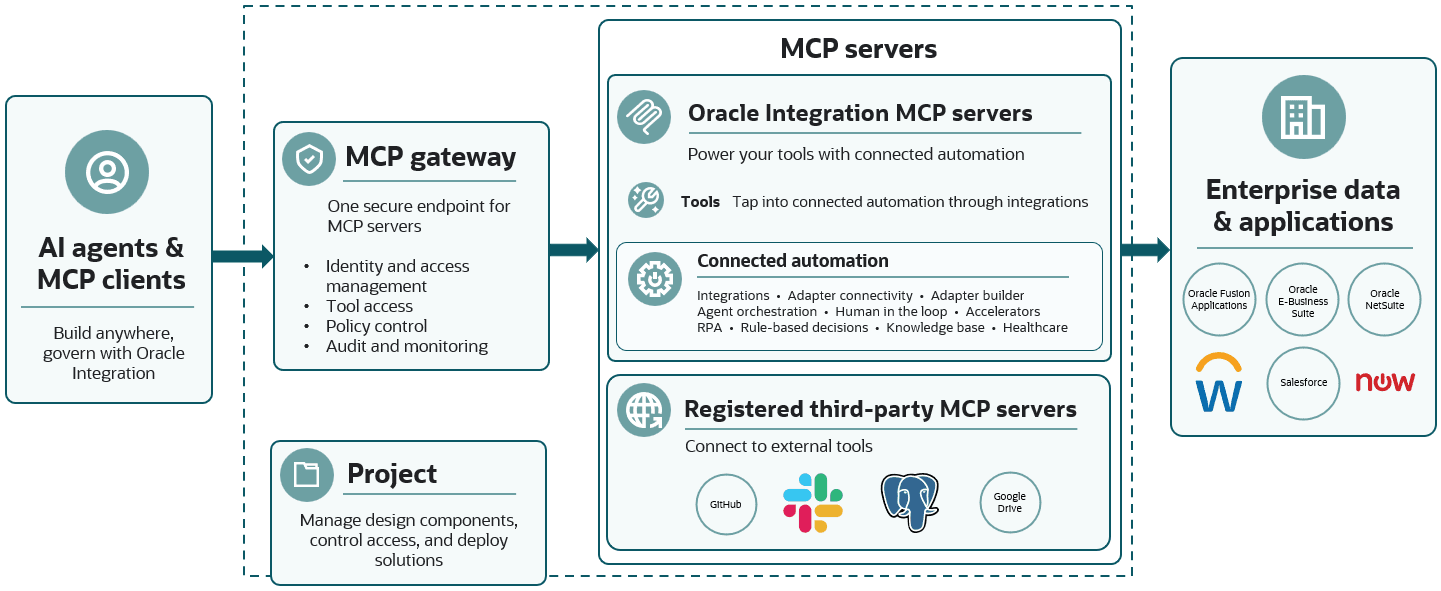
Allowing AI agents and MCP clients to connect directly to enterprise data and applications is risky. An MCP gateway mitigates your risk by providing a secure and governed endpoint that agents can use to connect to some or all of the MCP servers that your organization uses.
Introduction
An MCP gateway lets you create a trusted, governed path between AI agents and enterprise data and applications.
Direct connections between AI agents and MCP servers can leave access rules, credentials, policies, and audit information spread across different systems. The gateway brings these controls together. Before a request reaches an MCP server, the gateway authenticates and authorizes the caller, filters available tools, and evaluates policies. It can also apply controls to the response.
With an MCP gateway, your organization can give AI agents the access they need to do their jobs while keeping their access more consistent and easier to manage. For example, an agent can reach CRM and ERP tools through the same gateway instead of managing separate direct connections.
Benefits
An MCP gateway provides centralized control, security, and visibility for AI agents accessing enterprise tools and data.
| Area | Without an MCP gateway | With an MCP gateway |
|---|---|---|
|
Access control |
Connect to each MCP server individually. |
Connect to multiple MCP servers from one endpoint. |
|
Tool control |
Agents have access to all tools that the MCP server connects to. |
Control the tools that agents can see and use. |
|
PII protection |
Organizations must rely upon the PII policies for each AI agent. |
Protect sensitive data, such as personally identifiable information (PII). |
|
Policy enforcement |
Policy enforcement is different for each MCP server, or it happens too late. |
Apply security and business policies before a tool runs. |
|
Vault credentials |
Credentials are exposed or duplicated outside enterprise vault controls. |
Keep credentials in controlled, vault-backed stores. |
|
Enterprise routing |
Inconsistent trust boundaries across agents, clients, and MCP servers. |
Route requests to the right enterprise system. |
|
Request tracing |
No single location for tracing requests, outcomes, and exceptions. |
Trace requests, tool actions, results, and exceptions in a single location. |
If you don't need to use the controls that MCP gateway provides, you can allow AI agents to connect directly to an MCP server.