Create an Oracle Integration Instance

To create an Oracle Integration instance in a selected compartment:
  1. In the upper corner, note your selected region.
    Once created, instances are visible only in the region in which they were created.
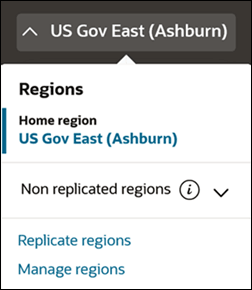
    This image shows the region selection at the top of the page. The selected home region is shown. Below the selected region, there is a drop-down field that lists non-replicated regions, and options to replicate and manage regions.

  2. Open the navigation menu and click Developer Services. Under Application Integration, click Integration.
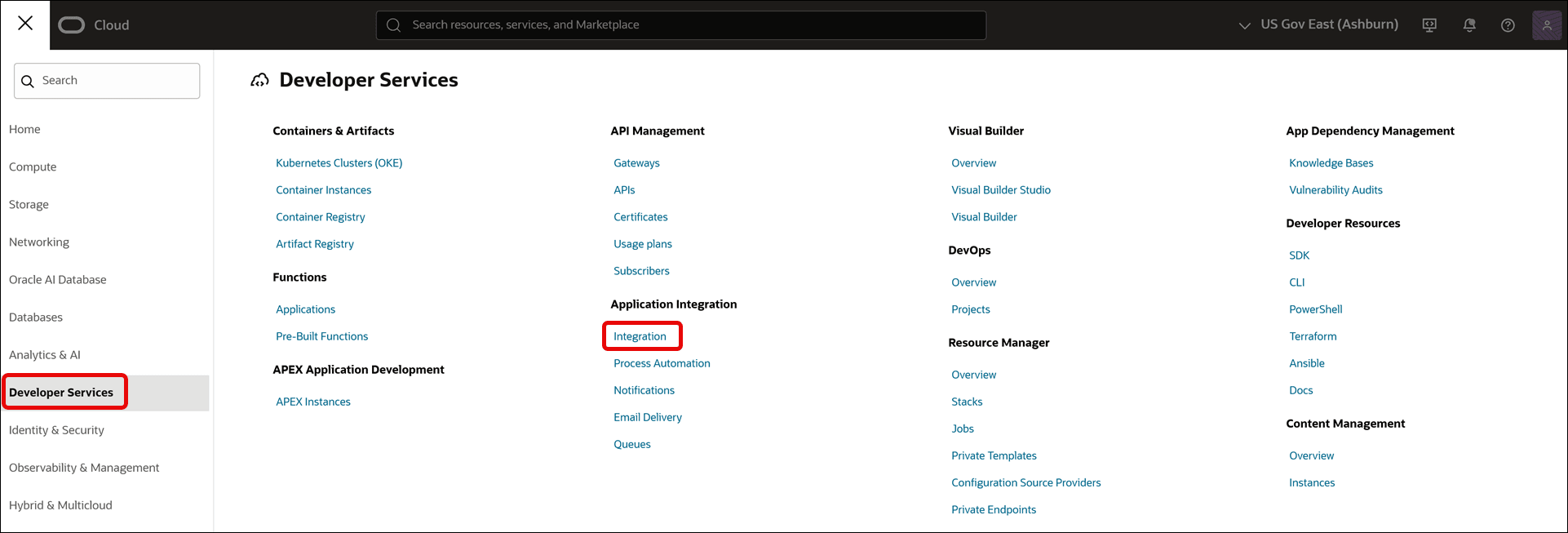
    This image shows the navigation pane on the left side of the page. It shows categories such as Home, Compute, Storage, Networking, Oracle AI Database, Databases, Analytics & AI, Developer Services, Identity & Security, Observability & Management, and Hybrid & Multicloud. The Developer Services category is selected and highlighted. On the remaining portion of the page on the right side, the following subcategories are displayed under the Developer Services category as headings: Containers & Artifacts, Functions, APEX Application Development, API Management, Application Integration, Visual Builder, DevOps, Resource Manager, App Dependency Management, Developer Resources, and Content Management. The first item below the Application Integration subcategory is Integration. This first item is highlighted to indicate that this is the option to be selected.

  3. From the Compartment list, click through the hierarchy of compartments and select the one in which to create the instance. You may need to expand the + icon to find the compartment to use. Compartments can contain other compartments. It may take several minutes for the new compartment to appear after the policy has been created.
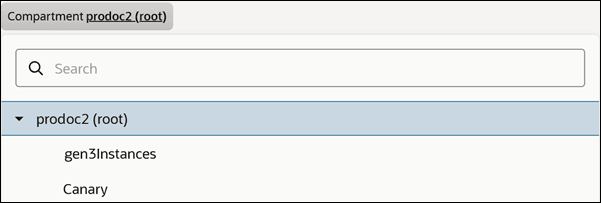
    This image shows the compartment list that is expanded to display a hierarchy of compartments available for selection.

    Note:

    Do NOT select the root or ManagedCompartmentForPaaS compartment in which to create your instance.

    The page is refreshed to show any existing instances in that compartment.
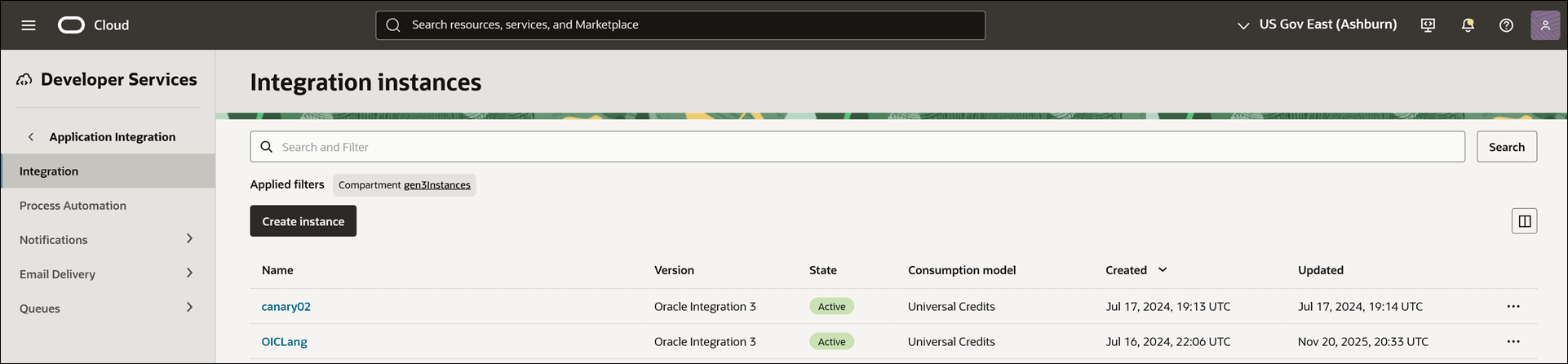

    This image shows the Integration instances page. On the left side, all the options under the Application Integration subcategory are listed, and the Integration option is selected. On the Integration instances page, a compartment is selected, and all the instances available in that compartment are listed in a table with columns such as Name, Version, State, Consumption model, Created, and Updated. Each row has an Actions menu to perform more actions. Above the list of instances, the Create instance button is available. At the top of the page, there is an option to search and filter instances.

  4. Click Create instance.
  5. Enter the following details and click Create:
    Field Description
    Name Enter the name for the instance. Note that the name becomes part of the URL for accessing the instance.
    Consumption model Lists consumption models available in this tenancy. Typically, one model is displayed, but multiple consumption models are listed if your tenancy is enabled for more than one. Available models include:
    • Metered (Universal Credits)
    • Oracle Integration Government

    Note:

    Oracle Integration Government is a license and doesn't specify the realm.
    Edition Select the edition you want this instance to be:
    • Standard
    • Enterprise
    Shape

    Choose a shape for the instance. The shape determines when the instance receives updates, which happen every other month.

    Only some regions allow you to choose a shape. If you don't see the option to choose a shape, your instance is created in the Production shape. For details about the shapes that each region supports, see About Oracle Integration 3 on Oracle Cloud Infrastructure US Government Cloud.

    • Development: Instances with this shape receive updates two weeks before instances with a Production shape.

    • Production: Instances with this shape receive updates two weeks after instances with a Development shape.

    Note: You can't change the shape after you create the instance. However, you can move data to another instance using the export and import features.

    License type
    • Select to create a new Oracle Integration license in the cloud. This provides you with packages of 5K messages per hour.
    • Select to bring an existing Oracle Fusion Middleware license to the cloud for use with Oracle Integration. This provides you with packages of 20K messages per hour. This option is also known as bring your own license (BYOL).
    Message packs The message pack options available for selection are based on the version of Oracle Integration instance you are creating.

    Select the number of message packs. The total number of messages available per pack is based on the License Type option you selected. You can select up to 100 message packs if you bring an existing Oracle Fusion Middleware license to the cloud. You can select up to 100 message packs if you create a new Oracle Integration license in the cloud.

    Typically, the selected model is displayed after Consumption model. If multiple consumption models are listed, choose the model you'd like used for this instance.

    Instance creation takes some time. If you attempt to click the instance name and receive a 401: Authorization failed or a 404: Not Found error, but followed all the correct steps, instance creation has not completed. Wait a few more minutes.

  6. When instance creation completes successfully, the instance shows as Active in the State column.